
DX upgrades raise AI productivity by 10% for dev teams
Serge Bulaev
Studies suggest that improving developer experience (DX), like better tools and clear processes, may raise AI productivity in developer teams by about 10%. Teams with good DX see faster workflows and more reliable AI agents. Surveys show most engineers use AI helpers, but actual time savings are limited unless bottlenecks like slow tests are fixed. Clear command-line tools and well-written documentation also appear to help both humans and AI work more smoothly. Continued improvements to DX, not just new AI models, may be key to ongoing productivity gains.

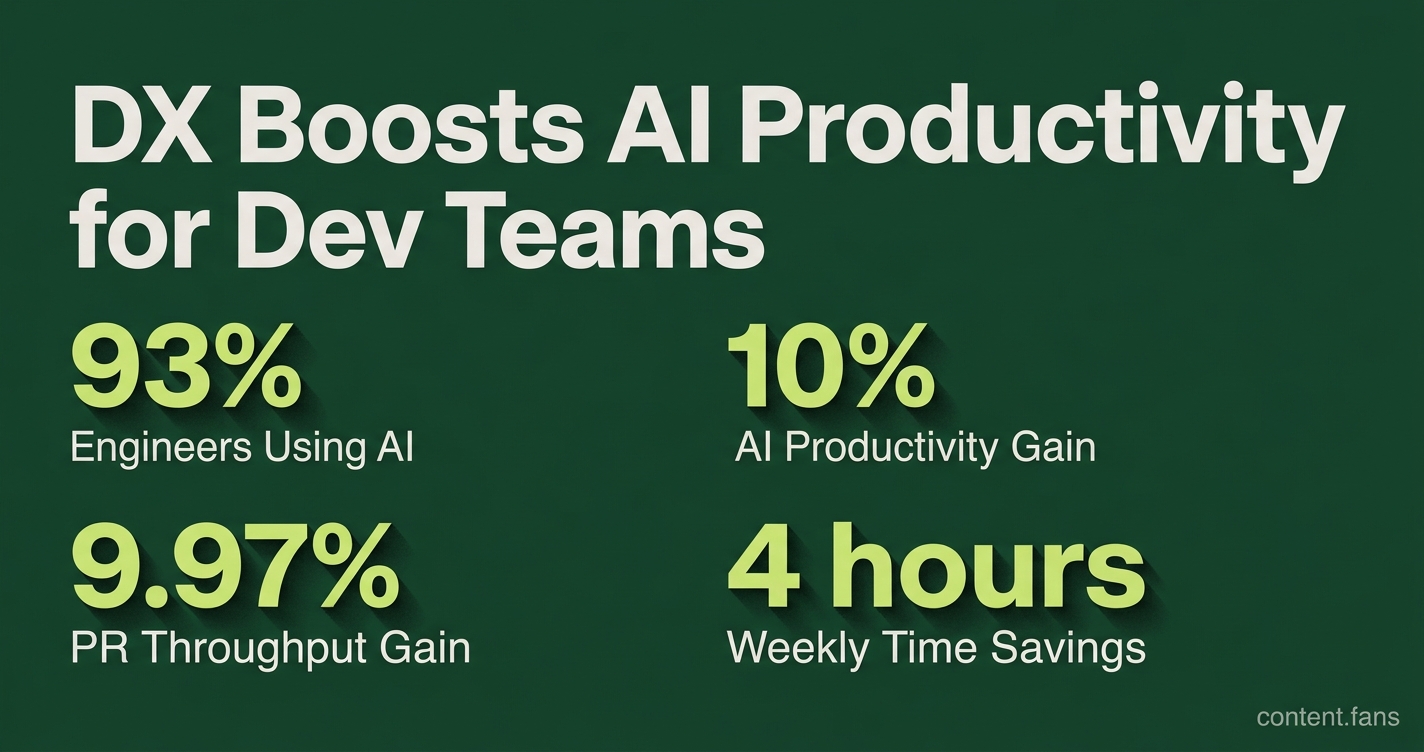
Upgrading the developer experience (DX) is increasingly recognized as a method to raise AI productivity for software teams. The principle is simple: what helps humans also helps AI. Teams with clear tooling, fast feedback loops, and strong documentation see measurable lifts in both engineer throughput and AI agent reliability. A study found 9.97% PR throughput gain with AI adoption, no direct link to DX upgrades specified (DX).
Researchers observe a clear pattern: when repositories, scripts, and environments create smooth "blessed paths" for human developers, autonomous agents follow these same efficient routes. This synergy means that foundational DX work doesn't just add to but multiplies the productivity gains promised by individual code-generation tools.
Why Productivity Gains Are a Game-Changer
Investing in developer experience (DX) creates clear, efficient workflows for engineering teams. When AI agents are introduced into these optimized environments, they follow the same streamlined paths as human developers, hitting fewer bottlenecks like slow tests or confusing tools. This multiplies their effectiveness, leading to measurable productivity gains.
While a Q4 2025 survey from ShiftMag found 93% of engineers use AI coding helpers, weekly time savings often plateau around four hours. The reason? AI agents hit the same bottlenecks as humans, such as review queues and flaky CI tests, which act as primary brakes on productivity (ShiftMag). Teams that address these gaps - by shortening test suites, ensuring deterministic staging data, and using automatic linters - unlock greater AI efficiency. According to industry reports, improvements to developer experience can reclaim significant time per developer weekly, translating to substantial value at scale.
How Clear Tooling and Fast Pipelines Guide AI Agents
For an AI agent to work effectively, command-line tools must be non-interactive and predictable. Best practices include adding non-interactive flags like --yes and machine-readable --json output. An agent will stall if a tool waits for a human keystroke. Therefore, structured output should be treated as a stable API, with semantic exit codes and a --help --json flag for automated discovery. This approach dramatically lowers error rates for autonomous tasks and allows AI to programmatically verify outcomes.
Key CLI patterns that sources highlight:
--dry-runpreviews with JSON diffs- Idempotent mutations that return "already exists" instead of generic errors
- Batch operations via selectors (
delete --selector app=old) - Strict separation of data on stdout and progress on stderr
This principle extends to documentation. Instead of forcing agents to scrape prose, teams should provide structured 'skill files' alongside binaries. These files clearly define commands, flags, and examples, allowing agents to instantly parse a tool's capabilities.
Case Studies: A Virtuous Cycle of DX and AI
Production stories from many Fortune 500 companies highlight this trend. For example, AT&T successfully deployed a supervisory AI agent by leveraging its prior investments in automated testing and cloud dev containers. Another global firm used agents for user-story creation and Terraform provisioning, freeing up its DevOps team. In both cases, developers maintained low cognitive load while agents handled repetitive tasks at scale.
Even companies in regulated industries report success, using agents for compliance checks and data validation to reduce manual review without increasing defects. These examples prove that AI success mirrors human-centric DX: organized repositories, consistent policies, and fast feedback are essential to closing the "AI productivity paradox."
The Future of Productivity: Continuous DX Improvement
Analysts observe that while agentic AI already reduces developer fatigue by automating boilerplate code and monitoring, its full potential is capped by friction points like slow integration tests and ambiguous requirements. The path forward is clear: industry experiments show that once these underlying DX issues are fixed, productivity accelerates significantly. This indicates that sustainable velocity gains for both humans and AI will be driven by continuous investment in developer experience, not just by newer AI models.
Why do DX upgrades boost AI agent productivity instead of delivering the promised multiplier effects?
Longitudinal data from many companies shows AI usage jumped significantly, yet median pull-request throughput rose modestly.
The gap exists because agents hit the same bottlenecks humans face: slow CI, unclear requirements, and long review queues.
Teams that cut cycle time and documented blessed paths captured greater gains, while others plateaued at several hours saved per week.
Which DX improvements matter most for making AI agents follow "blessed paths"?
-
Non-interactive CLI contracts
Every command needs--json,--dry-run,--yes, semantic exit codes, and a--help --jsonflag.
These let agents discover, simulate, and execute without human prompts. -
Fast, cloud-based dev environments
Ephemeral environments that spin up quickly remove "works-on-my-machine" drift and give agents a clean, repeatable sandbox. -
Living documentation & skill files
Askill.mdin the repo tells the agent when and how to call each tool, turning docs into runnable context.
How does Notion's prior DX work illustrate the virtuous cycle?
Notion had already invested in clear CLI tooling, strict typing, and fast CI.
When agents arrived, they could parse schemas, verify changes, and iterate inside those guardrails on day one.
The result: agent PRs merged at almost the same rate as human PRs, something teams with weaker DX rarely achieve.
What measurable efficiency gains do structured teams see after DX + AI?
- Significant efficiency lift for improvements on the DX Core-4 index (speed, quality, effectiveness, impact).
- Notable increases in R&D time shifted to feature work in teams that paired agents with fast CI.
- Substantial annual value for large engineering organizations when velocity improvements are realized.
How can we start today without a full DX overhaul?
- Pick one high-friction CLI and add
--json,--dry-run, idempotent writes, and a clear exit-code map. - Create a
skill.mdthat shows an agent one realistic task (e.g., generate unit tests) and document exact flags. - Run the task, capture failures, and tighten the loop - each fix compounds because both humans and agents benefit.