
CME Group and Silicon Data Launch GPU Futures Market
Serge Bulaev
CME Group and Silicon Data announced a plan to create a futures market for GPU computing power, letting traders lock in prices for standardized units based on daily rental rates. The contracts may help businesses manage costs as GPU prices have swung by over 30 percent, but the project still needs approval from regulators and has some technical details to resolve. Launch timing and trading volumes remain uncertain, and experts suggest more contract types may be needed due to differences in hardware and regions. Early users might include cloud providers, asset managers, and data-center operators who want stable prices. Standardizing GPU pricing appears difficult because of price differences across locations and hardware, and no test trades have taken place yet.

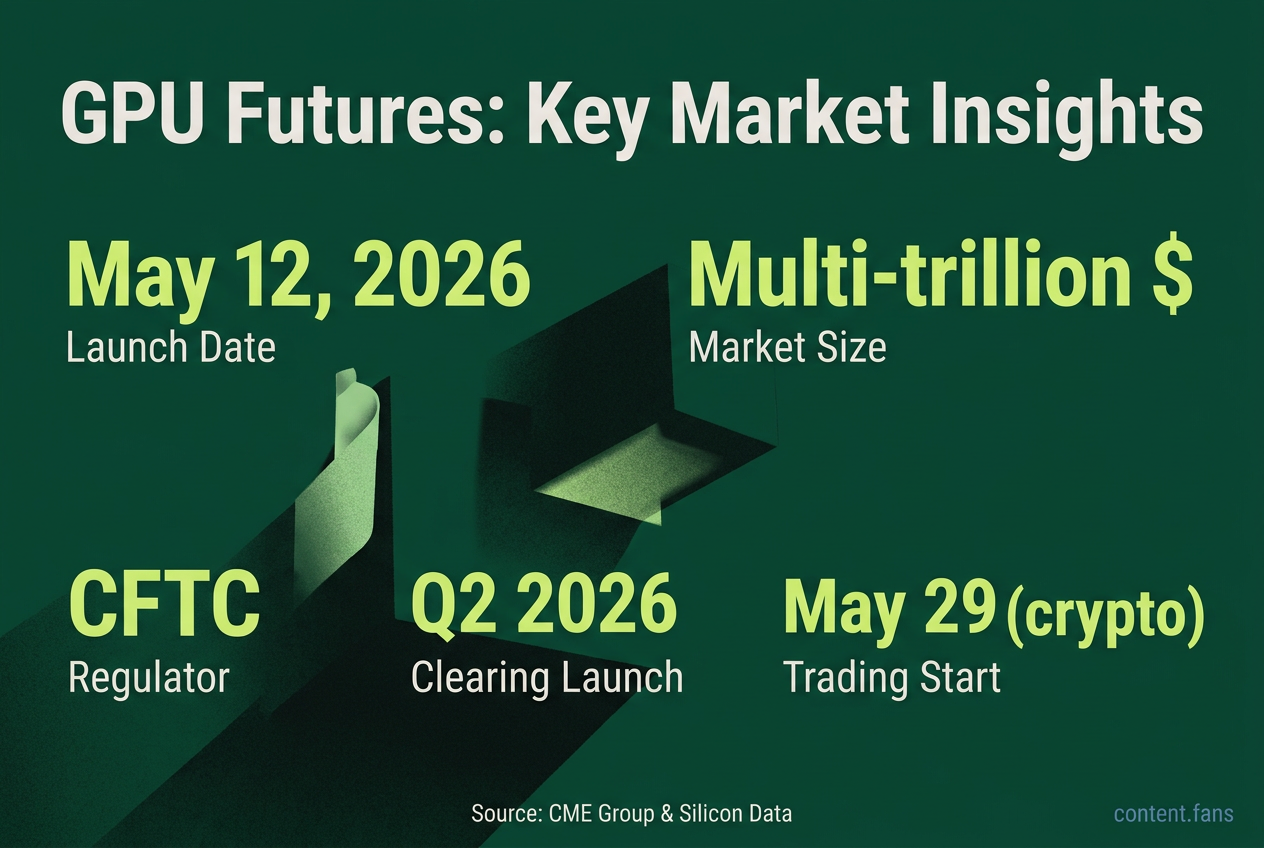
CME Group and Silicon Data are partnering to launch a GPU futures market, a landmark move to bring regulated trading to the volatile world of AI computing power. The proposed contracts, announced on May 12, 2026, will allow traders to hedge and speculate on the cost of GPU rental rates using a benchmark index from Silicon Data.
While the project awaits approval from the Commodity Futures Trading Commission (CFTC), it marks a significant step toward commoditizing computational resources for the rapidly growing AI industry.
How the Planned Contracts Work
These futures contracts will enable market participants to buy or sell standardized units of GPU computing power for a future date at a predetermined price. The contract's value is tied to Silicon Data's daily index of on-demand GPU rental rates, offering a transparent benchmark for hedging costs.
Each contract is financially settled against Silicon Data's index, which tracks daily on-demand rental rates for high-performance GPUs like the NVIDIA H100 and A100 across various cloud providers. Industry reports indicate this allows participants to lock in future compute costs (a long position) or hedge revenue from selling capacity (a short position).
This addresses a critical need, as sources note upward pressure on prices and volatility in the multi-trillion-dollar AI infrastructure market, for which traders previously lacked standardized hedging instruments.
Key Hurdles and Regulatory Review
CME Securities Clearing launch is expected Q2 2026, with crypto 24/7 trading beginning May 29 pending review. The Commodity Futures Trading Commission (CFTC) must first approve the contract's benchmark methodology and margin requirements. Initial trading volumes are undisclosed as liquidity projections are still under development.
Another significant challenge is benchmark granularity. The current index aggregates rates across different hardware and regions, but experts note that variations in memory, networking, and architecture can cause significant performance differences, potentially requiring more specialized contract types in the future.
Potential Market Participants
Industry analysis suggests the primary users of GPU futures will include:
- Cloud Providers: Hedging revenue from long-term enterprise contracts.
- Asset Managers: Securing predictable budgets for AI model training.
- Data-Center Operators: Locking in prices for surplus GPU capacity sold on the spot market.
While large cloud companies have internal reservation systems, these futures could provide longer-term price stability. Furthermore, the contracts offer a vital tool for AI startups, enabling them to manage volatile compute costs without committing to restrictive, multi-year leases.
The Challenge of Standardization
Standardizing a price for computing power presents challenges similar to those faced by energy and bandwidth markets. Factors like GPU architecture, regional power costs, and supply chain disruptions can create significant price spreads. This volatility requires a robust index methodology to prevent arbitrage based on sourcing cheaper regional capacity at contract settlement.
While final specifications are being drafted, CME Group is actively consulting with trading firms, cloud providers, and risk managers to refine the product. Crucial details, including margin requirements and contract specifications, have not yet been released, and no test trades have occurred.