
Dust raises $40M Series B for multiplayer AI for work
Serge Bulaev
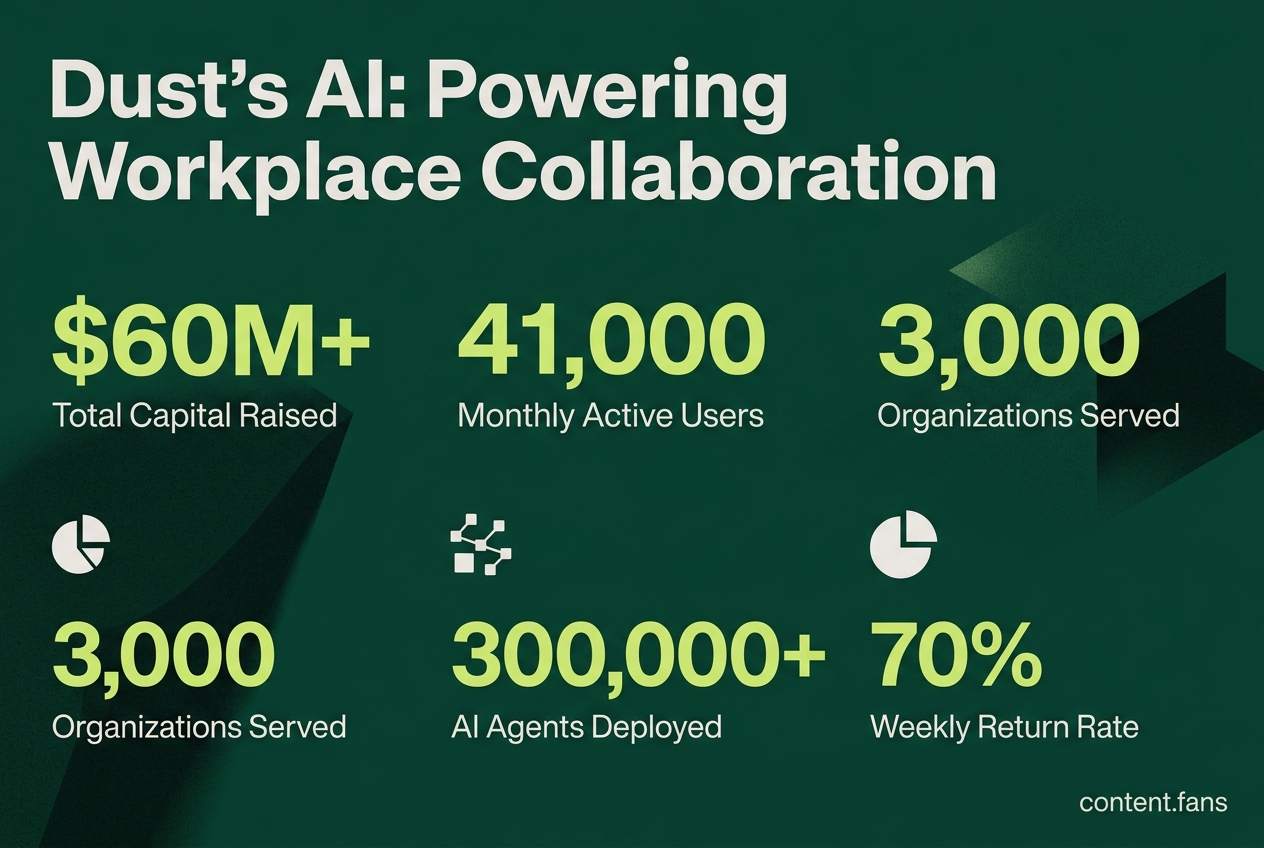
Dust, a startup based in Paris and San Francisco, has raised $40 million in Series B funding, bringing its total funding to over $60 million. The money may help Dust deepen its connections with enterprise data sources and expand its multi-user AI agent platform. Dust's platform lets teams use AI agents inside their usual work apps, but it does not build its own language models. Reports suggest early adoption is strong, with thousands of organizations using hundreds of thousands of Dust agents. The new funding is expected to be used for adding more features and integrating with partners like Snowflake and Datadog, though the timeline for these changes is not set.

Dust, a platform provider for multiplayer AI for work, has secured $40 million in a Series B funding round, elevating its total capital raised to over $60 million. The round, announced on May 18, 2026, was co-led by Abstract and Sequoia Capital, with strategic investments from Snowflake Ventures and Datadog.
This fresh capital is aimed at enhancing Dust's multi-user agent framework and deepening integrations with enterprise data sources. The investment positions the company to expand its footprint in the rapidly growing market for AI-powered workplace collaboration.
How Dust's Multiplayer AI Platform Works
Dust provides a cloud-based platform allowing teams to create and deploy AI assistants within their existing applications. It acts as a connective layer, enabling users to ground responses in company data from sources like Slack or Google Drive while using their preferred large language model from providers like OpenAI.
The platform is model-agnostic, supporting LLMs from Anthropic, Google, OpenAI, and Mistral. By connecting to internal tools like Slack, Google Drive, Notion, and Intercom, Dust ensures that AI-generated answers are grounded in secure, company-specific knowledge. As noted by TechCrunch, Dust focuses on providing the critical connective tissue between LLMs and corporate data rather than building its own foundation models Dust grabs another $16M.
Early adoption metrics indicate significant traction. By April 2026, The Next Web reported that Dust had attracted 41,000 monthly active users across 3,000 organizations, with over 300,000 AI agents deployed Dust raises $40M. High engagement is demonstrated at key clients including Qonto and Alan, with strong adoption rates across their teams.
Dust's Funding and Strategic Backers
Dust raised a $40M Series B on 18 May 2026 led by Abstract and Sequoia; prior rounds are mentioned in secondary reporting, but the seed-round details and 'participation in every funding round' are not directly verified by the provided sources.
The strategic investments from Snowflake Ventures and Datadog also signal potential for future deep technical integrations, as both firms are key players in the data ecosystem.
Common Use Cases for Dust's AI Agents
According to company reports, assistants are commonly configured for:
- Sales prospect research
- Engineering documentation search
- Recruiting coordination
- Support ticket triage
Recruiters, engineers, and sales operations teams have emerged as prominent early adopters. The platform's utility is further highlighted by Dust's internal metrics, which reveal a 70% weekly return rate for its monthly active users, suggesting strong repeat use.
Market Landscape: The Rise of Collaborative AI
According to industry reports, the enterprise collaboration software market is experiencing significant growth through 2030. This growth is driven by the integration of AI into core products by vendors like Microsoft and Slack for tasks like automated summaries and drafting, as well as the broader trends of hybrid work and cloud adoption. In this competitive landscape, Dust is strategically positioned, betting that its agent-driven, data-connected multiplayer framework will offer a superior alternative to isolated, single-user AI chat interfaces.
Future Roadmap and Integrations
With the Series B funding, Dust's management plans to enhance its multi-agent orchestration capabilities and introduce advanced access controls for regulated industries. The company is also exploring integrations with Snowflake's Data Cloud and Datadog's observability platform, a move that aligns capital with strategic technical partnerships. A specific timeline for these developments has not been announced.