
Dolfin raises $2.5M seed to automate sales compensation with AI
Serge Bulaev
Dolfin, a startup from Barcelona, has raised $2.5 million in seed funding led by Swanlaab to help companies use AI for managing sales compensation. The company wants to replace manual spreadsheets in finance teams with faster, simpler, and more accurate tools. Some experts say AI may improve how pay plans are designed by using better data and allowing teams to test ideas before making changes. Dolfin claims its platform automates and tracks commissions, which might reduce errors and make pay decisions clearer. The market for AI in sales compensation appears crowded, and Dolfin still needs to show its product is accurate, fast, and easy for users.

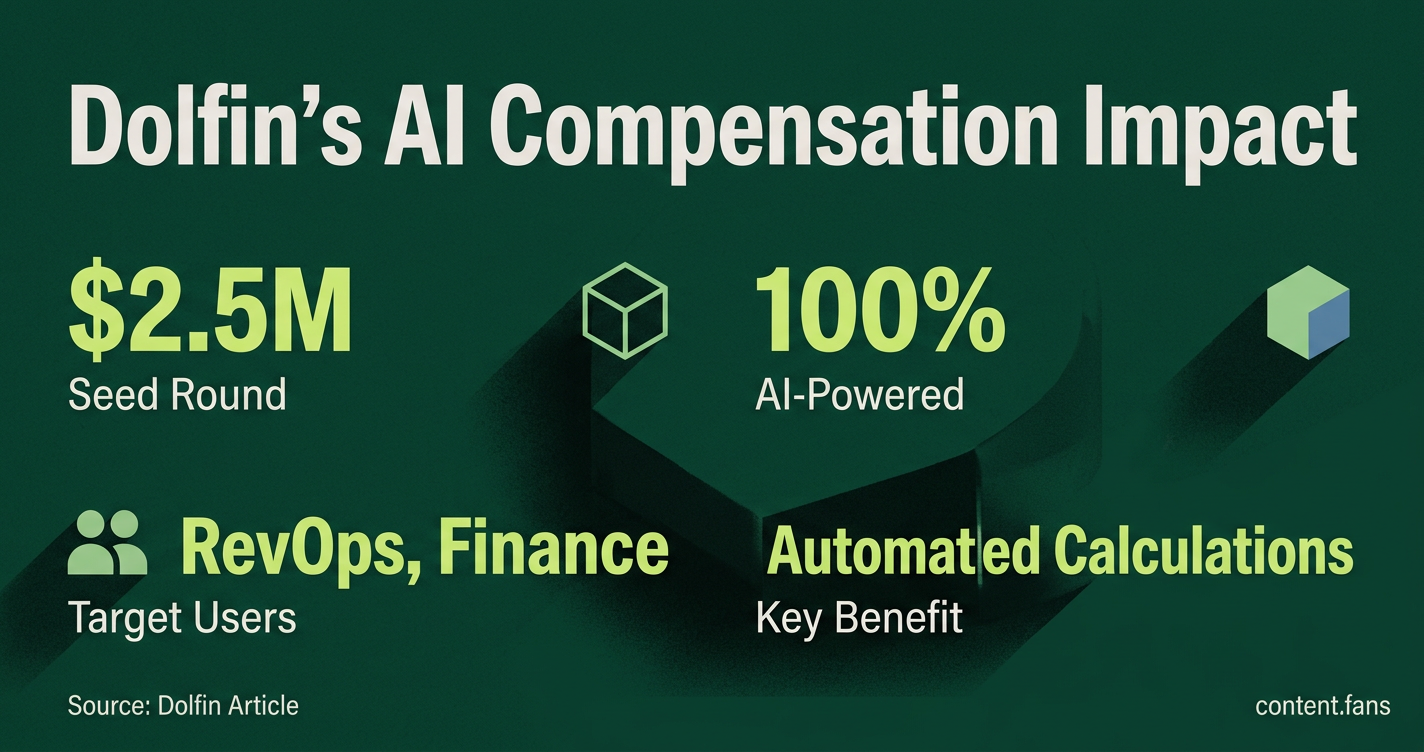
Dolfin raised $2.5M in a seed round led by Swanlaab, with participation from Archipelago Next, Inveready, and Dozen Investments. It is an AI-native sales compensation platform that provides real-time tracking, automated calculations, and performance dashboards for RevOps, Finance, and sales teams.
Key details about the seed round:
- Amount raised: $2.5 million
- Lead investor: Swanlaab
- Additional investors: Archipelago Next, Inveready, and Dozen Investments
- Product focus: no-code, AI-powered commission automation
- Target users: finance and revenue operations teams
The Growing Role of AI in Sales Compensation
The use of artificial intelligence in sales compensation is on the rise. According to The Alexander Group, AI enhances "data capture and analysis," enabling companies to refine compensation plans and accelerators for specific roles. This marks a strategic shift from intuition-based plan design to data-backed, simulation-based planning. Experts at Qobra note that scenario modeling allows finance teams to test plan changes before implementation, significantly reducing the risk of costly errors.
AI in sales compensation involves using algorithms to analyze performance data, model potential incentive plans, and automate commission calculations. This technology helps organizations move beyond manual spreadsheets to design more effective, data-driven compensation strategies that can be tested and refined before being implemented across sales teams.
Dolfin's Stated Value Proposition
According to its product description on a SourceForge comparison page, Dolfin provides a unified platform to "automate, review and track commissions." The vendor promises real-time data access and claims to deliver high commission accuracy. Although these claims are from promotional materials, they define Dolfin's core mission: to eliminate spreadsheets, increase payment transparency, and reduce costly payout errors.
Key Buyer Priorities in Sales Compensation Software
Market data from G2 reviews for sales compensation software reveals that buyers prioritize ease of use, real-time commission tracking, and calculation accuracy. Common complaints with existing tools include steep learning curves and system performance issues. These market expectations set a clear benchmark for Dolfin as it enters the market with its new funding.
Operational Benefits for Finance and RevOps
Adopting AI-powered compensation tools can deliver significant gains. Industry reports indicate that many companies using AI free up team time for strategic work, while a significant portion see a reduction in administrative tasks. Furthermore, as noted by Sequoia, there is a growing demand for transparent and well-documented compensation processes. Dolfin's features, such as audit trails and live dashboards, directly address these critical operational and governance requirements.
Navigating a Competitive AI SaaS Market
Dolfin enters a competitive but rapidly expanding market. Investors are heavily focused on AI-native B2B SaaS, as observed by Harlem Capital. Moreover, AI integration is now considered "table stakes" for securing funding in this category, according to GrowthList. With its fresh capital, Dolfin must now demonstrate superior accuracy, speed, and user adoption to gain traction among its rivals.
What is Dolfin and what problem does it solve?
Dolfin is a Barcelona-based AI-native platform that automates and redesigns sales compensation. It targets finance teams that still rely on manual spreadsheets and legacy tools, cutting the time to roll out new incentive plans from weeks to hours. Early positioning claims high commission accuracy and real-time visibility for every stakeholder.
How will the $2.5 M seed round be used?
The round, led by Swanlaab Venture Factory, will finance product development and European go-to-market hires. Swanlaab's usual focus on hands-on B2B software companies fits Dolfin's AI-driven workflow layer for finance teams.
What measurable impact can finance teams expect?
Buyers of comparable AI commission tools report significant reduction in admin cost and time and, in some cases, revenue lift after aligning incentives to strategic goals. Dolfin's own pitch mirrors these benchmarks, promising real-time calculation, error-free payouts, and scenario modeling that prevents expensive plan mistakes before rollout.
How mature is the product and where is customer proof?
Public listings on SourceForge describe Dolfin as a no-code, collaborative commission hub, but named customer case studies or third-party reviews have not yet surfaced. Prospects should request audit trails, dispute-resolution metrics, and reference calls to validate the accuracy claims.
What are the risks of adopting an early-stage AI comp tool?
Industry surveys show the top pitfalls for AI sales-comp platforms are data-quality errors, opaque logic, and slow integration with CRM/ERP stacks. Finance leaders should insist on on-prem data validation rules, SOC-2-compliant hosting, and clear escalation paths before signing multi-year contracts.