
DOE Targets 2028 for First Fault-Tolerant Quantum Computer
Serge Bulaev
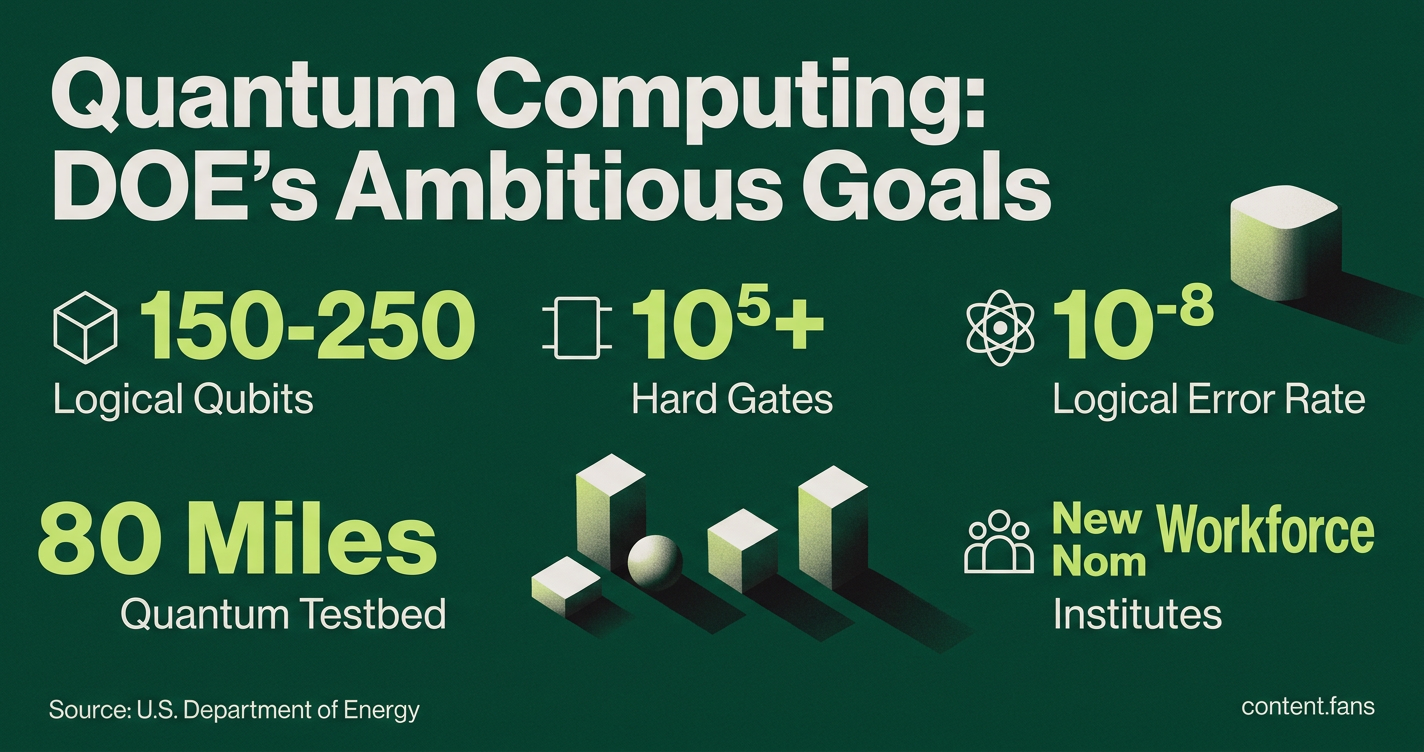
The Department of Energy plans to build the first fault-tolerant quantum computer for scientific discovery by 2028, following new executive orders signed by President Trump. This computer may have 150-250 logical qubits and must meet strict error rates, but experts note that error correction is still a big challenge. Private companies like IBM and PsiQuantum might reach similar milestones around the same time, though success is not certain. The orders also call for faster work on quantum sensors, networks, and workforce training, with several government agencies assigned specific tasks. Some experts suggest the 2028 goal is ambitious and may only lead to a first demonstration rather than a full, ready-to-use system.

According to industry reports, the U.S. Department of Energy (DOE) is working to accelerate its timeline to build the nation's first fault-tolerant quantum computer. The DOE has issued a formal request for information detailing the specific hardware parameters for this first-generation scientific machine (Quantum Computing Report).
While described as an "entry point" for scientific discovery rather than a commercial product, the proposed system has precise targets. These include 150-250 logical qubits, a capacity for at least 10⁵ hard gates, and a logical error rate of 10⁻⁸ per operation. A funding roadmap to achieve these goals is expected from an Office of Science Advisory Committee sub-committee.
Hardware race and private-sector timelines
The DOE's ambitious goal intensifies the race for quantum supremacy, with companies like IBM and PsiQuantum also targeting similar milestones. While their roadmaps appear competitive with the federal timeline, a significant challenge remains: developing effective quantum error correction, a critical step for building a truly fault-tolerant system.
According to industry reports, private sector timelines from key players suggest the DOE's goal is competitive but achievable. IBM's roadmap targets significant logical qubit capabilities in the coming years, a timeline that could potentially be accelerated. Meanwhile, according to industry sources, PsiQuantum aims for delivery from its new facility in the near future. Despite these promising trajectories, experts emphasize that robust error correction remains an unresolved hurdle.
Sensors and networks within five years
Related executive orders also mandate the transition of quantum sensors and networks from prototype to early deployment. The Department of Defense has been tasked to identify priority sensor projects for accelerated field testing. Current readiness levels vary significantly across different quantum sensor technologies. Key projects in quantum inertial navigation are projected for advanced testing in the coming years.
For quantum networking, the DOE's quantum internet blueprint serves as the guiding document. An 80-mile testbed connecting key research institutions in Illinois is already active. The blueprint sets ambitious goals for long-distance quantum links, with smaller, metro-scale government networks anticipated sooner.
Workforce and supply-chain provisions
Related executive orders on post-quantum cryptography align with the new hardware goals. To support this national effort, the Department of Labor and the National Science Foundation will expand apprenticeships through new National Quantum Workforce Development Institutes. Federal agencies have also been granted streamlined hiring authority for critical quantum and cybersecurity positions.
Agency assignments at a glance
- DOE: Deliver fault-tolerant quantum computer and support sensor-network deployment
- Defense: Identify priority field-ready quantum sensor projects
- Commerce: Produce supply-chain strengthening plan
- Labor/NSF: Expand apprenticeships and workforce institutes
- FBI/Counterintelligence teams: Protect quantum intellectual property and talent
Industry response has been largely positive, with companies like Google pointing to existing hardware like its Willow chip as a sign of domestic readiness. However, academic experts like Yale's Stephen Girvin caution that current logical error rates are still "far short" of what is needed for full fault tolerance. According to industry reports, this suggests the goal likely targets a landmark demonstration rather than a fully operational, plug-and-play system.
According to government sources, the orders represent a significant update to national quantum policy since the 2018 National Quantum Initiative, emphasizing that U.S. leadership relies on setting ambitious national goals, a strong domestic workforce, and trusted supply chains. Federal agencies are now mobilizing to meet a series of deadlines, starting this summer.
What exactly must the DOE deliver and why is it considered a "first-generation" machine?
According to industry reports, the Department of Energy is working toward a fault-tolerant quantum computer that can run at least 150-250 logical qubits and complete circuits of ≈100 000 "hard" quantum gates with a logical error rate ≤10^-8 per gate.
The system - intentionally framed as a first-generation device rather than a commercial product - must be integrated into a national-lab super-computing environment so scientists can tackle problems in quantum chemistry, materials science and high-energy physics that are beyond today's classical machines.
How is the goal being turned into a concrete procurement program?
According to industry sources, DOE's Office of Science released a formal Request for Information to industry, asking vendors to show how they would satisfy the above specs and deliver a machine to a DOE site.
Responses will shape coming solicitations, intellectual-property terms and cost-share models, effectively turning the White House deadline into a competitive acquisition race rather than an internal research project.
What technical milestones sit between now and completion?
- Office-of-Science advisory sub-committee delivers a milestone-based investment roadmap
- Demonstration of a quantum inertial-navigation package in a GPS-denied environment (DARPA TQS program) - a proxy for hardware readiness
- Down-select of vendor(s) and start of system integration at the chosen national lab
All steps assume continued progress in quantum error-correction so that physical-qubit error rates can be pushed below the fault-tolerance threshold for the specified logical qubits.
How much money has Congress already locked in for the push?
- Significant funding over multiple years to renew the National QIS Research Centers
- Additional funding for quantum-computing research projects focused on algorithms, control electronics and component supply
These funding sources sit on top of baseline DOE Office-of-Science quantum budgets and are explicitly aligned with the fault-tolerant milestone.
Which vendors are considered credible to meet the window?
According to industry reports, public timelines that overlap DOE's logical-qubit requirements include IBM's roadmap and PsiQuantum's photonic system under construction. The DOE RFI is architecture-agnostic, so ion-trap, superconducting, photonic or hybrid platforms can compete as long as they hit the error-corrected gate budget.