
DHL Explains How B2B Influencers Drive Trust, Sales
Serge Bulaev
DHL says B2B influencers with special knowledge may help build trust and move buyers through complex decisions faster. They report that working with experts who share real stories or teach about products, instead of just selling, appears to be effective. Research suggests these expert influencers can drive more engagement, like more demo requests or downloads, compared to general influencers. Measurement tools are getting better, but finding the right influencers and showing clear results still might be hard. DHL suggests long-term relationships and clear rules may help, and brands seem to be testing these ideas as they adjust to longer buying cycles.

The rise of B2B influencers is reshaping marketing, and new guidance from DHL explains how these experts build trust and accelerate sales. For professional buyers facing complex decisions, niche practitioners with proven authority are proving more effective than traditional advertising.
Marketers observing this trend see a clear formula for success: prioritize expert voices over follower counts, build sustained partnerships, and create content that educates before it sells.
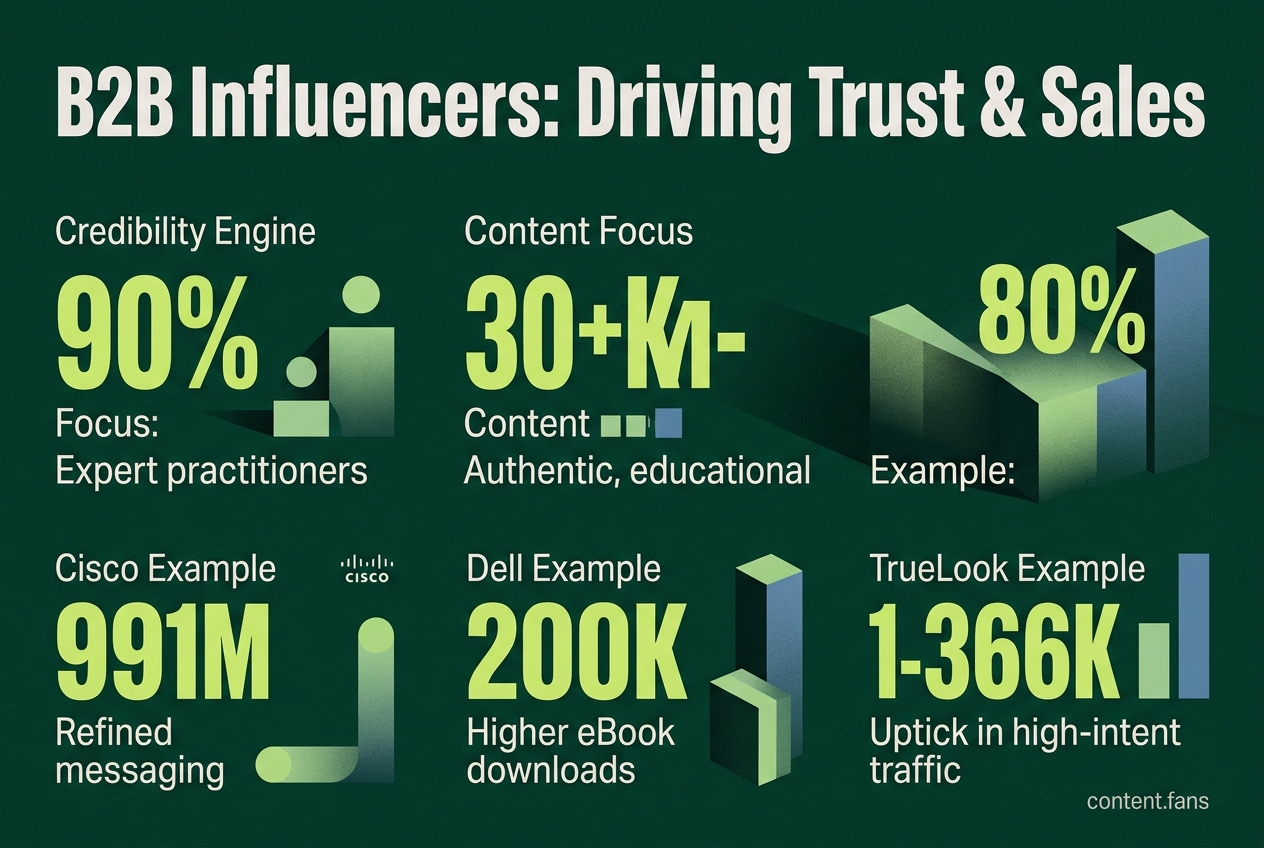
Why DHL Calls Influencers a Credibility Engine
DHL's definition is closer to a collaboration between businesses and subject specialist creators/experts to promote a brand's product or service through the creator's expertise.
B2B influencers drive trust by acting as expert practitioners who provide authentic, educational content. Instead of direct selling, they share real-world use cases, technical insights, and unbiased reviews, helping professional buyers navigate complex decisions with greater confidence and speed, ultimately influencing sales.
In its guidance, DHL highlights one successful example:
- Cisco Champions: A vetted group of IT specialists are invited to test pre-launch technologies and share their findings through blogs and podcasts. DHL notes that this insider access helped Cisco refine its messaging while giving the Champions authentic stories to share.
This example illustrates DHL's broader playbook: align influencers with buyer intent data, segment messaging by funnel stage, and use AI-driven personalization for distribution.
External Case Studies Echo the Same Playbook
Industry research confirms that expert creators consistently outperform generalist personalities, especially when products involve technical or operational complexity. For example, the GRIN compilation notes Dell's Data Paradox campaign used eight tech influencers to amplify an interactive report, resulting in significant engagement spikes. Similarly, industry reports highlight how in-depth assets like whitepapers and webinars deliver superior results compared to one-off social posts.
A comparison of approaches reveals recurring themes:
| Brand example | Content format | Outcome recorded |
|---|---|---|
| Cisco Champions | Blogs, community radio, feedback sessions | Influenced product direction, audience trust |
| Dell Data Paradox | Interactive eBook, research briefings | Higher eBook downloads per GRIN data |
| TrueLook | Demo-focused influencer videos | Uptick in high-intent traffic |
The data shows that practitioners who can translate complex features into real-world benefits generate higher-value engagement, measured by metrics like demo requests and content completions.
Measurement Frameworks Are Maturing
While recent surveys show that identifying the right experts and proving impact remain top challenges, measurement frameworks are evolving. Industry reports suggest positive returns on B2B influencer marketing investments, though this varies by industry. To prove value, DHL's guidance recommends tracking metrics across the entire sales funnel:
- Top Funnel: Target-account impressions, webinar sign-ups
- Mid Funnel: MQL to SQL conversion, demo requests
- Bottom Funnel: Pipeline influenced, win rate
- Long Horizon: Category credibility and SEO authority
To accurately attribute revenue, program owners must integrate influencer links and gated assets into their CRM. This allows for precise reporting on assisted revenue, even across long sales cycles.
Building an Always-On Bench of Experts
Industry experts agree that sustained, "always-on" relationships build the trust and familiarity that B2B buyers require - a stark contrast to one-off sponsored posts. DHL echoes this, urging brands to grant influencers early product access, co-create research, and respect their authentic voice. A B2B influencer marketing guide from DHL reinforces this, flagging compliance basics like clear disclosure as essential for protecting credibility.
Ultimately, the evidence points to a winning strategy built on three pillars: deep domain expertise, educational storytelling, and performance metrics tied directly to pipeline quality. As brands in logistics and other high-consideration sectors adapt their marketing, these fundamentals are proving essential for success.
What is the core difference between B2B and B2C influencer marketing?
In B2B, trust is rooted in proven expertise, not follower count. DHL's guidance stresses that logistics buyers care more about warehouse-automation practitioners or freight-visibility experts than lifestyle creators. This is why Cisco Champions - a program in which IT experts receive pre-launch access to technology and create technical content - is held up as the template. Longer buying cycles and higher stakes make subject-matter authority the decisive currency.
Which formats and platforms perform best for logistics and supply-chain brands?
Industry reports suggest effective approaches pair three key ingredients:
- Live, educational demos: factory walkthroughs, trade-show floor streams, and hands-on product testing
- Native LinkedIn assets: short-form video, carousel posts, and AMA threads where experts answer questions in their own voice
- Co-created resources: whitepapers, case-study webinars, and interactive ROI calculators that can be gated for lead gen
Industry observations note that educational, platform-native content earns reach, while one-off sponsored posts fade.
How should companies measure influencer ROI in a B2B setting?
Forget vanity metrics. Recent studies show that many B2B marketers still struggle to identify ideal influencers, with a significant portion citing measurement as the bigger headache. The fix is to track four layers:
- Top: reach within target account lists and webinar sign-ups
- Mid: MQL-to-SQL conversion, demo requests, content-assisted pipeline value
- Bottom: influenced opportunities, win-rate lift, sales-cycle velocity
- Strategic: share-of-voice among analysts and search authority on technical keywords
Industry reports suggest positive returns on B2B influencer marketing investments, with logistics leaders reporting the ratio climbs when campaigns are tied to ABM lists or product launches.
What are the biggest operational pitfalls when working with B2B influencers?
The research flags a clear top-three list:
1. Finding credible niche voices rather than generic "thought leaders"
2. Validating true audience fit - checking comment quality and industry engagement
3. Protecting authenticity while aligning on brand messaging
Industry best practices recommend:
- Start with ICP-aligned discovery: scan conference speaker rosters, podcast guest lists, and trusted customer referrals
- Audit recent posts for topic depth and authentic interaction
- Build "always-on" relationships instead of one-off posts - repeat collaboration compounds trust and message consistency
How can logistics marketers get started with a pilot program?
Follow a structured sprint approach outlined across DHL and recent industry briefings:
Week 1-2:
Define one narrow use case (e.g., launch of a new freight-visibility API). List potential micro-experts who frequently speak on TMS integrations.
Week 3-4:
Shortlist several creators via manual plus tool-assisted vetting; score on relevance, engagement quality, and audience fit.
Week 5-6:
Co-develop a LinkedIn Live demo + gated technical brief. Negotiate creative freedom and clear FTC disclosure.
Week 7-12:
Run the campaign with UTM tracking, CRM integration, and weekly pipeline check-ins. Measure assisted conversions and demo requests rather than likes.
Post-campaign:
Debrief with creators; repurpose the webinar into a multi-part article series and a snackable video clip for sales follow-up.
Early pilots in the sector show that even a single well-aligned expert can generate significant demo-request lift when the asset is anchored in real operational insight rather than brand puffery.