
Demand Gen Report: 96% of Marketers Use AI, 58% Struggle With Volume
Serge Bulaev
Most marketers use AI, but over half still struggle to create enough quality content for buyers. People are tired of generic, boring material and want real proof and expert facts. Teams that mix AI speed with strong research see better results, more sales, and higher trust. Customizing content with AI, backed by real data, makes sales go faster and builds brand power. To win, marketers should focus on quality, proof, and clear expert support in every sales piece.

While nearly all B2B marketers use AI, a significant portion struggle to create sufficient content, according to industry reports. This has led to buyer fatigue with generic, synthetic material, placing a new premium on proof-driven resources backed by verifiable expertise to shorten sales cycles and build authority.
Why Proof Beats Volume
Proof-driven content outperforms high-volume AI material because it builds buyer trust in a market saturated with generic output. Assets grounded in verifiable research, case studies, and expert insights signal credibility to both search algorithms and purchasing committees, leading to stronger funnel performance and longer-lasting search rankings.
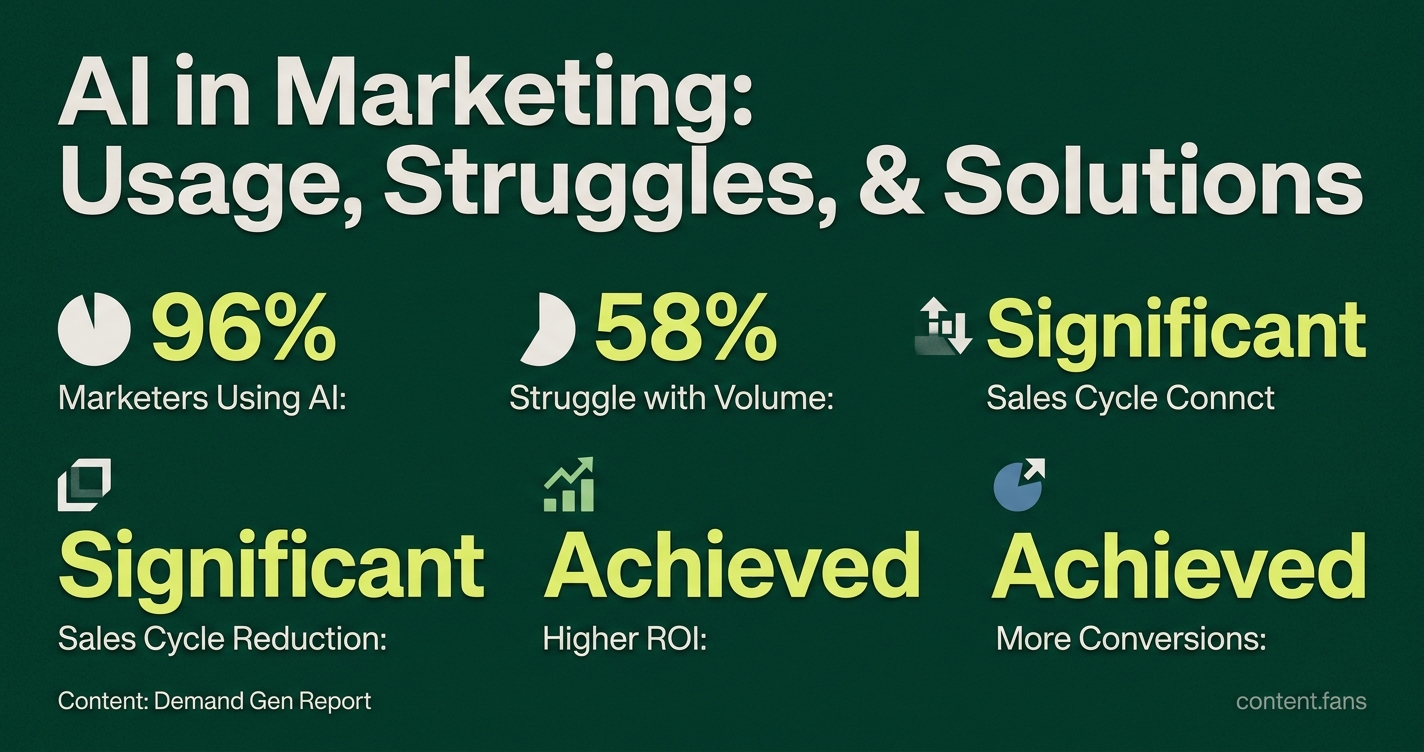
This performance gap is validated by industry analysis. Research-backed assets deliver superior funnel performance and search durability compared to high-velocity AI copy, as noted in the B2B Trends Research Report from Demand Gen Report. This trust deficit has real financial impact: according to industry reports, enterprises face significant losses due to buyer distrust of GenAI outputs.
High-Impact, Brand-Approved Customization in Action
Modern AI sales enablement systems provide a solution, significantly boosting productivity and reducing sales cycles. These platforms create on-brand digital sales rooms, automatically tailoring content like decks and ROI calculators to a specific buyer's industry, role, and stage. Human oversight maintains message control, compliance, and brand consistency.
A typical workflow includes:
- Marketing provides master assets with verified citations and expert commentary.
- Content is tagged by industry, use case, and buying stage for easy retrieval.
- AI assembles personalized materials in seconds, populating fields for company name, logo, and specific pain points.
- Brand-approved templates prevent unauthorized edits while still allowing reps to add contextual notes.
This process accelerates deals by ensuring every piece of collateral is backed by provable data, not generic filler.
Metrics That Matter
Industry reports indicate that campaigns blending AI personalization with expert-led content achieve higher ROI, more conversions, and lower acquisition costs than traditional methods. Furthermore, many sales reps report that AI-surfaced intent data helps them close deals faster.
This superior performance relies on three core principles:
- Credible evidence: Original surveys, benchmark data, and validated outcomes create what analysts call trust currency.
- Precision personalization: AI slots the right stat or quote for each account, keeping messages relevant without diluting rigor.
- Governance guardrails: Brand-approved templates, SME sign-off, and transparent sourcing keep quality high even at scale.
Building a Repeatable Engine
To build a repeatable engine for high-trust content, marketers should first audit all assets for source clarity and data integrity, refreshing or retiring any piece that lacks cited proof. Next, embed structured metadata (e.g., persona, buying stage, vertical) to enable automated content surfacing. Finally, implement a simple governance checklist to verify citations, author attribution, and link validity.
This process is reinforced when sales leaders require quantitative proof in all prospect-facing materials. This consistency trains buyers to expect substance, solidifying brand authority with every interaction.
How widespread is AI adoption among B2B marketers today?
According to industry reports, the vast majority of marketers already use AI and many rank it as the single most important trend. Studies show a significant portion credit AI with major efficiency gains, but they also reveal a critical side-effect: many teams lack the human capacity to produce enough content, tempting them to lean on high-volume, low-depth AI drafts that buyers quickly dismiss as "synthetic."
Why are buyers losing trust in AI-only content?
Research indicates that 19% of B2B buyers using GenAI feel less confident in purchasing decisions due to inaccurate info, a problem already costing enterprises over $10B in value loss from stock declines, settlements, and fines. In this "synthetic landscape," genuine thought leadership becomes a rare commodity and buyers revert to analyst reports, peer reviews, and brand-approved proof points before short-listing vendors.
What concrete steps increase content trust?
- Make humans visible: publish under named SMEs, cite real data, and explain methodology.
- Lead with evidence: swap "top five trends" posts for case-backed analysis that shows what broke and how you fixed it.
- Govern AI use: many teams lack internal rules for when and how AI may be used; documented oversight keeps quality high and reputation safe.
How does research-backed content perform versus pure AI output?
Industry experts warn that "purely AI-generated content is easy to spot and dismiss," while analysts note that research-backed assets deliver stronger search durability and funnel conversion than volume-based approaches. Structured expert answers also align with Google's EEAT signals, boosting both ranking and buyer confidence.
Where should AI fit inside a modern content workflow?
Best-practice organizations treat AI as an ideation and personalization layer, not the final word. Typical stack:
- AI drafts outlines or variations
- SMEs add original insight, data, and risk disclaimers
- Governance team reviews for accuracy, tone, and compliance
This hybrid model lets marketers scale output without sacrificing trust, a key currency in today's crowded AI marketplace.