
OpenAI Caps Microsoft Revenue Share at $38 Billion
Serge Bulaev
OpenAI and Microsoft have agreed to cap Microsoft's share of OpenAI's revenue at $38 billion through 2030, according to a Reuters report. The terms suggest OpenAI will continue to pay about 20 percent of its revenue to Microsoft until the cap is reached. This cap may let OpenAI work with other cloud providers while giving Microsoft a steady, predictable return. Some analysts say the change could reduce antitrust concerns and help OpenAI grow by using more than one cloud. The exact timing of reaching the $38 billion cap is uncertain and depends on how OpenAI's business develops.

In a significant revision to their partnership, OpenAI and Microsoft have agreed to cap Microsoft's revenue share at $38 billion, a move detailed in a recent Reuters report. This updated agreement redefines the financial relationship between the AI leader and its primary cloud partner through 2030, potentially allowing OpenAI greater flexibility while guaranteeing Microsoft a predictable return.
Key Mechanics of the New Revenue Share Agreement
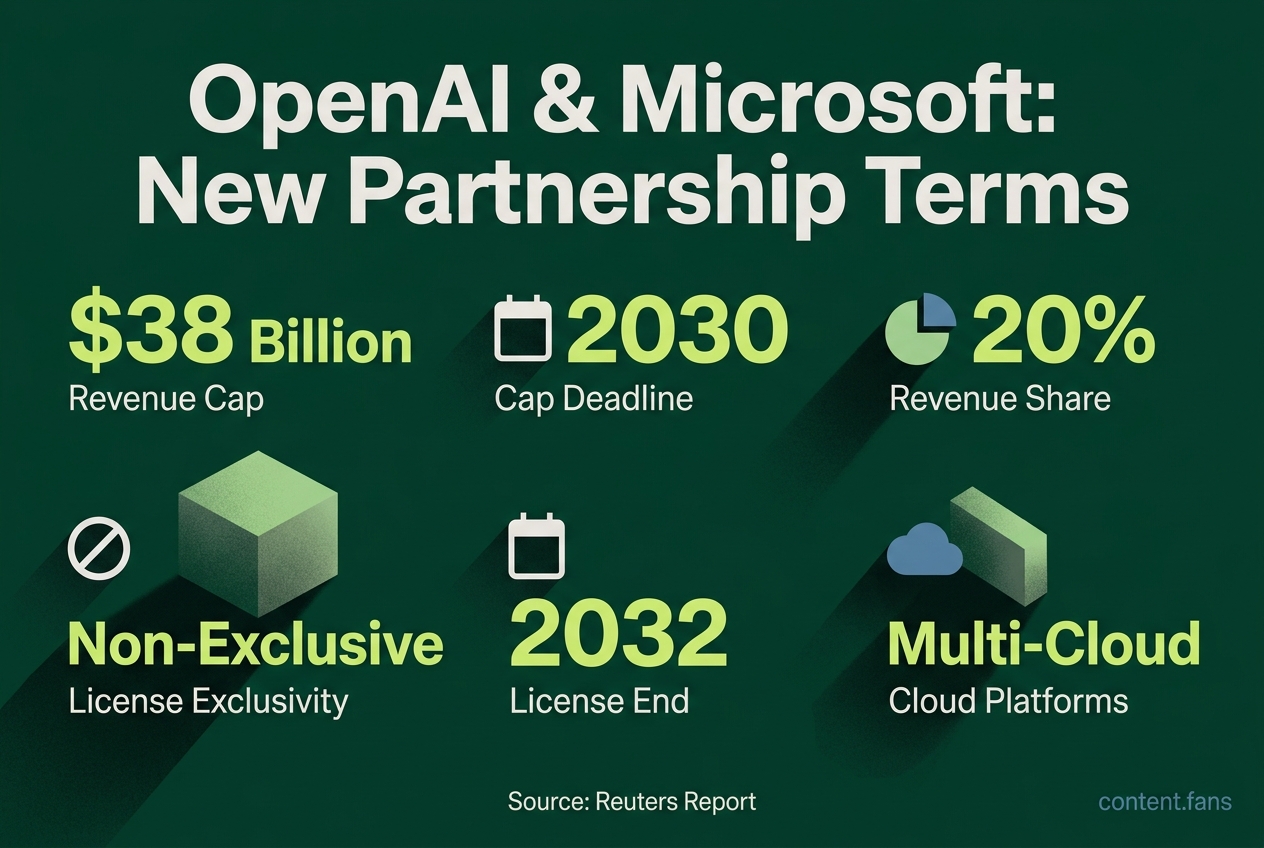
OpenAI and Microsoft have revised their financial partnership to cap Microsoft's total revenue share at $38 billion through 2030. OpenAI will continue paying 20% of its revenue to Microsoft until this limit is reached, after which OpenAI will retain all subsequent earnings from that period.
Following Microsoft's April 27 filing, which was further detailed by Reuters, the agreement introduces three primary changes:
- Revenue Share Cap: OpenAI's payments to Microsoft are capped at a cumulative $38 billion through 2030, though the payment rate remains an estimated 20% of revenue until the cap is met.
- Non-Exclusive Licensing: Microsoft's license for OpenAI's intellectual property becomes non-exclusive and extends to 2032, removing previous exclusivity constraints on future AI models.
- Multi-Cloud Distribution: OpenAI is now free to offer its products on any cloud platform, including competitors like Amazon Web Services and Google Cloud, although new models will still debut first on Azure.
Financial Implications of the $38 Billion Cap for OpenAI
Previously, Microsoft's share of revenue could have scaled indefinitely with OpenAI's growth. According to internal estimates cited by The Information and Reuters, this new ceiling is projected to redirect a significant portion of revenue back to OpenAI through 2030. This figure highlights the profound impact of commercial terms on financial outcomes.
Industry reports suggest OpenAI's payments to Microsoft could be substantial in the coming years, and the cap provides long-term predictability. Once the $38 billion threshold is met, OpenAI will retain all incremental revenue, significantly boosting its free cash flow in the latter part of the decade.
Strategic Implications for OpenAI and Microsoft
According to a Reuters article from April 27, which positions the deal as a reset of the alliance, industry analysts identify several key strategic outcomes:
- Reduced Antitrust Scrutiny: Easing the exclusivity ties to Azure may alleviate regulatory pressure on both companies.
- Market Expansion for OpenAI: The ability to deploy on multiple clouds could empower OpenAI to adopt more competitive pricing strategies and significantly expand its addressable market.
- Predictable Returns for Microsoft: The cap provides Microsoft with a guaranteed return on its investment while freeing up capital for its internal AI development efforts.
Broader Implications for the AI Industry
This agreement sets a significant precedent for the AI sector. Venture capital investors note that revenue-sharing caps can directly enhance a startup's valuation multiples by improving gross margins. For context, industry reports indicate that AI startups have commanded significant valuation premiums over their non-AI counterparts - a gap that could be sustained by deals protecting unit economics. Furthermore, market research highlights a growing preference for companies where capital expenditures are closely tied to monetization, a business model strengthened when platform fees are not permitted to grow without limit.
Unresolved Details and Considerations
Several key details have not been publicly confirmed. Microsoft's official announcements did not specify the revenue cap, and Reuters was unable to independently verify the figures reported by The Information. The exact timeline for reaching the $38 billion limit remains uncertain, as it depends on OpenAI's product adoption, enterprise sales, and multi-cloud strategy. Additionally, observers point out that Microsoft has also ceased its own revenue-sharing payments to OpenAI for Azure usage. Therefore, the net financial benefit to OpenAI will depend on its ability to generate new revenue from multi-cloud deployments to compensate for this change.