
Snowflake expands AI licensing, signs 17 publishers for six-figure deals
Serge Bulaev
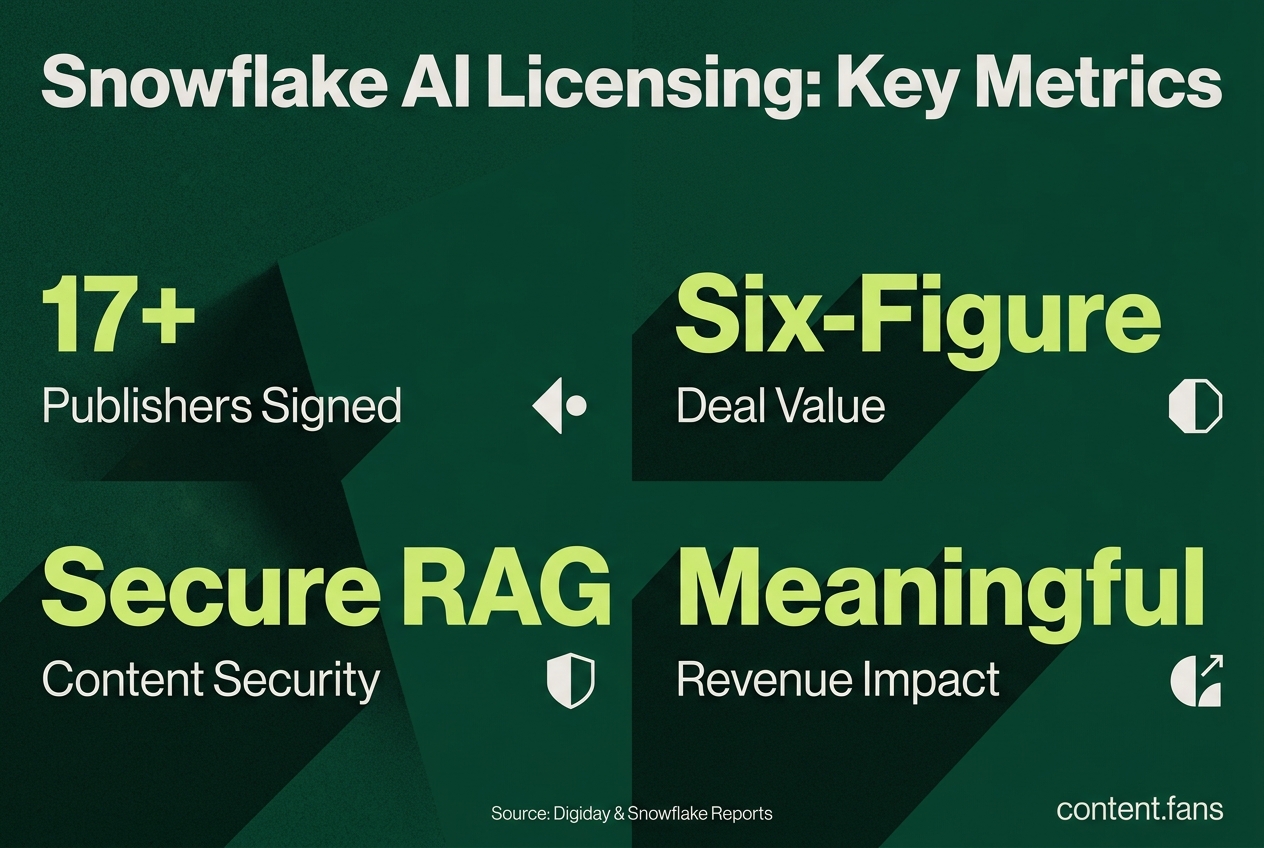
Snowflake has signed at least 17 publishers, including big names like The Washington Post and Associated Press, to six-figure AI licensing deals. These deals let financial and business customers access trusted, verified news content through Snowflake's platform for use in internal AI tools. The agreements may vary, with some buyers paying a flat fee and others paying based on how much they use. Revenue from these deals appears meaningful but uneven, and future earnings are uncertain since payments can be unpredictable. Some concerns remain about how content is controlled, credited, and priced as more data providers join the platform.

Snowflake's AI licensing platform is enabling major publishers to secure six-figure deals by converting their proprietary journalism into a secure, wholesale data product. A Digiday report confirms that at least 17 publishers - including The Washington Post, Associated Press, and the USA Today Network - are leveraging the platform to provide verified content for enterprise AI tools. Using its Cortex Knowledge Extensions, Snowflake provides a secure retrieval-augmented generation (RAG) conduit that keeps full articles within the Data Cloud. This allows enterprises to pay for a gated, copyright-safe search layer, delivering new revenue to publishers while buyers get attributable text within their existing Snowflake ecosystem.
Which Publishers Provide Data for Snowflake AI?
Publishers are licensing their archives as secure, queryable data sets within the Snowflake Data Cloud. Enterprises pay for access to this verified content for their internal AI models, providing publishers with a new revenue stream while retaining full control over their intellectual property and content.
The participating publishers range from global news wires to lifestyle magazines, reflecting a broad enterprise appetite for trusted content. The list of 17 initial sellers includes brands with diverse audience profiles. Kristin Heitmann, Associated Press chief revenue officer, noted the model serves "unlimited use cases," including compliance alerts and crisis dashboards. A Snowflake press release confirms providers can package unstructured data that is queryable via Cortex Search but never leaves the secure platform.
How AI Licensing Deals Are Structured
Enterprise customers, primarily large banks and investment firms, integrate the licensed content into their private AI agents for analysis and chatbots. Commercial terms are flexible and fall into two main categories:
- Flat-Fee Licenses: An upfront payment for a fixed term or usage cap, which publishers favor for predictable revenue.
- Usage-Based Pricing: A consumption model funded directly from the customer's existing Snowflake spending commitment, which institutions often prefer.
The Revenue Impact for Publishers in 2026
Early revenue from these AI licensing deals is described as "meaningful" but unevenly distributed among publishers. While some partners report that multiple six-figure contracts are helping to offset declines in programmatic advertising, forecasting remains a challenge. Newsroom executives note that license payments can be irregular, often tied to project milestones, making it difficult to predict future earnings with certainty. However, analysts suggest that broader AI adoption within Snowflake could create a rising ceiling for future licensing revenue.
Key Challenges and Considerations
Despite the early success, several challenges remain in this emerging marketplace:
- Governance: Balancing enterprise needs for fast, low-latency answers with publisher requirements for strict excerpt limits and clear linkage back to the original source.
- Attribution: While Snowflake provides article metadata, some publishers are advocating for more robust solutions, such as digital watermarking, to ensure credit.
- Pricing Power: As more content providers join the platform, increased competition could put downward pressure on licensing fees, although specialized and scarce content will likely retain high value.
Ultimately, these factors will determine whether AI licensing evolves into a repeatable, scalable revenue stream or remains an opportunistic bonus. For now, the Snowflake RAG channel has successfully demonstrated a powerful model that allows publishers to monetize licensed content without surrendering control of their valuable archives.