
Qumulo launches Cloud AI Accelerator to boost GPU utilization by 64%
Serge Bulaev
Qumulo has launched the Cloud AI Accelerator, which may help use GPUs better by keeping data close to where it is needed and making it easier to schedule jobs. The company says its new NeuralCache feature can cut GPU data-load times by up to 64 percent, but this number has not yet been independently checked. The service connects with other popular AI platforms like Microsoft AI Foundry, AWS Bedrock, and Google Vertex AI. Experts suggest that while this tool could reduce costs and speed up development, actual savings and performance improvements might depend on real-world testing. Current results are based on Qumulo's own claims, and more outside tests are needed to confirm these benefits.

Qumulo has entered the AI infrastructure race with its Cloud AI Accelerator, a new platform designed to treat GPU access as a scheduling problem rather than a complex data logistics project. By improving data access, the solution aims to dramatically increase the utilization of costly GPU resources for AI and ML workloads.
How the Cloud AI Accelerator Works
Qumulo's Cloud AI Accelerator is a data platform that gives AI workloads direct access to files across cloud and on-prem environments. By eliminating the need to copy or move data to the GPU, it reduces data-load times, boosts GPU utilization, and simplifies workload scheduling.
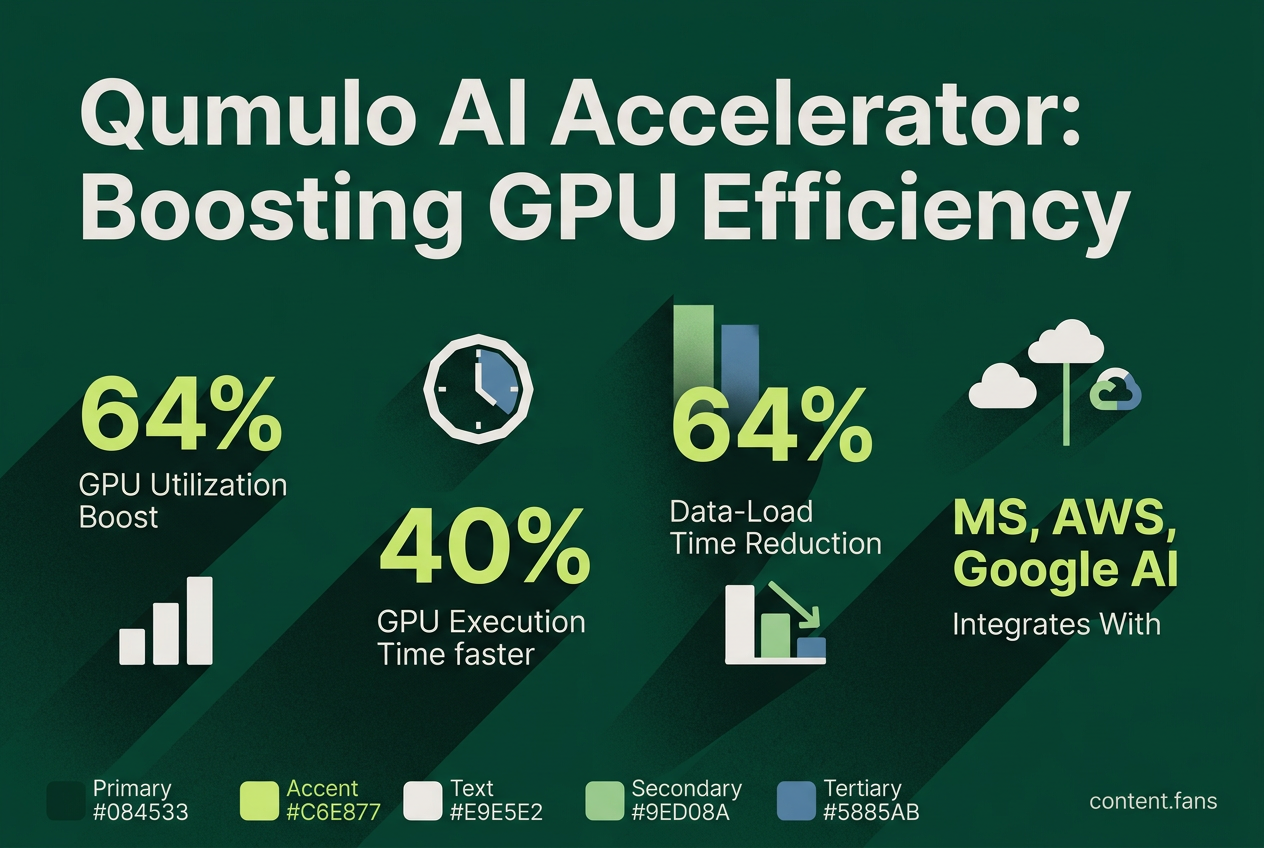
The service operates by combining three core components: Cloud Native Qumulo, its Cloud Data Fabric, and a new NeuralCache feature. This architecture keeps data in its original location, presenting it on-demand to any available GPU cluster. According to Qumulo's original release, GPU execution time can improve by up to 40%, while later reporting indicates that NeuralCache can reduce GPU data-load times by up to 64%, though independent verification is pending.
Crucially, the platform integrates with major managed AI services, including Microsoft AI Foundry, AWS Bedrock, and Google Vertex AI. This allows AI teams to connect their existing orchestration tools directly to datasets without a separate data-staging process, simplifying MLOps workflows.
Key Benefits and Potential Drawbacks
The primary benefit, as noted by Blocks & Files, is increased GPU utilization. By enabling GPUs to start processing immediately upon allocation, the accelerator can significantly lower idle compute costs. This leads to faster job starts, shorter development cycles, and reduced storage duplication, which mitigates data silo proliferation.
However, the performance claims are based on Qumulo's internal testing. Potential customers should approach these figures with caution until they are validated by independent, real-world benchmarks.
Competitive Landscape and Market Positioning
Qumulo's accelerator competes in a space with established players. On the data management side, it faces alternatives like Dell PowerScale and Pure Storage FlashBlade that offer hybrid file systems. On the compute side, it contends with specialized GPU clouds such as CoreWeave and RunPod, which provide raw GPU capacity.
Qumulo's key differentiator is its hybrid approach, bridging data and compute by pairing a distributed file platform with any available GPU resources. This strategy directly addresses a major industry bottleneck: GPU scarcity. With significant lead times for enterprise GPUs reported across the industry, solutions that provide "GPU liquidity" are critical. They allow organizations to shift focus from hardware procurement to maximizing the efficiency of every available GPU compute minute.
Evaluation and Future Outlook
For potential adopters, the next step involves running pilot programs to benchmark the Cloud AI Accelerator's performance with real-world AI workloads. These tests should focus on latency, throughput, and how well the platform integrates with existing data governance policies. Proof-of-concept results will be crucial for validating Qumulo's performance claims. Ultimately, decision-makers must weigh the platform's potential cost savings and performance gains against the added architectural complexity of a distributed data fabric.
What is Qumulo's Cloud AI Accelerator and how does it achieve higher GPU utilization?
Qumulo's Cloud AI Accelerator is a cloud-native data-access layer that lets enterprise GPUs reach datasets without copying or staging the data first. By integrating Cloud Native Qumulo, Cloud Data Fabric, and NeuralCache, the platform presents enterprise data to GPUs in real time across on-premises, edge, and multi-cloud environments. Eliminating the traditional heavy load phase into GPU-attached flash is what Qumulo credits for the significant reduction in GPU data-load times reported in industry coverage.
How does "GPU liquidity" translate into day-to-day IT flexibility?
GPU liquidity means GPU jobs can be scheduled based on where capacity exists rather than where data resides. Practically, this allows teams to:
- spin up training runs in any region the moment GPU spot capacity appears
- shift inference workloads from one cloud provider to another without re-staging petabytes
- avoid lengthy hardware lead times by treating GPU access as an on-demand resource pool
What integrations are already built in?
Out of the box, the accelerator connects without data copies to:
- Microsoft AI Foundry
- AWS Bedrock
- Google Vertex AI
These hooks allow existing MLOps pipelines to keep their orchestration layer while gaining the latency and utilization benefits Qumulo advertises.
What are the main deployment challenges buyers should expect?
Architects will face higher operational complexity compared with a tightly coupled storage/GPU stack. Key considerations include:
- distributed data fabric spanning on-prem, edge, and multiple clouds
- integration effort with existing cloud AI services and Cisco UCS-style networks
- data-governance requirements (access control, compliance, data locality) that remain even when data is no longer replicated
Vendors also note that strongest performance and cost claims are vendor-reported, so internal benchmarking is advised before procurement decisions.
How does the solution fit into broader AI infrastructure trends?
With GPU shortages extending lead times significantly, enterprises are pivoting from fixed-fleet purchasing to dynamic workload portability. GPU liquidity services like Qumulo's align with key macro trends:
- Hybrid architecture adoption - steady training on owned clusters, burst work in the cloud, and sovereign setups for regulated data
- Utilization-first budgeting - squeezing more jobs per GPU to offset rising cloud prices
- Portfolio-style procurement - mixing reserved instances, owned hardware, and on-demand capacity to hedge against scarcity
In short, the accelerator turns GPU sourcing from a logistics project into a scheduling decision, helping teams keep projects moving regardless of hardware delivery windows.