
Deloitte 2026 Forecasts AI Agents Will Transform SaaS Pricing
Serge Bulaev
Deloitte's 2026 forecast suggests that AI agents may change how companies pay for software, moving from paying per user to pricing based on what gets done. Enterprises appear to be moving gradually, starting with small, low-risk projects and focusing on strong rules and monitoring to keep things safe and compliant. Experts recommend building controls before making agents more independent and adjusting contracts to match new ways of working. It appears important to check that new platforms easily connect to current systems, handle mistakes well, and do not create lock-in problems. This careful approach may help companies use AI agents efficiently, manage costs, and avoid risks as they switch to new software models.

The Deloitte 2026 forecast on AI agents transforming SaaS pricing signals a fundamental shift from per-user seats to outcome-based models. According to Deloitte, AI agents could give one user the power of many users and reduce seat demand, but traditional licensing is described as becoming less adequate rather than already obsolete. For enterprises, the challenge is now managing this transition across procurement, IT, and business units to ensure strong governance, seamless integration, and clear ROI.
Frame migration as a phased program
Instead of a risky, all-at-once migration, enterprises should adopt a phased approach. A successful transition begins with a controlled pilot targeting a repeatable, low-risk workflow. Common starting points include IT ticket triage, procurement intake, or CRM data hygiene. The LuMay.ai guide suggests a "governance first" strategy, noting that integration with legacy systems like SAP or Oracle can take significant time. This allows teams to track key metrics like cycle time, resolution rates, and cost-per-task from the outset.
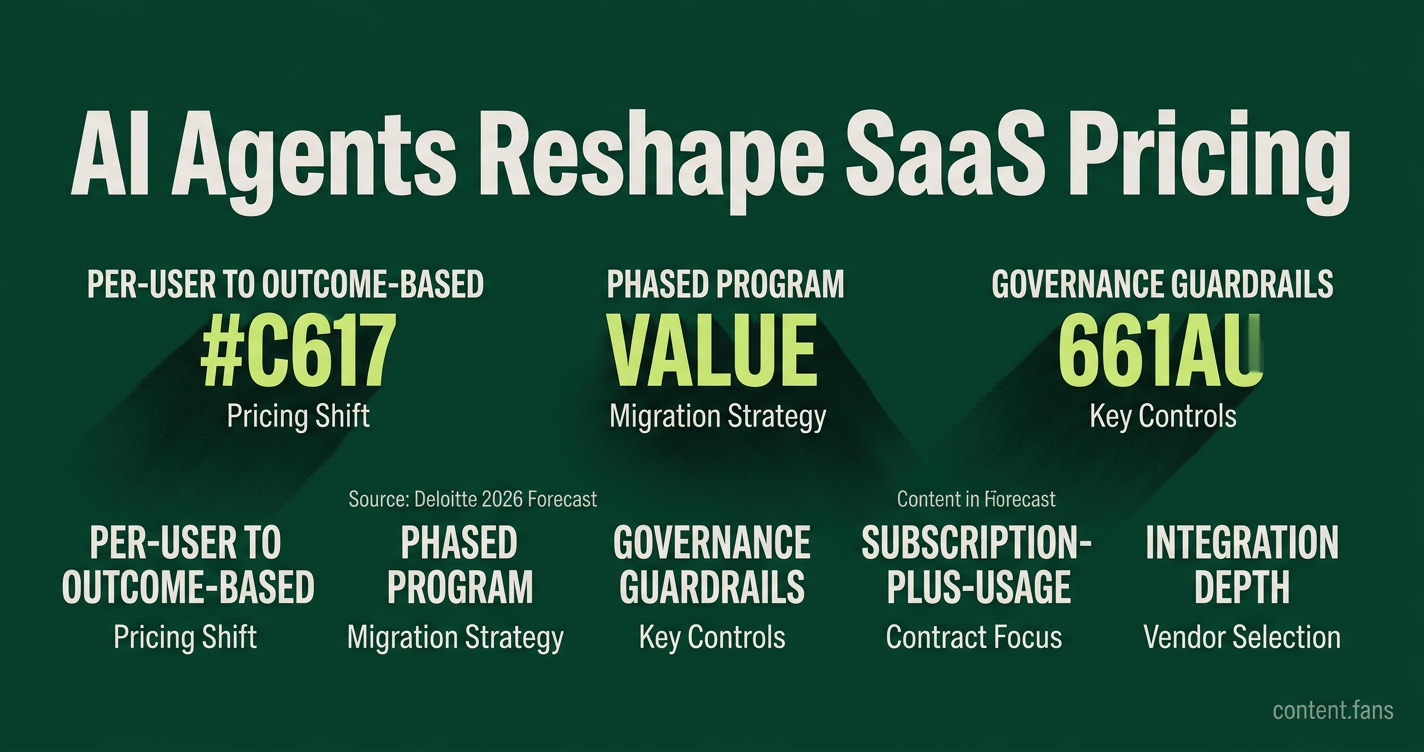
AI agents are shifting SaaS pricing from a per-user, seat-based model to a consumption-based one. Because a single agent can perform the work of multiple employees, value is no longer tied to headcount. This encourages hybrid models that combine a base fee with charges for usage or specific outcomes.
Build controls before you add autonomy
Unchecked AI agents can introduce significant audit and compliance risks. To prevent this, enterprises must establish robust governance guardrails before deploying agents at scale. Key controls include role-based access with clear human escalation paths, immutable logs of all agent actions, and strict data handling policies aligned with standards like SOC 2 or ISO 27001. According to industry reports, these controls are best managed through a central "control tower" to monitor agent performance, cost, and compliance, creating a scalable governance framework.
Align commercial terms with usage realities
As licensing shifts toward hybrid models, procurement teams must renegotiate contracts to reflect new usage realities. Deloitte confirms a rise in subscription-plus-usage pricing, so total cost of ownership (TCO) models must now account for platform fees, compute/token consumption, and change management. During vendor negotiations, clarify critical terms:
1. How is an "AI seat" defined versus a human one?
2. What thresholds trigger variable fees, and can they be capped?
3. Can unused human licenses be converted to agent capacity?
Evaluate platforms through a workflow lens
When selecting a vendor, prioritize platforms that align with your core operational needs. While many criteria exist, research shows three factors are critical for a successful migration:
* Integration Depth: The platform must have proven, bi-directional connectors for your key ERP, CRM, and ITSM systems.
* Reliability & Exception Handling: It must maintain state during long-running processes and recover gracefully from errors.
* Portability & Lock-In Risk: The vendor must offer clear terms on data residency, model controls, and exit clauses to prevent dependency.
Sequence rollouts to preserve momentum
A successful enterprise-wide rollout depends on a measured, sequential cadence built on proven success. Before expanding beyond the initial pilot, ensure you have achieved a stable error rate under production load, obtained documented security sign-off, and demonstrated clear ROI against baseline costs. This disciplined approach validates that the workflow-execution platform can handle scaled demand without compromising control, building momentum for retiring legacy seats and fully realizing cost savings.
1. Why are 2026 forecasts saying AI agents will transform traditional seat-based pricing?
Deloitte says AI agents may make seat-based pricing less adequate because one user can have the power of many users and agent actions create value in different ways, but it frames this as a likely market transition rather than an explicitly 'inevitable' shift. Because one AI agent can now execute the work of several human users across multi-system workflows, vendors are finding it harder to justify charging per human seat. Industry reports suggest we will see hybrid licensing (base subscription + usage & outcome fees) become increasingly common, with pure seat-based contracts facing pressure. Early adopters already report significant seat-compression rates in IT service-desk pilots where agents resolve tickets end-to-end, cutting both license counts and support labor costs.
2. Which enterprise workflows are safest to pilot first?
Procurement and IT leaders are converging on low-risk, high-repeatability use cases that live in contained domains. Current best-practice lists look like this (in order of fastest payback):
1. Internal IT service requests
2. Procurement approvals and vendor onboarding
3. CRM lead-to-quote hand-offs
4. HR employee life-cycle tasks
Each pilot is scoped to a limited number of upstream systems and targets a measurable ROI metric (e.g., mean time-to-resolution or cost-per-task) before any scale-up funding is released.
3. What governance guardrails must be in place before going live?
The most common post-pilot failure point is lack of auditability. Leading organizations now mandate three non-negotiable controls upfront:
- Every autonomous action is logged with full traceability
- Human-in-the-loop thresholds are defined contractually (e.g., any expense above certain amounts or customer sentiment below acceptable levels)
- Role-based access and policy guardrails are deployed through a central control tower before agents touch production data
Vendors that cannot surface these artifacts within reasonable timeframes are being disqualified early in the RFP stage.
4. How long and how much should enterprises budget for a typical pilot?
According to industry reports, integration with legacy SAP or Oracle systems can take several months; smaller SaaS-only stacks can be live much faster. Budget frameworks used by Fortune-500 procurement teams include:
- Integration & config: significant portion of total pilot budget
- Governance tooling & security validation: substantial allocation
- Change management & training: important budget component
- Performance monitoring & observability: dedicated line item
Industry analysts warn that token-cost overruns can significantly exceed original estimates once agents start reasoning across multi-turn tasks, so most enterprises now model GPU/compute as a separate line item.
5. What should be on the 2026 vendor-evaluation scorecard?
Enterprise teams are evaluating platforms on multiple weighted criteria according to leading analyst reports:
| Criterion | Importance | Red-flag threshold |
|---|---|---|
| Workflow fit & complexity handling | High | Cannot demo the exact process end-to-end |
| Multi-agent orchestration depth | High | No support for sequential & conditional branching |
| Native integration library & API coverage | High | Limited coverage of your critical systems |
| Governance, audit logs, policy controls | High | Cannot export immutable decision logs |
| Security & compliance certifications | High | Missing SOC 2 Type II or ISO 42001 |
| Runtime reliability & exception recovery | Medium | Cannot resume long-running workflows after failure |
| Scalability & deployment flexibility | Medium | Single-tenant only or hidden egress fees |
| ROI evidence & customer references | Medium | No reference achieving meaningful cost reduction |
| Vendor lock-in / portability risk | Medium | Proprietary scripting language or data egress fees |
Teams evaluate each criterion carefully; any vendor with significant weaknesses in governance, integration, or security is typically excluded before pricing discussions begin.