
Dell expands AI Factory client base by 1,000, now serves 5,000 enterprises
Serge Bulaev
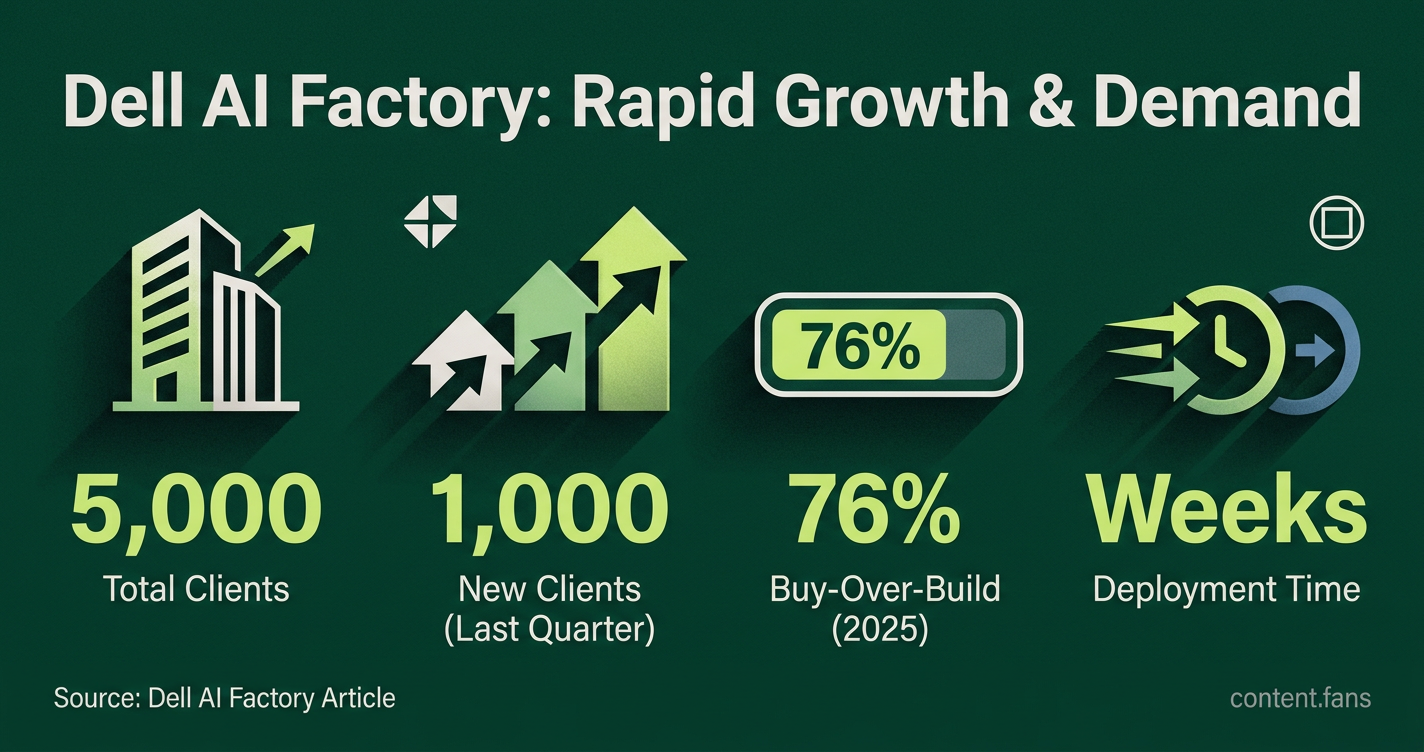
Dell now serves 5,000 enterprise clients for its AI Factory product, adding 1,000 new clients in the last quarter. This growth may be driven by more companies wanting to buy ready-made AI systems instead of building their own, a need for local control of data, and a wish to lower integration costs by using unified platforms. Dell ranks second in the 2026 ABI Research comparison of AI server companies, just behind Supermicro, suggesting a competitive but unsettled market. Buyers say they want better governance, faster delivery, more flexibility, and easier ways to connect business goals to AI results. Dell's recent growth appears to reflect wider trends in the market, but whether it continues may depend on how fast Dell and others can improve their products.

Dell's AI Factory has rapidly expanded its enterprise client base to 5,000, adding 1,000 new customers in the last quarter alone. This significant growth positions Dell as a leading vendor of integrated AI infrastructure, helping companies transition AI projects from experimental pilots to full-scale production.
The market is shifting toward pre-validated "AI factory" designs that accelerate deployment, strengthen governance, and bridge skills gaps. In this competitive landscape, industry reports suggest Dell ranks among the top AI server OEMs, competing closely with vendors like Supermicro. Competition now centers on delivery speed, thermal management, and ecosystem breadth, not just GPU counts.
Dell reports 5,000 clients for its AI Factory product line, adding 1,000 last quarter - what is driving demand?
The surge in demand for Dell's AI Factory is driven by a market shift toward "buy-over-build" solutions. Enterprises seek to lower integration costs, gain local data control for sovereign AI needs, and use unified platforms that simplify deployment, shortening project timelines from months to weeks.
Market analysis clarifies why Dell's AI Factory client base experienced significant growth in a single quarter. Key trends include:
- A Strong Buy-Over-Build Preference: According to Menlo Ventures, 76 percent of enterprise AI solutions were purchased in 2025, a significant increase from 53 percent in 2024.
- The Rise of "Sovereign AI": Spectro Cloud reports that regulated industries are adopting on-prem or hybrid systems like Dell's to maintain local control over data and models.
- Vendor Consolidation: Buyers are increasingly choosing unified platforms to reduce integration costs, bundling orchestration, monitoring, and security controls, as noted by Synvestable.
Competitive pressure and positioning
Dell competes with AI hardware vendors like Supermicro, HPE, Lenovo, and Cisco, as well as hyperscale cloud providers such as AWS and Microsoft. Dell has positioned itself as a leading rack-scale infrastructure provider, though industry analysis suggests competitive dynamics remain fluid across different performance metrics including delivery speed and cooling technology. The market remains competitive, with no single vendor dominating across all performance areas.
What enterprises say they need next
According to industry reports, enterprises are prioritizing several key features for future AI platforms:
- Integrated Governance: End-to-end governance tools built directly into the platform.
- Advanced Orchestration: Support for agentic AI and complex, multi-step workflows.
- Rapid Deployment: Rack-level delivery cycles measured in weeks instead of months.
- Hardware Flexibility: Support for multi-vendor silicon to prevent vendor lock-in.
- Business-Oriented Metrics: Services that clearly connect AI performance to business KPIs.
Dell's AI Factory, with its Nvidia-based architecture and extensive services, addresses many of these needs. However, industry analysis highlights that competitors like Supermicro lead in certain areas such as fulfillment speed and cooling, suggesting clear opportunities for Dell's future product development.
Ultimately, Dell's addition of 1,000 clients is not an anomaly but a reflection of major enterprise trends: vendor consolidation, data sovereignty, and the push for rapid AI deployment. Its continued growth will depend on its ability to innovate on ease of use, compliance features, and time-to-value in a highly competitive market.