
DeepSeek V4 Price Cuts Pressure OpenAI, Anthropic API Costs in 2026
Serge Bulaev
The rise of open-source AI models like DeepSeek V4 is making companies rethink their AI plans. DeepSeek's low prices and big funding may help it compete with more expensive models like OpenAI and Anthropic, though adoption so far is still small. Some reports suggest that these lower prices are forcing leading labs to consider cutting their own costs. However, there are still questions about data safety, export rules, and how the model is managed. Because of this, many companies might use a mix of open-source and proprietary models, choosing each based on cost, safety, and control needs.

The rapid emergence of powerful open-source alternatives is causing enterprises to fundamentally rethink their AI strategies according to industry reports. DeepSeek V4's aggressive price cuts are putting significant pressure on OpenAI and Anthropic's API costs, establishing the model as a viable, low-cost alternative to premium proprietary services. Backed by a reported seven-billion-dollar funding round, DeepSeek's disruptive pricing is forcing a market-wide response, even with modest early adoption. Analysts predict this trend will place a ceiling on inference pricing for leading AI labs.
Cost Signals Driving the Open-Source Shift
DeepSeek V4's disruptive pricing is compelling established AI leaders to reconsider their pricing models according to industry reports. This pressure from low-cost, open-source alternatives is forcing a potential downward adjustment of API costs for incumbents like OpenAI and Anthropic for common AI tasks.
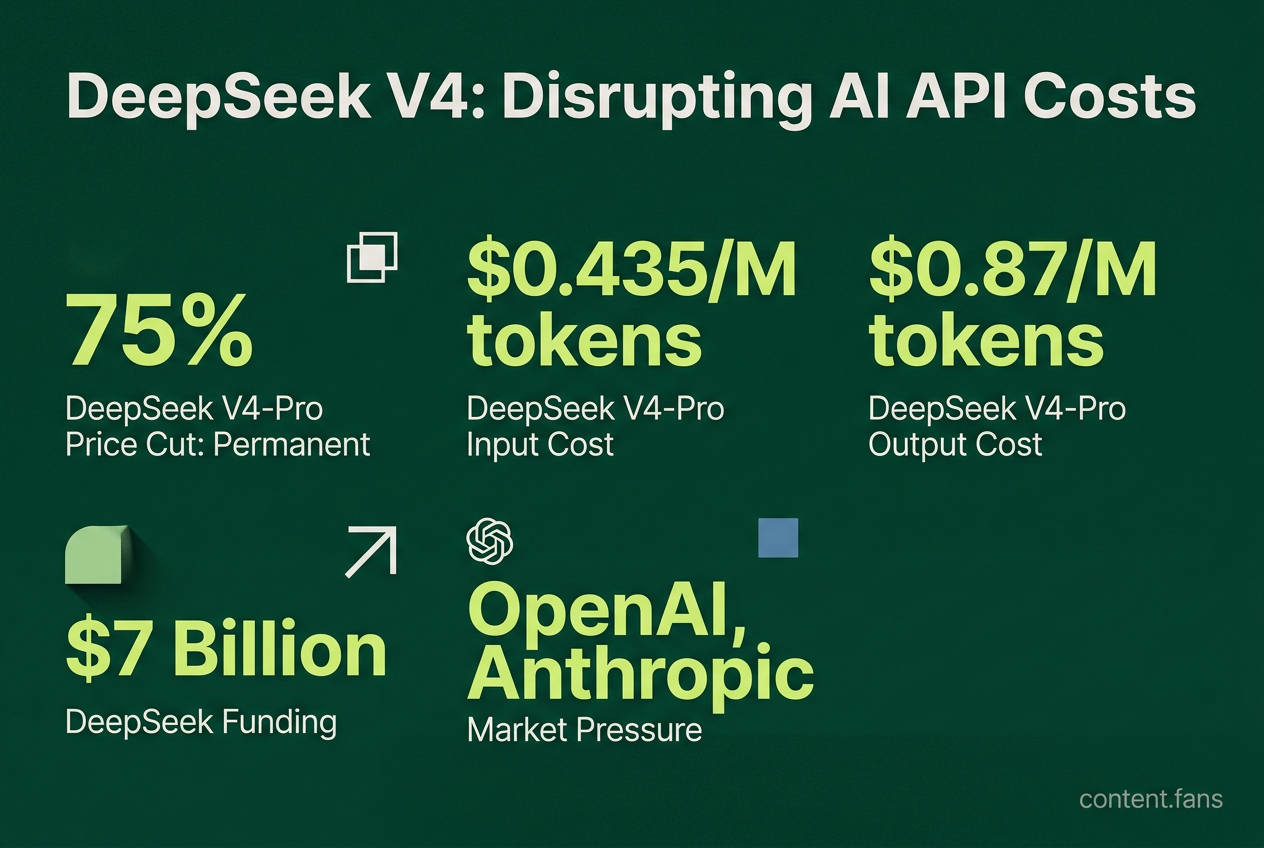
A key catalyst is DeepSeek's permanent 75% price cut. DeepSeek V4-Pro was reported as having a permanent 75% price cut to about $0.435 per million input tokens and $0.87 per million output tokens, as reported by TNW. While enterprise adoption remains limited, projections show growing market share potential. More significantly, DeepSeek is gaining traction in open-weight production workloads, suggesting widespread adoption within private, self-hosted environments according to industry reports.
Major cloud providers are taking notice. Reports suggest Microsoft is exploring integration of DeepSeek V4 into enterprise products as a cheaper alternative to premium models. Industry sources indicate this model would operate within the Azure compliance framework, preventing cross-border data transfers and appealing to security-conscious enterprises (Shelly Palmer; Windows Forum).
Pricing Pressure on Anthropic and OpenAI
The impact on market leaders is already visible, with reports that large buyers shifting to cheaper models are pressuring OpenAI and Anthropic to consider substantial token price cuts (WSJ). In a related move, CNBC notes that Anthropic has shifted from flat-rate subscriptions to metered, usage-based billing - a strategy designed to better correlate revenue with compute expenses. This market shift indicates that the premium for proprietary models is shrinking, especially for routine tasks like text summarization and code generation.
Governance, Safety, and Geopolitical Considerations
Despite the compelling price point, enterprises must weigh several critical concerns before adopting DeepSeek:
- Data Residency: API calls may traverse Chinese networks, raising data sovereignty issues for sensitive information.
- Export Controls: Self-hosting the V4 Pro model requires powerful hardware (multiple H100 GPUs), which could trigger scrutiny under U.S. export control regulations.
- Safety and Alignment: While DeepSeek provides community safety filters, its formal red-teaming has not been verified to match the parity of models from Anthropic or OpenAI.
- Long-Term Governance: The model is well-funded, but its long-term stewardship and governance structure remain unclear.
These risks are driving many organizations toward a hybrid AI strategy. In this model, less sensitive, cost-driven workloads are run on models like DeepSeek V4, while high-stakes tasks are reserved for proven proprietary APIs. Microsoft's multi-model routing capabilities formalize this pattern, allowing administrators to set different models for different task tiers.
What Procurement Teams Are Watching
Financial decision-makers are closely monitoring open-weight models as a benchmark for AI spending according to industry reports. The significant cost differences between open-source and proprietary models are reshaping procurement strategies.
Should DeepSeek achieve broader market adoption, it could effectively establish a new enterprise pricing anchor based on self-hosting costs. Consequently, procurement departments are evolving their evaluation criteria. RFPs are increasingly moving beyond single-vendor evaluations to a more holistic scoring matrix that includes total cost per million tokens, data governance guarantees, and verifiable safety coverage.
How steep are DeepSeek V4 price cuts compared to OpenAI and Anthropic tiers?
Industry reports suggest significant pricing advantages for DeepSeek V4 compared to premium proprietary models, with costs reportedly a fraction of GPT and Claude pricing.
Media reports indicate OpenAI is considering substantial cuts, while Anthropic has moved from flat-rate to per-token billing to remain competitive.
Enterprise buyers now treat the pricing gap as a significant factor, pushing both vendors to segment cheaper model tiers instead of holding premium pricing across the board.
What real-world adoption data exists for DeepSeek V4 inside enterprises?
Current adoption numbers remain limited but show directional growth according to industry surveys. A growing number of organizations are reportedly running some form of DeepSeek on-premise or in private cloud, with increasing usage in open-weight production AI applications.
Limited case studies have emerged, including reports of enterprise teams claiming improved efficiency after implementing DeepSeek V4, though these reports lack independent verification.
How are Microsoft, Google, or other cloud providers reacting to the open-source shift?
Microsoft has publicly opened Azure AI Foundry to DeepSeek models according to industry reports.
DeepSeek Flash is reportedly available as a serverless endpoint with Azure security and compliance controls.
For full data residency, enterprises can potentially self-host DeepSeek models inside their own Azure tenant, avoiding Chinese-jurisdiction routing entirely.
Google and AWS have not yet matched the same level of first-party integration, potentially leaving Azure with an early-mover advantage among Microsoft-centric buyers.
What governance, safety, or geopolitical concerns still slow enterprise sign-off?
Three themes surface in CIO-level discussions:
- Data-residency - Legal teams flag that calls to DeepSeek APIs may pass through Chinese infrastructure; most firms restrict usage to synthetic data or public corpora only.
- Export-control risk - Self-hosting requirements may activate Entity List considerations when deployed on U.S.-controlled GPUs; procurement teams seek written assurances from cloud providers.
- Safety alignment - Anthropic and OpenAI cite post-training safety scores as a differentiator, arguing that open-weight models require additional in-house red-teaming budgets.
Until standardized third-party audits emerge, hybrid strategies (hosted open-source plus private fine-tuning on proprietary data) are becoming the pragmatic compromise.
How should procurement teams model total cost of ownership for a hybrid stack?
A simplified TCO framework includes several key considerations:
- Model cost: open-source tokens at significantly lower rates vs proprietary tokens.
- GPU rental: Hardware requirements vary by model size, with cloud GPU pricing fluctuating based on demand.
- Red-team and governance overhead: Organizations should budget for security engineering resources per active model to cover safety evaluations and policy updates.
Industry reports suggest potential cost savings when switching from flat-rate proprietary APIs to self-hosted alternatives, though actual savings depend on usage patterns and infrastructure efficiency.