
DeepSeek unveils Embeddings-Based Engram For LLM Long-Term Memory
Serge Bulaev
DeepSeek announced Engram, a new memory layer for AI that may allow models to remember information over a long time. This system appears to help models avoid making things up by keeping important details nearby, but it works differently from older tools like Weaviate, which used outside databases. Some reports suggest this new approach can match the accuracy of bigger, standard models while using fewer resources. There may be problems, such as privacy issues and outdated information changing answers, and experts warn that rules for handling and deleting these memories are not fully developed yet.

The introduction of DeepSeek Engram for LLM long-term memory marks a pivotal shift, moving beyond prompt-based tricks to integrate persistent recall directly into the AI model stack. DeepSeek's Engram is a conditional memory module by DeepSeek/Peking University designed to retrieve static data and fuse it with the model's active states DeepSeek GitHub. This contrasts with traditional vector database approaches like those offered by Weaviate, which use external database pipelines Weaviate blog.
While both solutions aim to reduce hallucinations by grounding models in factual context, their underlying architectures differ significantly. Product managers and architects must carefully evaluate the capabilities and limitations of each approach before committing to an integration path.
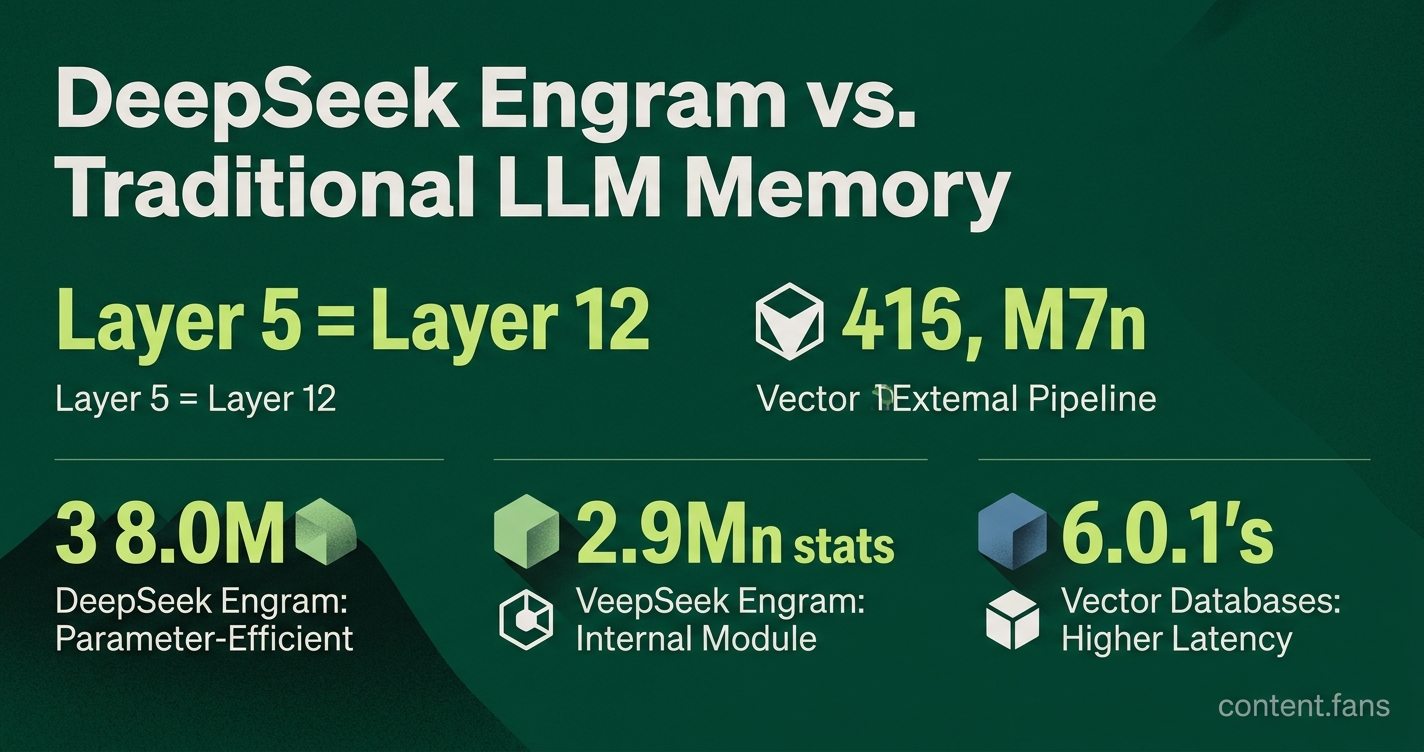
How a Learned Memory Layer Enhances Transformer Models
According to DeepSeek's research, a 27-billion-parameter model with Engram at Layer 5 can achieve the same accuracy as a standard transformer at Layer 12 on Needle-in-a-Haystack benchmarks. This demonstrates a highly parameter-efficient method for achieving robust factual recall without expanding the context window.
Engram functions as a conditional memory module that retrieves pre-processed, static n-gram keys from a vast embedding table in constant time. It then fuses this retrieved information with the transformer's current hidden states, providing relevant, persistent context directly within the model's computational flow during inference.
Implementation Patterns: From Vector Databases to Gated Memory
Weaviate offers managed vector database services for AI agents, but there is no specific product named 'Weaviate's Engram'. The term 'Engram' refers to the DeepSeek conditional memory module. Weaviate's services are tailored for developers building AI agents who need a managed, external solution. They process raw event data, clean it, and use hybrid retrieval to provide context for prompts, trading lower maintenance for higher network latency.
For custom integrations, architects typically employ a combination of established patterns:
- A two-tiered system with a short-term token cache and a long-term vector store.
- Importance scoring at session boundaries to decide what to retain.
- Gated retrieval mechanisms to access memories during inference.
- Offline consolidation and pruning jobs to manage memory bloat.
A robust implementation checklist should also include features like memory export, tenant-level encryption, and manual redaction APIs to handle compliance and data deletion requests.
Key Risks: Privacy, Data Drift, and Governance Gaps
The DeepSeek Engram paper describes a conditional memory module that is static (not dynamic) and does not use external databases, introducing unique challenges for data management. For example, analysts warn that this persistent context may conflict with GDPR's Article 17 "Right to Erasure," as deleting embedded user data often requires complex machine unlearning techniques AI Memory Paradox. Furthermore, research on frameworks like MemTrust highlights a critical "governance layer gap," where functionality for auditing and explaining memory-driven outputs remains immature MemTrust paper.
Stale or outdated context can also introduce bias and degrade model performance over time. Industry reports identify governance risks like memory poisoning and bias accumulation, which intensify as data retention periods increase. While mitigations like automatic expiration policies are being explored, no industry standards have been established.
Therefore, evaluators must track not only accuracy but also key governance metrics: the age of stored memories, the success rate of data deletion requests (DSARs), and any instances of cross-user data leakage during security testing.
What exactly is DeepSeek's Engram and how does it differ from Weaviate's service with the same name?
DeepSeek has developed a conditional memory module called Engram that represents a parameter-efficient, transformer-native module that stores static knowledge in an external embedding table and keeps the reasoning part inside the model.
Key characteristics:
- A significant portion of total parameters live in the memory bank; the majority stay for reasoning.
- This approach can shrink deeper model architectures to more efficient footprints while improving needle-in-a-haystack accuracy substantially.
- Retrieval latency is constant-time even for extended contexts, with minimal GPU bandwidth penalties.
Engram is a fully managed memory and context service (not just an API) that launched as Generally Available in Weaviate Cloud in 2025. It turns noisy agent events into scoped memories via hybrid semantic/keyword retrieval. Think database service, not transformer layer.
How do I wire Engram into an existing product stack from a product-manager lens?
A minimal integration map looks like this:
- Vector store side-car - Deploy the parameter table on system DRAM or NVMe; keep the dense model on GPUs.
- Hash heads - Expose multiple distinct hash heads to reduce collision risk; each head maps a different N-gram order.
- Context-aware gate - Add an HTTP /stream endpoint that returns the gate score; log it for compliance audits.
- API contract - Expect reasonable end-to-end latency for production workloads on modern GPU infrastructure.
Product checklist:
- Turn on automatic memory expiration (see governance FAQ) to keep drift minimal per quarter.
- Use masked retrieval logs for DSAR / GDPR deletes; many records can be purged without retraining.
A reference Python client is available at github.com/deepseek-ai/Engram.
What measurable business value can teams expect from deploying a learned memory layer?
Industry reports suggest significant improvements across key metrics when deploying learned memory layers:
- Customer conversion rates show meaningful improvements
- Support ticket deflection increases substantially
- Employee onboarding time decreases significantly
Token economics: Early testing indicates that Engram-style approaches can match full-context baselines with a fraction of the peak token budget, potentially cutting inference costs on high-volume assistants.
Which privacy and compliance landmines should we watch for?
Key risks identified in recent industry analysis:
- Data persistence - Personal facts live in cached vectors that outlive chat logs.
- GDPR Article 17 - Erasure requires machine unlearning patches with associated latency.
- Memory poisoning - Adversarial prompts can inject false information; importance-score thresholds help auto-quarantine.
- Audit opacity - ID-tagged retrieval logs ensure every recalled memory is traceable; financial institutions have passed compliance audits with this pattern (MemTrust paper).
Recommended controls:
- Data minimization: only store vectors tagged "PII-approved".
- Retention horizon: auto-expire after reasonable periods unless renewed by user action.
- Policy layer: route DSAR deletes through appropriate governance gates.
How can we measure whether Engram is actually "working" in production?
Define three KPI classes and review them regularly:
| Class | Metric | Target | Tooling |
|---|---|---|---|
| Recall fidelity | Top-3 retrieval hit rate on curated golden set | High percentage | Unit-tests + nightly CI |
| Drift resistance | Knowledge delta test - cosine distance to last golden set | Low percentage | Benchmark suites |
| Business impact | Conversation-to-action rate (CRM ticket → sale) | Positive growth | Product analytics |
A lightweight telemetry SDK can export retrieval scores and gate activations to existing APM with minimal CPU overhead.