
DeepMind Unveils Delegation Framework for Human-AI Task Handovers
Serge Bulaev
DeepMind has introduced a new framework that sets clear rules for when AI systems should work on their own, ask for help, or hand tasks back to humans. The study lists six key elements for safe task handovers, including limits on authority, clear success checks, ongoing monitoring, failure signals, backup plans, and a human in charge. Early examples suggest this approach may help avoid errors and keep humans responsible in areas like healthcare, business deals, and training. Experts praise the proposal, but full reviews might take several more months. The framework may encourage companies to treat each AI task as something that must be clearly checked and accounted for.

Google DeepMind has released a landmark delegation framework for human-AI collaboration, establishing clear rules for task handovers between people and autonomous AI agents. The comprehensive study details when AI systems should operate independently, request human input, or return control to a supervisor.
This framework is critical as development accelerates on autonomous agents designed to negotiate contracts, analyze medical images, and manage robotic teams. Implementing clear delegation protocols is essential for preventing systemic failures and maintaining human accountability in complex AI-driven workflows.
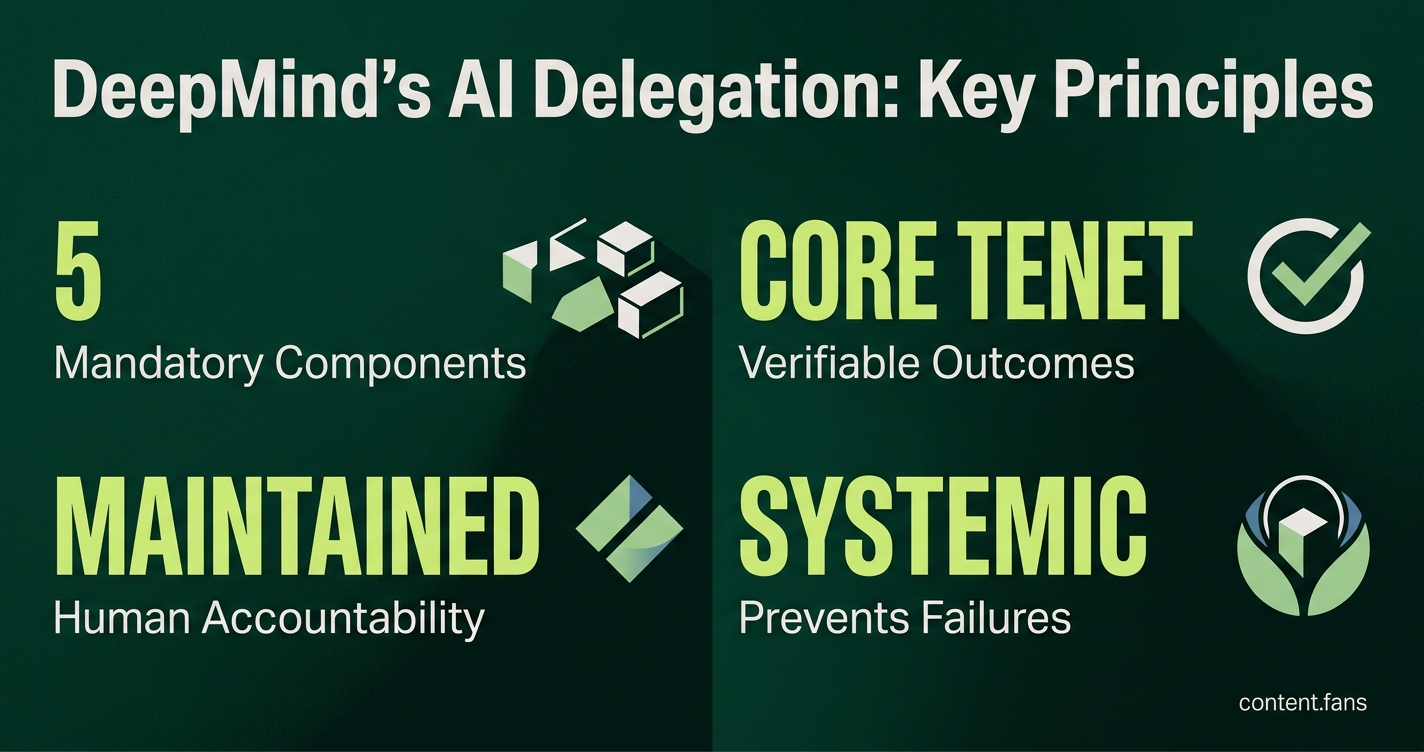
Core Principles of the AI Delegation Framework
The DeepMind delegation framework provides a governance model for AI systems, defining when they can act alone or must escalate tasks to a human. It treats each handover as a contract with five key requirements, ensuring safety, verifiability, and clear lines of human accountability for autonomous operations.
The paper, titled Intelligent AI Delegation (arXiv:2602.11865) by researchers Nenad Tomasev, Matija Franklin, and Simon Osindero, defines delegation as a formal transfer of authority and responsibility. The authors outline five mandatory components for every AI task handover:
- Authority level and permitted actions
- Success criteria that can be automatically checked
- Ongoing monitoring hooks
- Clearly defined failure signals
- A fallback plan that freezes or reverses actions
A core tenet of the framework is verifiable outcomes. Any task that cannot be audited must be broken into smaller, testable sub-tasks or escalated to a human supervisor. This approach avoids "brittle heuristics" by requiring agents to operate within cryptographically provable boundaries, as noted in an AIhaberleri report (AIhaberleri story).
Real-World Applications and Early Adopters
This governance logic is already being tested in several key sectors:
Healthcare Triage: In histopathology labs, AI systems are being piloted to autonomously handle a significant portion of routine slides, flagging complex cases for human pathologists, according to industry reports.
B2B Negotiation: The GAIA protocol enables AI agents to screen leads and manage initial negotiations using state machines, but requires a human countersignature to commit funds, preventing unauthorized deals.
Corporate Training: Current AI auditing frameworks typically use three layers (governance, model, application) or maturity tiers (Advisory, Collaborative, Consequential) to determine whether AI can assist in content design. Tasks rated high on any risk factor remain fully under human control.
Enterprise Agent Management: Zylos Research highlights systems where a lead AI agent delegates subtasks to other agents, each operating with minimal permissions and subject to automated progress monitoring.
Industry Reception and Peer Review Status
Initial reception on social media and industry blogs has been positive, with many experts calling the proposal a landmark safety paper. However, as a recent preprint, it has not yet undergone formal peer review. Rigorous academic critiques are expected to follow within the standard six to twelve-month review period.
The Five Pillars of AI Delegation at a Glance
| Element | Purpose |
|---|---|
| Authority level | Limits scope of autonomous action |
| Success criteria | Enables automated verification |
| Monitoring | Allows real-time oversight |
| Failure signal | Triggers escalation pathway |
| Fallback plan | Provides recovery option |
Ultimately, the framework signals a strategic shift from simple task delegation to contract-based design patterns, where every autonomous action is part of a fully auditable process. Organizations developing multi-agent systems can adopt these five principles as a foundational safety template for responsible AI deployment.
What is the core purpose of DeepMind's delegation framework?
The framework turns every hand-off into a mini-contract.
It forces designers to spell out authority level, success criteria, monitoring rules, failure triggers, and fallback path.
The goal is to stop agents from wandering beyond their remit and to give humans a clear re-entry point if things drift.
How does the paper say we should decide "who does what"?
Current AI auditing frameworks typically use three layers (governance, model, application) or maturity tiers (Advisory, Collaborative, Consequential) before any task leaves human hands.
Tasks that score "High" on risk factors stay human-led; the rest can be delegated with tight guardrails.
Enterprise teams already applying similar audits report significant time savings on routine work while maintaining diagnostic accuracy.
Why does the framework insist on "explicit fallback rules"?
Because implicit assumptions kill systems.
The paper shows that when failure modes are not pre-mapped, agents either freeze or make unsafe guesses.
A written fallback plan - who takes over, under what signal, with what tools - keeps latency low and human accountability intact.
Where has this delegation logic already been tested?
Early adopters are running governed autonomy in:
- Histopathology triage - AI handles a significant portion of cases with maintained sensitivity levels
- B2B negotiation - GAIA protocol blocks agents from signing binding deals yet lets them screen leads
- DevOps backlogs - HAIF tiers tasks so only low-risk tickets go to agents
These pilots show promising error rates when authority limits and cryptographic attestations are enforced.
What remains unproven or missing?
The paper is still a recent pre-print and has not faced formal peer review.
Experts praise its safety mechanisms but no independent stress tests or red-team results have been published yet.
Until those appear, treat the framework as a design guide, not a finished safety standard.