
Anthropic pricing changes reshapes AI budget, raises costs 10-30%
Serge Bulaev
Anthropic changed its pricing in April 2026, moving from flat-rate plans to a per-seat fee and metered billing, which may raise costs for most customers by 10-30%. This has made AI budgets less predictable and forces companies to treat costs as ongoing expenses instead of fixed subscriptions. Open-source AI models with lower prices are becoming more popular, and many firms might run at least one of these models internally by 2026. Teams are also changing their cost management and contract strategies to handle new, uncertain pricing and usage patterns.

Recent Anthropic pricing changes are reshaping enterprise AI budgets, as a shift to metered billing is poised to increase costs substantially. In April 2026, Anthropic moved from flat-rate plans to a model combining a per-seat access fee with full API-rate metered billing, according to analysis from NPI Financial. This mirrors a broader industry trend toward variable AI pricing, forcing companies to manage large language model (LLM) spending as a fluctuating operational expense rather than a fixed subscription.
Metered billing amplifies cost swings
Anthropic's new metered billing model makes AI costs unpredictable by replacing fixed subscriptions with variable, usage-based fees. Expenses now fluctuate with token counts, feature usage, and context window size, compelling finance teams to demand strict ROI calculations and slowing the pace of experimental AI projects.
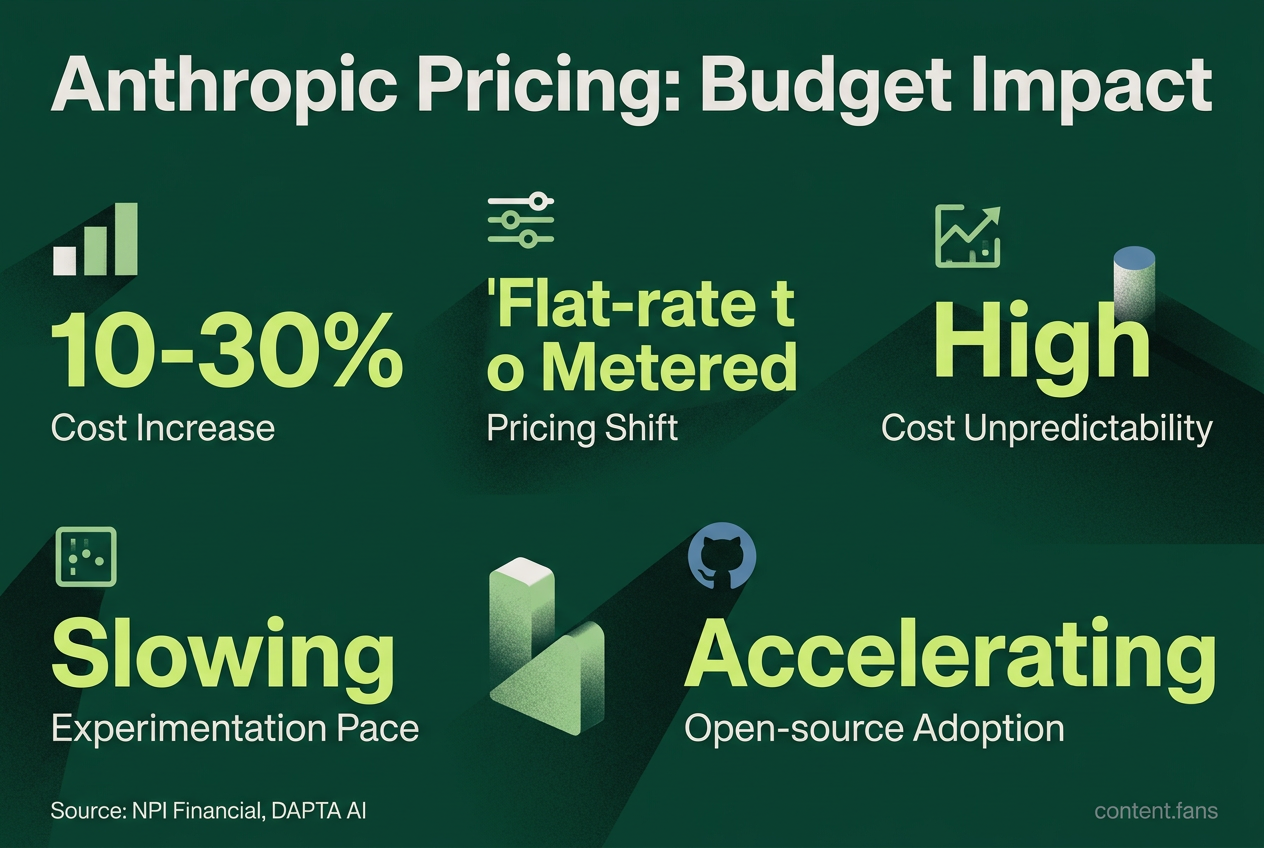
Under the new model, the elimination of historical API discounts and restrictions on using flat-rate tokens for third-party agent frameworks amplify the financial impact. Developers using certain frameworks reportedly saw significant cost increases once usage shifted to on-demand billing, a figure echoed in an analysis by DAPTA AI. Mid-market teams now face two budgeting hurdles:
- Unpredictable token totals tied to prompt length, context window, and premium features.
- Mandatory upfront consumption commitments that create downside risk if pilot traffic plateaus.
As a result, experimentation is slowing as finance groups demand per-feature ROI calculations before deployment.
FinOps playbook: routing, caps, hybrid stacks
To combat these unpredictable expenses, cost management is evolving from simple license counting to sophisticated FinOps strategies with continuous engineering controls. Best-practice guidance published by Redis Labs researchers outlines a three-stage routing pattern:
- Rule-based routing for obvious low-complexity tasks.
- Semantic routing once keyword rules miss intent.
- Predictive routing only after stable usage data exists.
Enterprises using this tiered approach have reported significant cost reductions while maintaining quality. Additional levers include usage caps at the gateway layer, conservative over-commitment limits, and semantic caches that eliminate duplicate calls.
Open models enter the mix
The high cost of proprietary models is accelerating enterprise adoption of open-source alternatives. Open-source models advertise substantially lower token prices, making them strategic tools for cost control. Industry reports suggest that a growing number of firms will run at least one open-weight LLM internally by 2026, driven by both cost savings and data-sovereignty concerns. With self-hosting becoming economical for high-volume usage, hybrid stacks now divert a significant portion of traffic to these budget-friendly models, reserving premium APIs for the most complex reasoning tasks.
Procurement language is evolving
Procurement and legal teams are adapting contracts to mitigate financial risk. New clauses now cap vendor price increases, mandate 30-day notice for changes to metering rules, and require cost-tracking APIs. Finance departments are replacing all-you-can-eat plans with utility-style forecasting, using Monte Carlo simulations to model token demand. Meanwhile, governance committees use detailed dashboards to track cost drivers like latency multipliers and feature add-ons, empowering product managers to make informed decisions about when to use premium modes.
Key takeaways for 2026 budgets
- Treat LLM spend as a variable operational expense (OPEX) and re-forecast quarterly.
- Benchmark all major task categories against at least one open-source model.
- Implement intelligent routing layers to escalate to premium models only when necessary.
- Negotiate provider commitments that align with realistic consumption forecasts, not aspirational ones.
How does the shift to metered billing affect enterprise AI budgeting?
Anthropic's move from flat-rate subscriptions to a $20/seat base fee plus full API-rate metered billing has fundamentally disrupted how enterprises plan AI investments. Most organizations face a 15 - 30% increase in TCO (approximately 67% of customers), with costs potentially doubling or tripling for heavy usage when using third-party agent frameworks [1][2][5].
The core challenge is unpredictability. Under the old model, finance teams could treat AI as a fixed subscription cost. Now, expenses fluctuate based on prompt length, context window size, feature usage, and latency modes. This variability forces per-feature ROI calculations before any integration, concentrating AI development in teams with mature usage data while pricing out exploratory teams [7][8]. For mid-market organizations without strict compliance mandates, the unpredictable TCO has become a primary barrier to adoption [5].
What specific pricing changes are driving these cost increases?
Several structural changes compound the financial impact:
- Lost API discounts: Anthropic eliminated the 10 - 15% API discounts, adding to per-token costs [1][5]
- Mandatory upfront commitments: Organizations must now commit to consumption levels in advance, creating downside risk if usage drops - with no volume discounts for higher commitments [1]
- Third-party framework restrictions: Generic third-party harnesses and agent frameworks can no longer use flat-rate plans, forcing developers onto direct API billing [2][4]
- No flexibility to adapt: Real usage patterns cannot easily adjust spend, particularly painful for teams with variable adoption rates [1]
| Cost Component | Old Model | New Model | Impact |
|---|---|---|---|
| Seat fee | $40 - $200 (tokens bundled) | $20 (access only) | Lower line-item, no consumption headroom |
| Token pricing | API rate with discounts | Full API rate | Higher per-token costs |
| Billing | Flat monthly with allowance | Usage-based metered | Variable costs replace predictable budgeting |
| Agent frameworks | Flat-rate compatible | Blocked | Significant cost increase for autonomous workflows |
How are enterprises technically controlling AI costs?
Organizations are implementing tiered intelligence architectures that deliver substantial cost reductions while maintaining quality [3][5][6]. The most effective approach follows three principles:
1. Route to the cheapest capable model
- Start with rule-based routing by task type (classification, extraction, formatting)
- Escalate to premium models only when necessary
- Directing a majority of traffic to small models achieves significant cost-per-query reductions [3]
2. Implement semantic caching
- Place cache before the router to bypass LLM calls entirely when queries match
- Eliminates both routing overhead and model invocation for repeated patterns [2]
3. Reserve premium models strategically
- Tier 1 (Fast): Classification, extraction, simple replies
- Tier 2 (Reasoning): Planning, tool orchestration, ambiguous cases
- Tier 3 (Premium): Only for final deliverables and high-stakes outputs [4]
Re-benchmarking quarterly - and within one week of major model releases - prevents quality regressions from routing decisions [7].
What role are open-source models playing in cost management?
Open-source alternatives have shifted from experimental to strategic cost-control instruments in 2026. While cost gaps between open and premium models are large (up to 100× per [6]), leading open models now match or exceed proprietary benchmarks at substantially lower costs:
| Model Type | Cost Advantage | Best For |
|---|---|---|
| Open LLMs | Significantly lower costs | General tasks, coding, multilingual |
| Reasoning Models | Major cost savings | Reasoning, math, complex analysis |
| Multimodal | Fully open alternatives | EU data residency, multimodal |
| Code Models | Substantial savings | Software engineering tasks |
A significant portion of enterprise accounts now use hybrid routing to low-cost open models for high-volume workloads, with self-hosting becoming economical for high-volume usage [3][6]. Beyond cost, open models enable air-gapped deployments where data never leaves internal infrastructure - critical for regulated industries - and eliminate risks of proprietary data being used to train external models [6][9].
Industry reports suggest that a growing number of businesses will adopt open-source LLMs for at least one application by 2026, up from negligible adoption two years prior [7].
What governance and procurement adaptations are necessary?
The financial unpredictability of agent-based AI demands cross-functional FinOps discipline:
Budgeting models
- Track latency multipliers (Fast mode), long-context pricing (>200K tokens), data residency premiums, and tool-specific charges (web search, code execution) [3]
- Model monthly token consumption before committing; avoid over-committing due to no volume discounts at higher tiers [1][5]
Procurement clauses
- Include usage caps and rate limit protections in vendor contracts
- Negotiate fallback provisions for third-party framework access
- Build in transition credits (currently limited to one month's subscription at Anthropic) [2][4]
Governance structures
- Establish cross-functional AI committees with finance, legal, and engineering representation
- Implement approval flows for new agent deployments
- Deploy monitoring dashboards tracking cost-per-success and tier escalation rates [4]
The fundamental shift is treating AI as a variable-cost utility rather than fixed subscription software - requiring the same rigor applied to cloud infrastructure spending [6][8].