
AI Unbundles SaaS: SMBs Cut Costs, Build Custom Apps in Days
Serge Bulaev
AI may be changing how small businesses use software. Many small firms are now building their own custom tools in just days, which might help them avoid expensive software contracts. Some analysts suggest spending is shifting from big, generic software platforms to more tailored AI solutions. However, there appear to be risks, as about half of AI-generated code may have security problems, and these tools can be hard to set up safely. Experts recommend that companies still plan for security, monitoring, and training when using AI to build software.

The rise of generative AI is fundamentally reshaping the software landscape for small and medium-sized businesses (SMBs). This trend, the AI unbundling of SaaS, allows companies to bypass expensive, monolithic software contracts by building bespoke applications in days. Analysts observe a rapid spending reallocation from generic platforms to tailored AI workflows, a phenomenon dubbed the "Great Unbundling" of business software How LLMs Are Democratizing Software Development and ....
The Market Shift: Sizing the Impact of AI on SaaS
While proof-of-concept generative AI applications can be built in 4-8 weeks, production-ready implementations typically take 8-12 weeks for non-technical staff to develop - still dramatically faster than traditional development cycles that once took many months. This shift is fueled by significant productivity gains from LLMs that industry reports suggest could substantially impact the global software market.
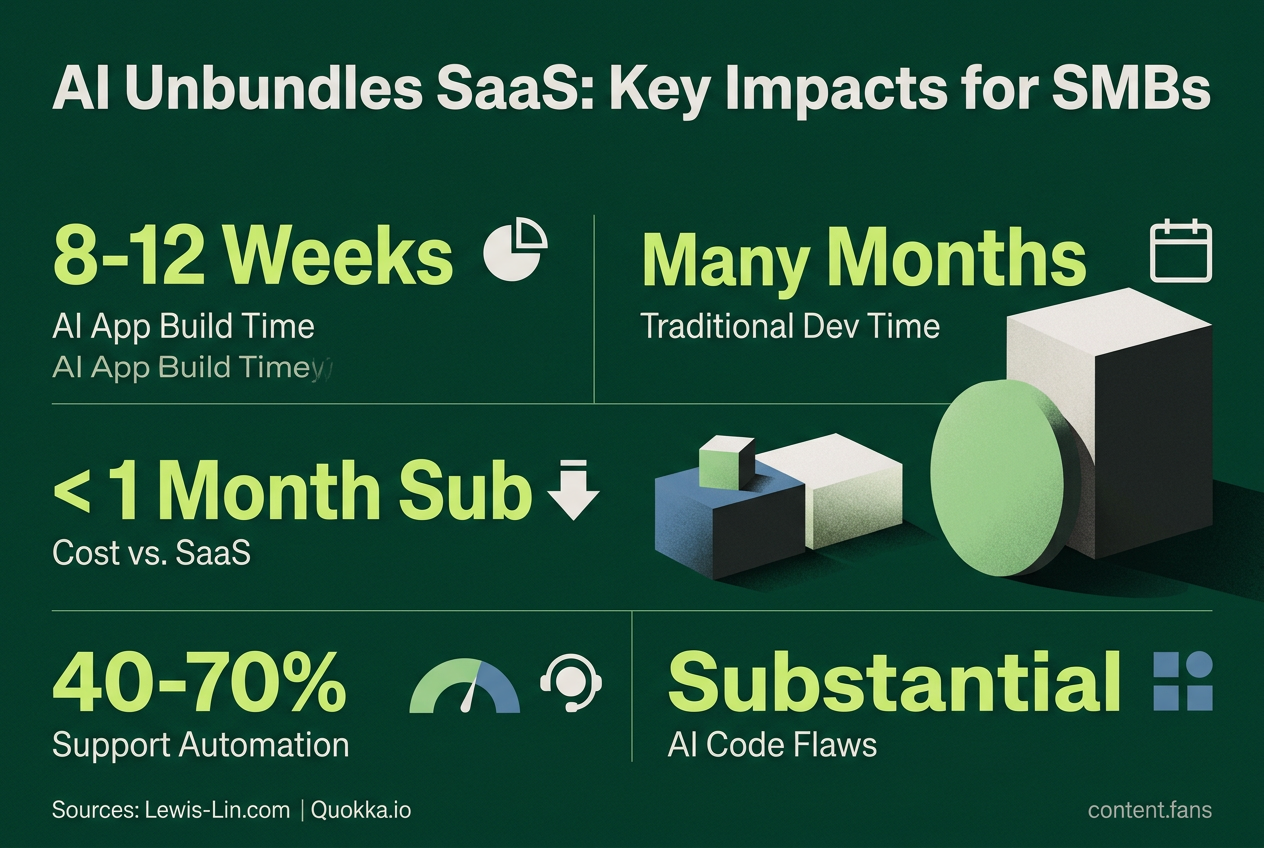
This democratization of development means tools once requiring months of coding can now be prototyped rapidly. For many SMBs, the cost of building with AI is often less than a single monthly software subscription, empowering firms with fewer than 30 employees to achieve perfect-fit automation. A common application includes automating 40-70% of tier-1 support tickets using long-context chat agents, with best-in-class deployments achieving higher rates.
Key Risks and Challenges of Custom AI Development
Despite the speed advantages, building with AI introduces significant risks. Security analysis reveals that a substantial portion of AI-generated code contains exploitable flaws, increasing data exposure risks compared to vetted commercial software The Security Risks of AI-Driven App Development - Quokka.io. Beyond code, integrations are often brittle, and reliability is probabilistic, with issues like hallucinations and model drift requiring continuous monitoring that many SMBs are not equipped for.
A side-by-side comparison illustrates the tradeoffs:
| Dimension | AI-built custom app | Mature SaaS |
|---|---|---|
| Security review cadence | Continuous testing required | Vendor-managed patches |
| Integration effort | Manual wiring of APIs | Pre-built connectors |
| Output determinism | Probabilistic, may drift | Deterministic, versioned |
Therefore, SMBs must budget for MLOps, continuous vulnerability scanning, and robust policy training before replacing established SaaS solutions.
A Survival Playbook for Legacy SaaS Vendors
For incumbent SaaS providers to survive this shift, research points to a four-part strategic playbook that has emerged from recent market analysis SaaSpocalypse Explained: AI Agents & SaaS Market Impact:
- Composable Architecture: Move from monolithic platforms to composable APIs, allowing customers to integrate external AI models without complex migrations.
- Proprietary Data Moats: Fortify and leverage unique, proprietary data sets to create high switching costs that AI models cannot easily replicate.
- Hybrid Pricing Models: Transition from seat-based pricing to hybrid models based on usage and outcomes, which better align with the variable costs of AI.
- First-Party Agent Deployment: Rapidly launch proprietary AI agents with built-in governance, prompt engineering, and cost-management features.
Vendors that successfully implement these strategies can mitigate churn from SMBs seeking hyper-customized solutions. Conversely, those clinging to rigid, all-in-one contracts face the risk of steady erosion as customers unbundle workflows one by one using purpose-built AI.
How quickly can SMBs actually build custom AI applications compared to traditional development?
The speed differential is dramatic. Non-technical users - marketing managers, operations leads, even CMOs - can now build functional clones of tools like Trello or basic CRM systems in 4-8 weeks for proof-of-concept builds or over several weekends using modern AI tools. Production-ready implementations typically require 8-12 weeks. Traditional development cycles for equivalent functionality typically stretched across many months. This democratization of software development eliminates the need for dedicated machine-learning teams or six-figure budgets that previously gated custom solutions.
What makes this shift a genuine threat to established SaaS vendors rather than just hype?
The economics are stark. Deploying frontier AI now costs less than a single software subscription for many use cases, making it accessible to 5-person e-commerce stores and 30-employee logistics firms alike. More critically, industry reports suggest the annual productivity uplift from LLMs represents a significant reallocation of value from subscriptions to custom tooling. SMBs increasingly prioritize speed and cost-saving over feature completeness, accepting narrower but perfectly tailored solutions over bloated platforms.
Which SaaS segments face the most immediate disruption from AI-native replacements?
Market segments with routine, repeatable processes are most vulnerable. Customer support functions see 40-70% automation of tier-1 tickets with realistic net cost reductions of 20-35%. Data analytics workflows where non-technical staff previously required SQL expertise now run on natural language queries. Compliance and document-heavy operations - financial analysts parsing complex reports, legal teams summarizing contracts - face immediate pressure. Any SaaS product serving multiple use cases "reasonably well" rather than excelling at specific workflows risks erosion.
What concrete strategies should legacy SaaS vendors pursue to remain relevant?
Incumbents must execute on four fronts simultaneously. Architecturally: abandon monolithic "walled gardens" for composable APIs and modular AI services that interconnect via microservices. Commercially: shift from seat-based licensing to usage-based pricing and hybrid models - while outcome-based pricing is being experimented with by around 40% of companies, only about 15% have implemented it at scale. Strategically: deepen vertical specialization and protect proprietary data moats that resist workflow replication. Operationally: deploy agentic AI fast to automate key customer workflows before competitors or DIY solutions capture that value.
What risks should SMBs weigh before replacing mature SaaS with custom AI builds?
The security and reliability gaps are substantial. A significant portion of AI-generated code snippets contain exploitable vulnerabilities - weak encryption, improper authentication - because AI lacks inherent security best practices. Custom apps introduce unique attack vectors like prompt injection and model poisoning that traditional security tools miss. Shadow AI risks proliferate as employees feed sensitive data into unapproved tools. Reliability suffers from hallucinations, model drift, and the "black box" problem where decision logic becomes opaque. Integration remains fragile without standardized connectors. For core business functions, traditional SaaS maintains advantages in pre-vetted security, compliance certification inheritance, and deterministic stability that custom builds often cannot match without dedicated security expertise.