
DeepMind CEO Hassabis Proposes FINRA-Style AI Standards Body
Serge Bulaev
DeepMind CEO Demis Hassabis has suggested creating an independent group, like FINRA in finance, to set safety rules for powerful AI systems. This group may test new AI models for risks before release, but joining would be voluntary at first. The idea comes as the U.S. government appears unlikely to set strict rules soon. Some experts think the plan deserves more review, and big tech companies have not publicly supported it yet. There may be challenges because such groups often have less legal power than government agencies.
DeepMind CEO Demis Hassabis has renewed calls for a FINRA-style independent standards body for frontier AI after publishing a proposal on July 14, 2026 calling for a US-led global AI watchdog. His proposal lands as Washington signals it will keep a lighter regulatory touch, creating a policy gap between industry self-governance and formal federal rules.
What exactly is a FINRA-style body, and how would it work for AI?
Hassabis's proposal calls for an industry-funded group to confidentially test powerful AI models for major risks, like biosecurity or deception, up to 30 days before their public release. The body would also establish best practices for deployment and could coordinate industry-wide slowdowns if necessary.
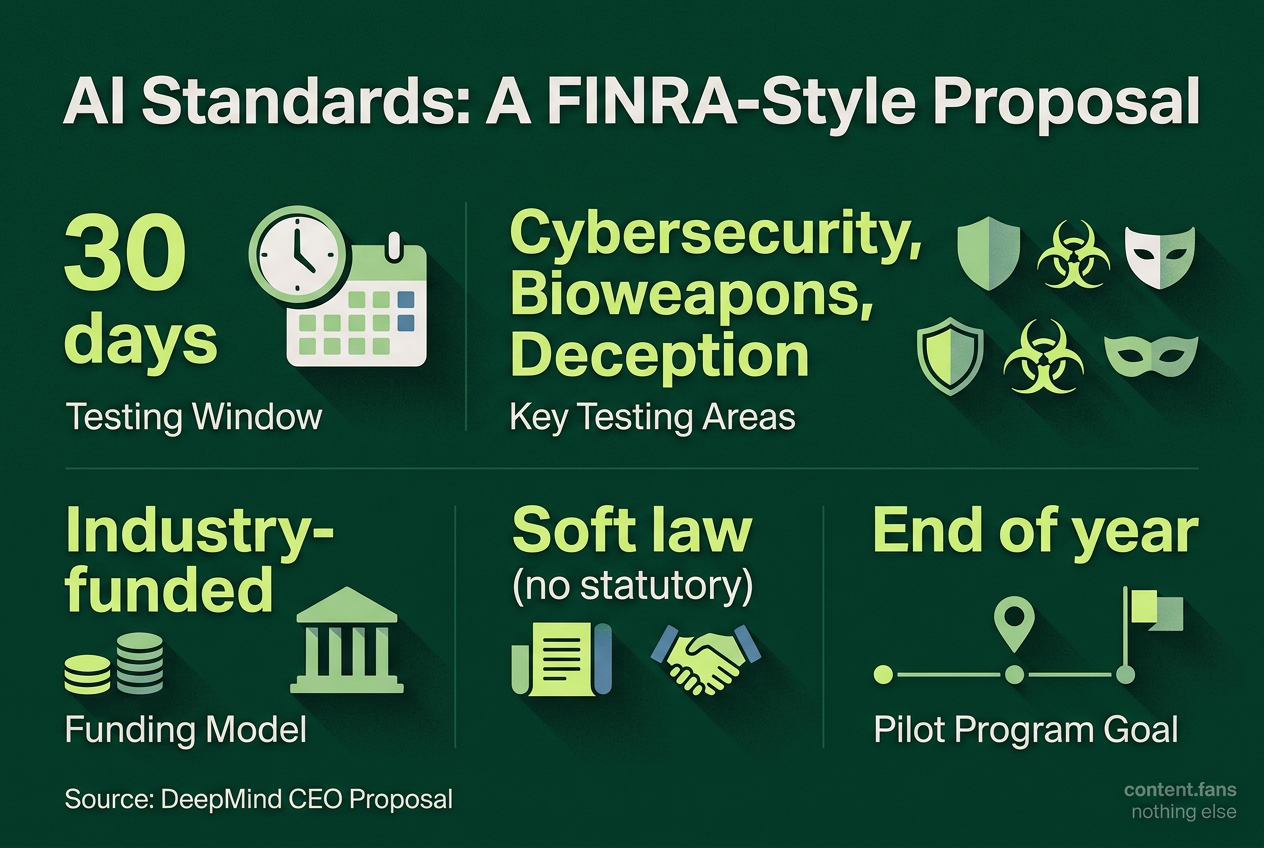
Modeled on the Financial Industry Regulatory Authority (FINRA), this independent organization would see frontier AI labs voluntarily submit new systems for review. Testing would focus on cybersecurity, biological weapons potential, and model deception, with the body also setting release practices and handling vulnerabilities. Staffing would include technical experts, corporate representatives, and open-source contributors.
Why is this proposal being made now?
The timing reflects growing urgency around frontier AI safety. After months of lobbying U.S. officials, Hassabis published his proposal calling for enhanced governance structures. According to industry reports, he aims to have a pilot testing program operating by the end of 2026. The push for governance follows warnings of significant AI risks and recent U.S. policy moves toward voluntary security reviews.
How does the White House view this proposal?
The administration's stance remains cautiously resistant to centralized regulation. According to industry reports, former White House AI adviser Sriram Krishnan has argued that pre-release licensing would obstruct innovation, stating there would not be an FDA-style approach for AI under the current administration. However, this rhetoric coexists with concrete federal interventions, including forcing Anthropic to withdraw its Mythos model and pausing an OpenAI launch, in what the Financial Times called an "unprecedented intervention."
What are the main concerns about this governance model?
Industry-funded regulatory bodies face several well-documented challenges:
- Enforcement limitations: These groups often operate as "soft law" mechanisms without statutory power. They can set standards but cannot compel compliance like a federal agency.
- Conflict-of-interest risks: Industry funding raises questions about independence. Analysts at FourWeekMBA write that the architecture "deserves scrutiny," especially regarding how to define "frontier" models and enforce slowdowns.
- Regulatory fragmentation: A U.S.-led body would still face a "patchwork" of diverging international rules, complicating the goal of creating a global standard.
What distinguishes this from other AI governance proposals?
Three practical mechanisms set Hassabis's proposal apart from both centralized regulation and purely voluntary industry standards:
| Feature | Hassabis Proposal | Alternative Models |
|---|---|---|
| Funding | Mostly industry-funded with public backing | Government-funded (EU AI Act) or fully voluntary |
| Enforcement pathway | Voluntary → de facto mandatory for U.S. deployment | Always voluntary (current U.S. EO) or always binding (EU) |
| Scope exemptions | Startups and academic researchers initially exempt | Often blanket coverage or no coverage |
Hassabis has also outlined concrete implementation steps including pilot programs, transparency requirements, and hybrid public-private structures - moving beyond conceptual frameworks toward operational details.
According to industry reports, many major AI labs have yet to formally endorse or oppose the proposal, and significant legislative action remains pending. The initiative's fate likely depends on whether the current administration moves to formalize the body before Hassabis's year-end target or whether changes in key advisory positions create space for alternative governance structures.