
Report: AI agents shift from prompts to complex workflows by 2026
Serge Bulaev
The AI Agent Trends 2026 report suggests that businesses may soon move beyond simple prompts to using more complex, semi-autonomous agents for multi-step tasks. By 2026, executives believe that managing agent governance, security, and employee skills will become essential. The study finds that most organizations expect to switch from single-task AI pilots to more advanced agent systems next year. However, the report notes that less than 15 percent of pilot projects currently make it to full production, mostly due to missing monitoring and controls. Case studies in the report suggest that when companies focus on orchestration and governance first, they might see quick returns on investment.

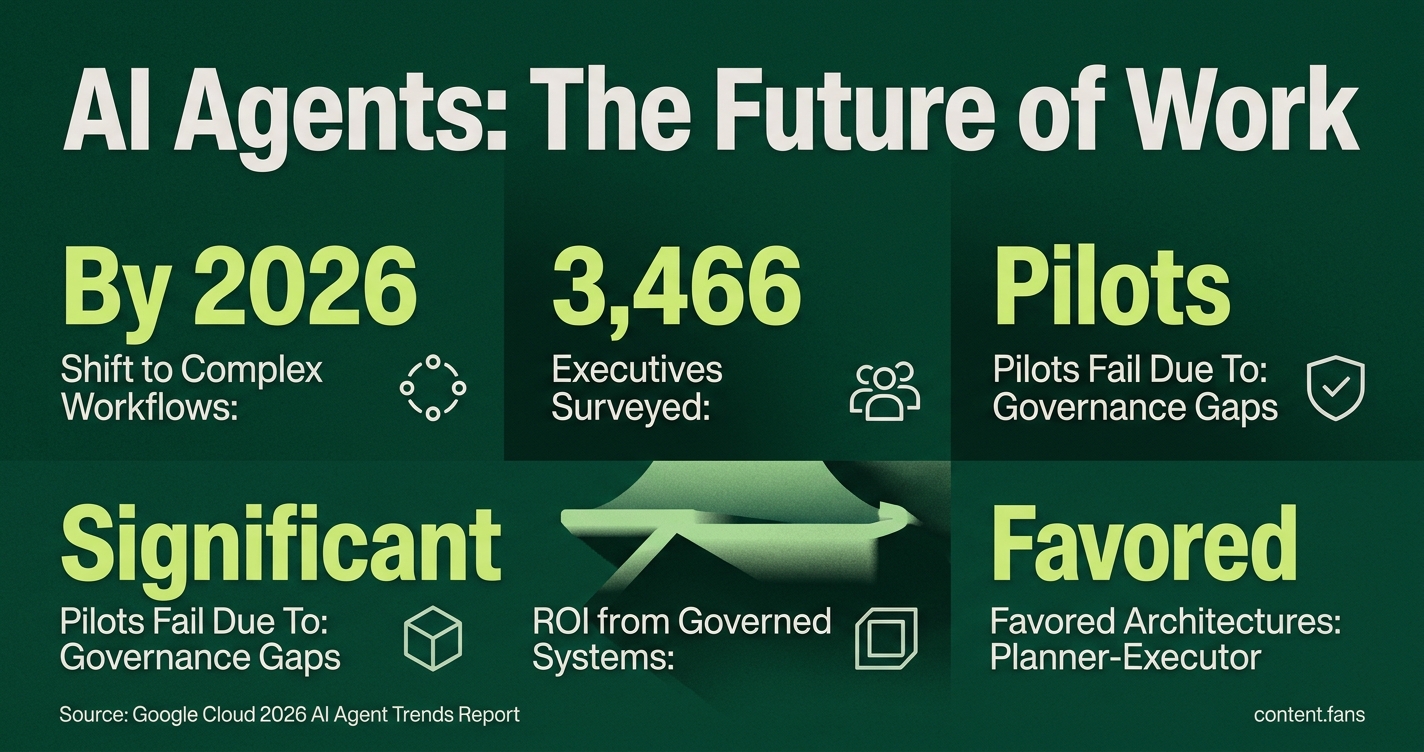
A landmark report on AI agents forecasts a pivotal shift from simple prompts to complex workflows by 2026, signaling the end of the single-task AI era. The study, based on a global survey of 3,466 executives, shows businesses are rapidly moving toward orchestrated, semi-autonomous agent systems to manage entire processes, making governance and security top priorities.
What makes 2026 the turning point for AI agents?
By 2026, AI agents are expected to handle complex, multi-step workflows autonomously, moving beyond simple prompts. The report states that a significant portion of enterprises have at least one AI agent in production, with a growing number deploying 'fully agentic systems' that autonomously plan multi-step actions.
The Google Cloud 2026 AI Agent Trends Report dubs this the "agent leap." The report states that many executives in organizations using generative AI have moved AI agents into production, and a significant majority of early adopters are seeing positive ROI. However, only a small percentage of enterprises have deployed 'fully agentic systems'. This shift away from simple prompt chaining is powered by multi-agent orchestration that can autonomously manage end-to-end processes like customer onboarding, supply chain management, and security incident response.
Why are most AI-agent pilots failing today?
Crucial governance gaps cause a significant majority of AI agent pilots to fail before reaching production, according to the report. The most common blockers include a lack of inventory of agent capabilities, no clear audit trail for regulators, and ambiguous ownership when an agent makes a costly error. In contrast, companies with a mature governance model are putting significantly more agents into live systems and reporting substantially higher success rates.
Which real-world deployments show measurable ROI?
Leading companies are already demonstrating significant returns on investment by deploying governed, multi-agent systems:
- Danfoss automated a significant portion of its customer orders with service agents, substantially reducing processing time.
- Telus provided an internal agent to thousands of employees, saving each user considerable time per interaction.
- AdVon Commerce used agents to rewrite thousands of product pages, significantly lifting daily sales and adding substantial revenue.
What architecture patterns work best for multi-agent systems?
Successful production teams are favoring architecture patterns like "planner-executor" and "reviewer-overlay." These models effectively chain multiple agents together while maintaining reasonable human-in-the-loop oversight. Industry reports suggest that the adoption of open standards is becoming increasingly important for lowering integration costs and preventing vendor lock-in.
How should leaders start scaling safely this year?
The report advises a strategic, phased approach to scaling AI agents safely and effectively:
- Start with a single, high-volume, low-risk workflow, such as expense claims or L1 support. Build robust audit, permission, and explainability layers before expanding scope.
- Utilize an orchestration platform that offers native support for role-based action permissions and queryable logs to ensure legal and procurement teams can grant approval quickly.
- Tie ROI directly to time-to-value metrics. Agents that achieve significant cycle time compression can fund the next use case, creating a self-sustaining roadmap for enterprise-wide autonomy.