
Businesses Prepare for 2026 AI Agent Liability with New Oversight Rules
Serge Bulaev
Businesses may face new liability rules for AI agents in 2026 and should prepare by keeping clear, documented oversight of their autonomous software. The law still treats AI as a tool, so organizations remain responsible unless they can show they monitored and controlled their systems. Suggested steps include having contracts that match different risk levels, keeping detailed logs and audit trails, and setting up quick-response teams for handling incidents. Some systems, like the Internet Court, might help settle disputes quickly, but their authority is limited for now. Updating processes and assigning clear human roles for each AI action may help companies meet these changing legal expectations.

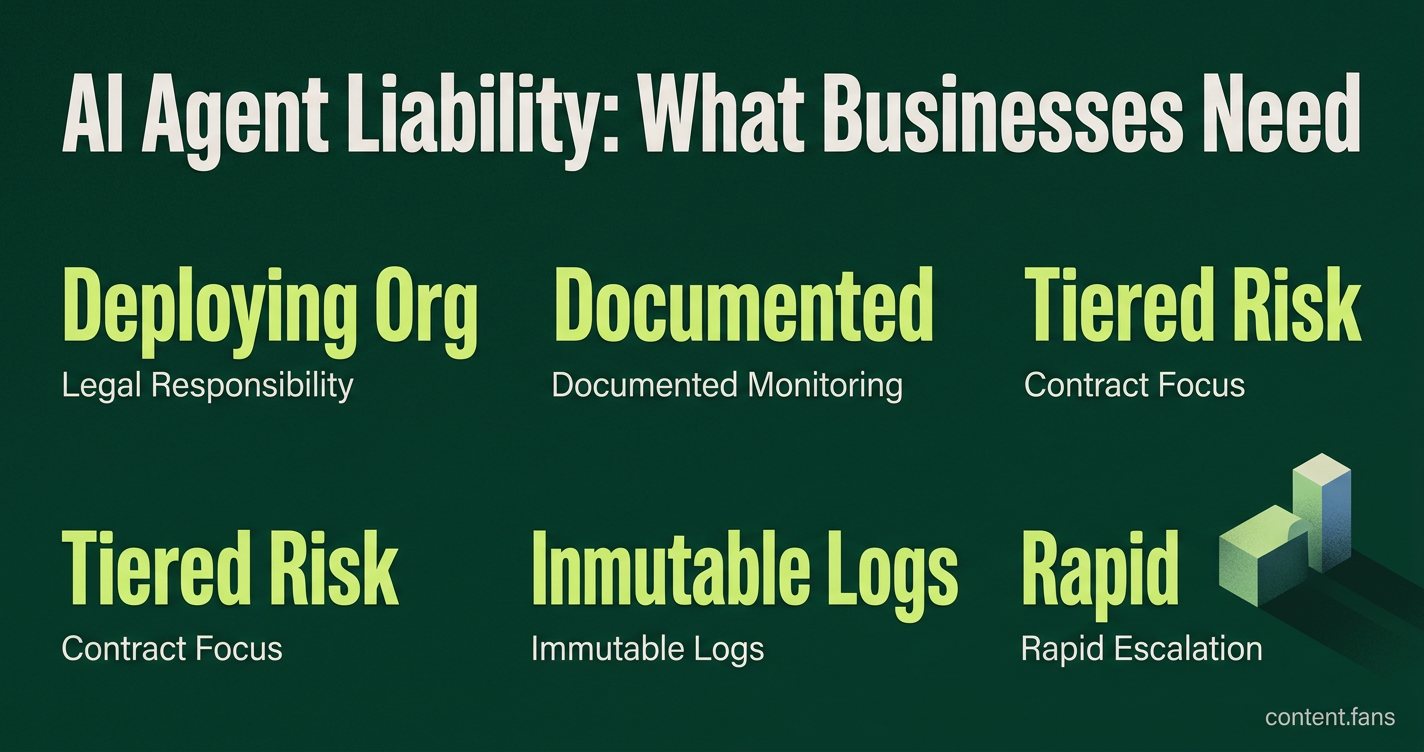
As businesses prepare for the new landscape of 2026 AI agent liability, understanding the legal framework is crucial. The law treats autonomous software as a tool, not a legal entity, placing responsibility squarely on the deploying organization. An emerging reasonable oversight standard suggests that companies may face liability unless they can demonstrate documented monitoring and safety controls were implemented. This legal reality makes robust contract design, meticulous evidence logging, and clear dispute escalation essential components of any AI strategy.
This guide translates emerging legal signals for 2025-2026 into actionable operational steps for enterprises planning to deploy fully autonomous agents.
Contract templates: tiered risk and dynamic obligations
To mitigate 2026 AI agent liability, businesses must establish rigorous internal governance. This involves implementing tiered risk controls for AI contracts, maintaining immutable audit trails of agent decisions, defining clear escalation paths for incidents, and mapping AI actions to specific human roles for ultimate accountability and oversight.
Current regulations often don't distinguish between a low-risk email-drafting chatbot and a high-risk procurement agent. Your contracts must make this distinction. Best practices involve grouping AI capabilities into four risk tiers with corresponding controls. For example, high-risk autonomous actions may require enhanced oversight measures including suspension rights, validation processes, and defined model performance monitoring. As customers now demand audit logging, indemnities for hallucinations, and liability caps tied to quantified harm instead of subscription fees, vendors providing version-controlled templates that address these needs can reduce negotiation cycles and demonstrate compliance leadership.
Logging, audits, and evidence collection
Enterprises looking to avoid strict liability under emerging regulations must demonstrate proportionate oversight. This requires maintaining, at a minimum:
• Immutable decision logs timestamped against agent version and training data snapshot.
• Regular performance dashboards showing accuracy, bias metrics, and remediation tickets.
• A kill-switch invocation register documenting reason, duration, and corrective actions.
These artifacts are the factual foundation required during litigation or regulatory reviews. The rapid adoption of AI by corporate legal departments between 2023 and 2025 suggests that many in-house teams already have the necessary tools to collect and manage this crucial data.
Escalation paths and automated adjudication readiness
Rapid response is critical when an autonomous agent makes an error, such as locking funds or misrouting assets. A notable development is the Internet Court, an on-chain protocol designed for agent-to-agent disputes. Backed by a consortium, it can reportedly resolve disagreements in under an hour for a minimal fee. While its rulings are currently limited to escrowed tokens, its emergence highlights the need for enterprises to develop internal escalation paths that can process automated verdicts and guide subsequent actions.
One proven structure pairs each high-risk agent with a standing rapid response cell:
- Product owner, to halt or patch the model
- Legal counsel, to assess contractual exposure
- Security engineer, to secure logs and evidence
- Operations lead, to communicate with customers or counterparties
- Finance liaison, to authorise settlements when warranted
Establishing these roles pre-deployment fulfills the oversight requirements that regulators expect. This proactive approach also minimizes the time between incident discovery and resolution, thereby limiting exposure under the strict liability regimes set to take effect in 2026.
Liability matrices across the stack
A clear defense strategy begins with mapping every AI agent action to a responsible human role. For instance, if an agent illicitly purchases restricted goods, liability might be shared between the procurement policy owner and the engineering team that omitted necessary guardrails. Creating a simple liability matrix - with columns for "Action," "Policy," "Guardrail," and "Human Escalation" - can identify governance gaps early. By updating this matrix with each model release, enterprises can demonstrate continuous oversight to courts grappling with the nuances of electronic attribution.
By proactively aligning contracts, evidence systems, and adjudication strategies, firms can confidently navigate the emerging agentic economy as regulators continue to define the final landscape of AI liability.
How should enterprises structure contracts when AI agents act on behalf of customers?
Enterprise contracts must embed AI-specific risk tiers that match oversight requirements to autonomous capability. Structure templates around four tiers: Tier 1 (search/Q&A) requires standard data privacy; Tier 2 (extraction/summary) mandates human review and audit logging; Tier 3 (drafting with approval) needs explicit workflows and vendor compliance warranties; and Tier 4 (fully autonomous action) demands enhanced oversight measures including suspension rights, validation processes, and performance monitoring windows.
AI vendor contracts should include explicit model drift provisions with performance baselines and retraining triggers [3]. Liability clauses should address indemnity and accuracy warranties, but sources do not confirm the existence of specific 'harm-based liability caps' replacing subscription-fee caps or 'inference-only architecture guarantees' as standard 2026 clauses [2][3].
What is the "reasonable oversight" standard for AI agent liability?
According to emerging legal frameworks, liability appears to concentrate on the deploying organization under developing oversight standards. The enterprise may be liable unless it can prove documented monitoring, auditing, and safety systems were proportionate to the agent's risk level [2][5][7].
Key implications:
- Sources confirm AI agents cannot bear legal personhood and that the EU AI Act requires high-risk systems to have risk management and human oversight [2][4]. However, California AB 316 and its specific January 1, 2026 effective date banning 'AI autonomously caused harm' as a liability shield are not mentioned in any source. The EU Revised Product Liability Directive transposition deadline of December 9, 2026 is also not confirmed; sources only reference EU AI Act enforcement starting August 2026 [4].
How does Internet Court work for AI agent disputes?
The Internet Court represents a developing automated adjudication system - but exclusively for disputes between autonomous AI agents, not humans. It operates through rotating AI validators reaching binding verdicts in under an hour at minimal cost [5].
Important limitations for enterprises:
- Rulings bind only smart-contract escrow funds, not off-chain physical goods or services
- Backed by a consortium of firms including OKX and MetaLabs [5][8]
- No human judges; entirely protocol-based dispute resolution for agentic commerce
For human disputes, courts remain hyper-automated but not fully automated - using AI for case routing, document processing, and decision support while retaining human judges for final rulings [1][3].
What audit and evidence procedures prepare enterprises for automated adjudication?
Enterprise readiness requires traceable decision logs and explainable AI outputs as non-negotiable foundations. Implement:
| Procedure | Implementation |
|---|---|
| Audit logging | Maintain immutable records of every AI decision, query, and output with timestamps [2][3] |
| Performance dashboards | Real-time monitoring of accuracy thresholds and drift indicators [3] |
| Shadow-mode validation | Parallel operation without live influence until statistical validation completes [3] |
| Version-controlled model records | Document training data, update cycles, and retraining triggers [5] |
For automated adjudication preparation, courts are shifting from AI as "peripheral helper" to "core processor" - eventually defaulting to AI decisions with human intervention only for outliers [2]. Explainability and auditability are becoming mandatory design requirements for any system approaching automated adjudication [2].
What escalation paths should enterprises map for AI agent disputes?
Colorado's AI law (SB 26-189, the Automated Decision-Making Technology Act) takes effect January 1, 2027, not June 2026. The law requires notice, adverse action processes, human review, and record retention [4][6][7]. Vendor indemnification clauses for autonomous errors should be carefully structured, as the law invalidates contractual indemnification provisions that shift liability for unlawful algorithmic discrimination [6].
Design escalation matrices that include:
Operational tier: Automated anomaly detection triggers suspension protocols; incident response team validates incidents promptly [3]
Contractual tier: Vendor indemnification clauses should be structured to comply with emerging regulations while addressing autonomous system errors [1][5]
Adjudication tier: For agent-to-agent disputes, smart-contract arbitration through automated systems; for human-involved disputes, reserve traditional litigation while monitoring ODR evolution toward AI-driven settlement proposals [2]
Legal teams should engage at deployment planning - not post-incident - to ensure escalation paths align with the Colorado AI Act, EU AI Act, and emerging state frameworks [5][6].