
BCG: AI Reshapes 50% of US Jobs by 2026, Not Just Replaces Them
Serge Bulaev
Research from BCG suggests that by 2026, about half of all U.S. jobs may be reshaped by AI and robotics, though only a small number of companies report reducing their workforce so far. The main change appears to be breaking jobs into tasks, automating simpler parts, and focusing people on more complex work. Some jobs, especially entry-level and some blue-collar roles, might be at higher risk of being replaced or changed by technology. Experts recommend that companies help workers learn new skills and update job roles to keep up with the changes. Following certain steps, like mapping out how people and AI will work together, may help companies and workers adapt more smoothly.

Generative AI and robotics are transforming daily workflows, and new research from BCG suggests this AI reshapes US jobs more than it replaces them. This article analyzes the latest data on task reallocation, identifies at-risk job profiles, and outlines actionable strategies for HR and operations leaders seeking to navigate this transition.
AI Job Reshaping Outpaces Layoffs
Job reshaping involves breaking down roles into individual tasks. Companies then automate the routine, repetitive parts while reassigning employees to focus on more complex, creative, or strategic work. This strategy aims to enhance productivity without large-scale layoffs, elevating the value of human judgment and expertise.
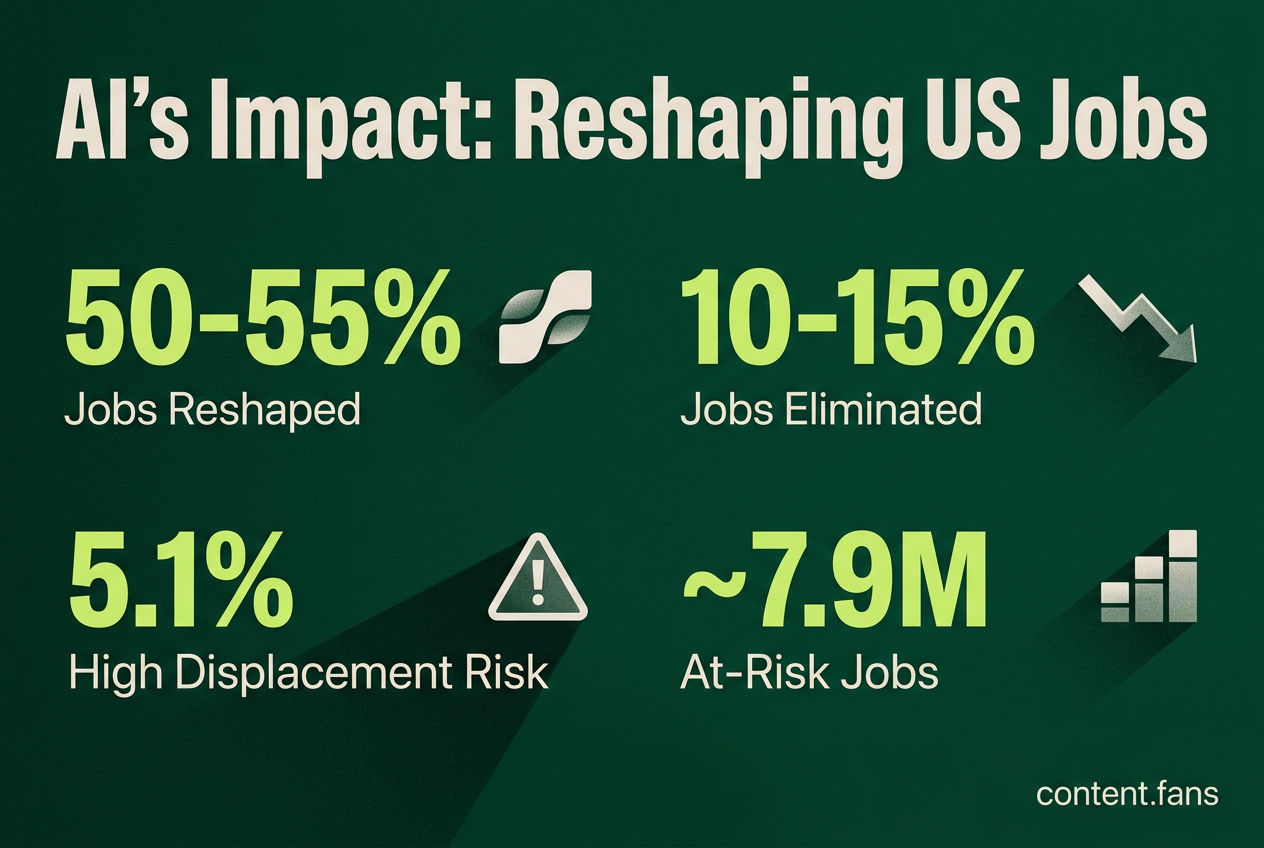
A recent BCG analysis projects that 50%-55% of U.S. jobs will be reshaped over the next 2-3 years (approximately 2026-2029). However, while many companies are adopting AI, a significant portion report focusing on task reallocation rather than workforce reduction. The dominant trend is task decomposition: automating routine work and shifting employees to judgment-heavy responsibilities. This shift extends to physical trades, where AI-powered robots are increasingly being deployed for tasks like pipe repair, increasing pressure on mid-skill blue-collar roles.
The Two-Track Labor Market: Augmentation vs. Democratization
Researchers describe a labor market splitting into two tracks. Professional roles like specialized healthcare and engineering are experiencing job growth at double the average rate, as AI augments their complex expertise. In contrast, "democratized" positions that rely on software for core functions are seeing shrinking demand, particularly for entry-level analysts and basic support staff.
High-risk groups include entry-level/junior knowledge workers and routinized roles (customer service, data analysis). SHRM estimates 5.1% of US employment (~7.9M jobs) faces high displacement risk. BCG projects 50-55% of US jobs will be reshaped by 2026, with 10-15% potentially eliminated.
A Strategic Workforce Planning Playbook for 2025-2026
As AI transforms roles, static job descriptions are becoming obsolete. Experts now advocate for skills-based workforce planning using internal talent marketplaces. Major companies like Amazon, AT&T, and IKEA are leading the way, investing substantial resources in reskilling programs that connect training to defined career paths. According to Harvard Business Review, programs that promise a salary bump upon completion achieve roughly triple the participation of unlinked courses.
Key projections for workforce planners include:
| Metric | Projection Year | Value |
|---|---|---|
| Jobs reshaped (US) | 2026 | 50%-55% |
| Jobs potentially eliminated (US) | 2026 | 10%-15% |
| US jobs at high displacement risk | Current | 5.1% (~7.9M) |
Avoiding Common Pitfalls in AI Change Management
Failed AI adoption often stems from poor change management. Industry reports indicate that a significant majority of companies deploy AI without redesigning target workflows, leading to resistance and stalled progress. Organizations that proactively define new performance metrics and train managers are substantially more likely to hit their adoption targets.
Key recommendations from multiple reports include:
- Map human-AI handoffs at the task level before any code rollout.
- Build universal AI literacy so users know system limits.
- Give managers coaching scripts to address role anxiety.
- Establish clear ownership for error governance and data quality.
By following these steps, organizations can mitigate change fatigue and successfully transition employees into higher-value, AI-augmented roles.
What exactly does "reshaping" mean - will I lose my job or just do different tasks?
Roles will be both restructured and removed. BCG estimates 50-55% of US jobs will be reshaped over 2-3 years, but companies like Amazon (16,000 roles), Walmart (~1,000 roles), and Tesco (380 roles) are actively cutting positions in 2026. In practice the work is split into pieces: routine tasks are handed to AI or robots while complex, creative and empathetic tasks stay with people. Many companies using AI are redesigning workflows so employees do higher-value activities rather than reducing headcount.
Which workers face the biggest shift right now?
White-collar staff in entry-level positions and manufacturing operators are among the groups most likely to see their daily tasks re-allocated. Retail workers also face significant changes as automation affects many store and warehouse tasks. Conversely, specialized healthcare, engineering and infrastructure-build roles tied to new data-center construction are adding head-count twice as fast as the market average.
How should companies plan hiring and training in the coming years?
- Replace static job descriptions with skills-based marketplaces so workers can move from task to task
- Build mandatory AI-literacy for every employee before offering deeper technical tracks
- Pair new hires with structured apprenticeships that let AI handle routine practice while humans learn oversight and judgment
- Track productivity, internal mobility and retention, not course-completion hours, to prove ROI
What are the biggest change-management mistakes?
- Layering AI onto today's workflows without redesigning them - many firms do this and see adoption stall
- Ignoring middle managers who coach frontline teams; adoption targets are significantly more likely to be hit when managers receive role-specific coaching toolkits
- Declaring victory after go-live; treat AI as an operating-model evolution with continuous metrics updates
Where can I see a program that actually worked?
Amazon's "Upskilling 2025" is a $1.2 billion pledge (expanded from $700M in 2021) to provide access to training for 300,000 U.S. employees by 2025. As of recent reports, over 70,000 employees have taken advantage of the programs, using a blended mix of online classes and internal project work. The program focuses on moving warehouse and call-center employees into cloud and machine-learning positions, with participants typically earning higher base salaries upon completion.