
AI Transforms Jobs, Not Professions, As Skills Shift Rapidly By 2026
Serge Bulaev
AI appears to be changing the specific tasks people do at work, but it may not eliminate whole professions. Skills needed for jobs affected by AI are shifting faster, especially for entry-level roles, and there is more focus on abilities like leadership and rapid learning. Most companies say they use AI, but few feel fully ready, and many workers do not feel completely prepared for new tools. Training budgets may not keep up with the need for new skills, even though pay is rising for jobs that require more AI-related abilities. Overall, AI seems to be making human judgment and creativity more important, rather than replacing workers entirely.

The rapid adoption of AI is transforming jobs by fundamentally altering required skills, yet it isn't eliminating entire professions - much like spreadsheets revolutionized but didn't replace accounting. Generative models are becoming as common as office software, automating routine tasks while elevating the value of human judgment. This shift is already visible in hiring trends and evolving training needs.
AI will change tools but not eliminate professions - think Excel/spreadsheet analogy
AI's primary impact is on job composition, not job existence. It automates repetitive tasks, which elevates the need for uniquely human skills like critical thinking, creativity, and strategic oversight. This shift means professionals are not being replaced, but their roles are being redefined around higher-value, judgment-based work.
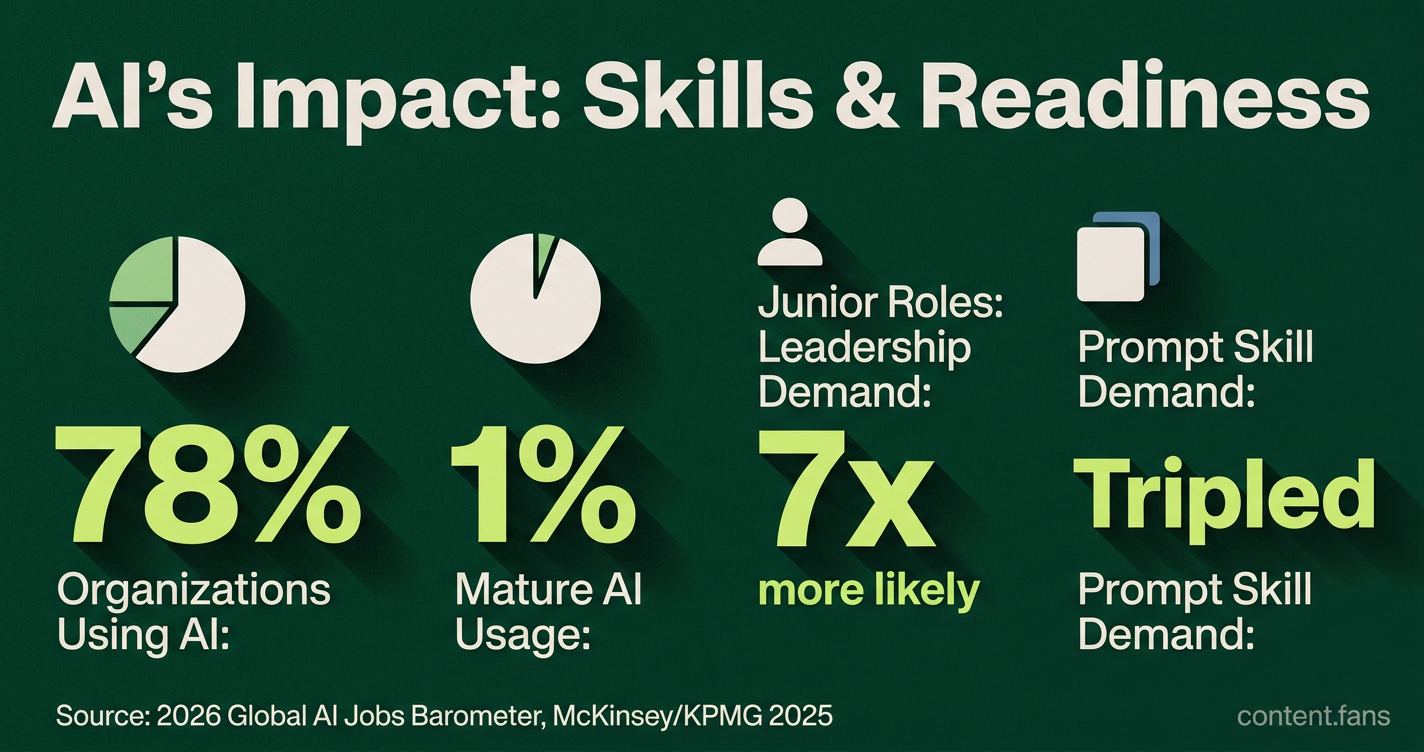
Data from the 2026 Global AI Jobs Barometer shows that skills for the most AI-exposed jobs are changing significantly faster than those in low-exposure roles. This acceleration is particularly acute for entry-level positions, which see substantially more net skills change than senior posts. Consequently, junior job listings are now seven times more likely to demand leadership and strategic thinking, as automation absorbs routine work. The evolution of prompt engineering exemplifies this: while the standalone 'Prompt Engineer' title has declined, demand for the skill has tripled, becoming a baseline competency for designers, analysts, and writers.
A two-track labour market is forming
The labor market is bifurcating into 'AI-absorbing' roles that partner human insight with machine learning, and routine jobs that see little augmentation. Industry reports indicate that a significant portion of explicit AI skill demand is concentrated in computing, management, and finance. However, fields like healthcare and consulting are catching up as professionals learn to supervise specialized models. In this new landscape, formal degrees are becoming less critical as the Barometer shows entry-level roles are seven times more likely to require senior skills like judgment and leadership.
What retraining actually needs to cover
A significant gap exists between AI adoption and workforce readiness. While 78% of organizations use AI, only 1% consider their usage 'mature' (McKinsey/KPMG 2025). The workforce feels this gap acutely: a substantial number of employees do not feel fully prepared for AI tools. Confidence is lowest in critical areas. Four foundational competencies are now essential:
- Output evaluation: Spotting hallucinations and subtle errors.
- Prompt construction: Crafting prompts for consistent, high-quality results.
- Task decomposition: Breaking down complex problems into machine-friendly steps.
- Safe and compliant use: Handling regulated data properly.
Industry reports indicate that many employees lack confidence in data compliance, highlighting a major governance risk reminiscent of early spreadsheet misuse.
Emerging oversight and context roles
As generative AI becomes increasingly integrated into enterprise applications, demand is surging for new oversight roles. The focus is shifting from simple prompting to 'context engineering' - designing, orchestrating, and evaluating complex multi-agent systems. This has created a significant talent shortage, with industry reports indicating a substantial gap between open AI engineer positions and qualified candidates. Consequently, wages remain high, with senior roles commanding over $180,000 and premiums for specialists in regulated industries. Just as the spreadsheet boom created a need for expert auditors and modelers, AI is creating value in oversight, safety, and domain-specific creative roles.
Training budgets lag behind need
A critical investment paradox is emerging: while many tech firms identify upskilling as the best solution for talent gaps, a significant number do not plan to fund new training programs. This clashes with projections from the World Economic Forum, which estimates that a substantial portion of workers will need retraining by 2030. The market is already responding to skill scarcity. Job postings with multiple new skills command substantial pay premiums in both the UK and US. Much like the early days of spreadsheets, organizations that invest now in retraining and reimagining roles are best positioned to capture productivity gains while retaining institutional knowledge. The evidence is clear: AI's immediate effect is the rapid reorganization of work around human judgment and creativity, not a wholesale replacement of jobs.