
Deep Tech Startups Raise Record Rounds, Face Higher Proof Thresholds in 2026
Serge Bulaev
Deep tech startups are raising larger funding rounds, but there may be fewer deals happening. Investors now expect stronger proof from founders before they provide money. Companies like Valar Atomics show that using both equity and debt might help move from prototype to full production. Funding is often tied to reaching certain milestones, such as showing a working product or proving it works at a customer site. It appears investors still prefer sectors like defense, robotics, and AI infrastructure, and clear evidence that money will reduce specific risks is now very important.

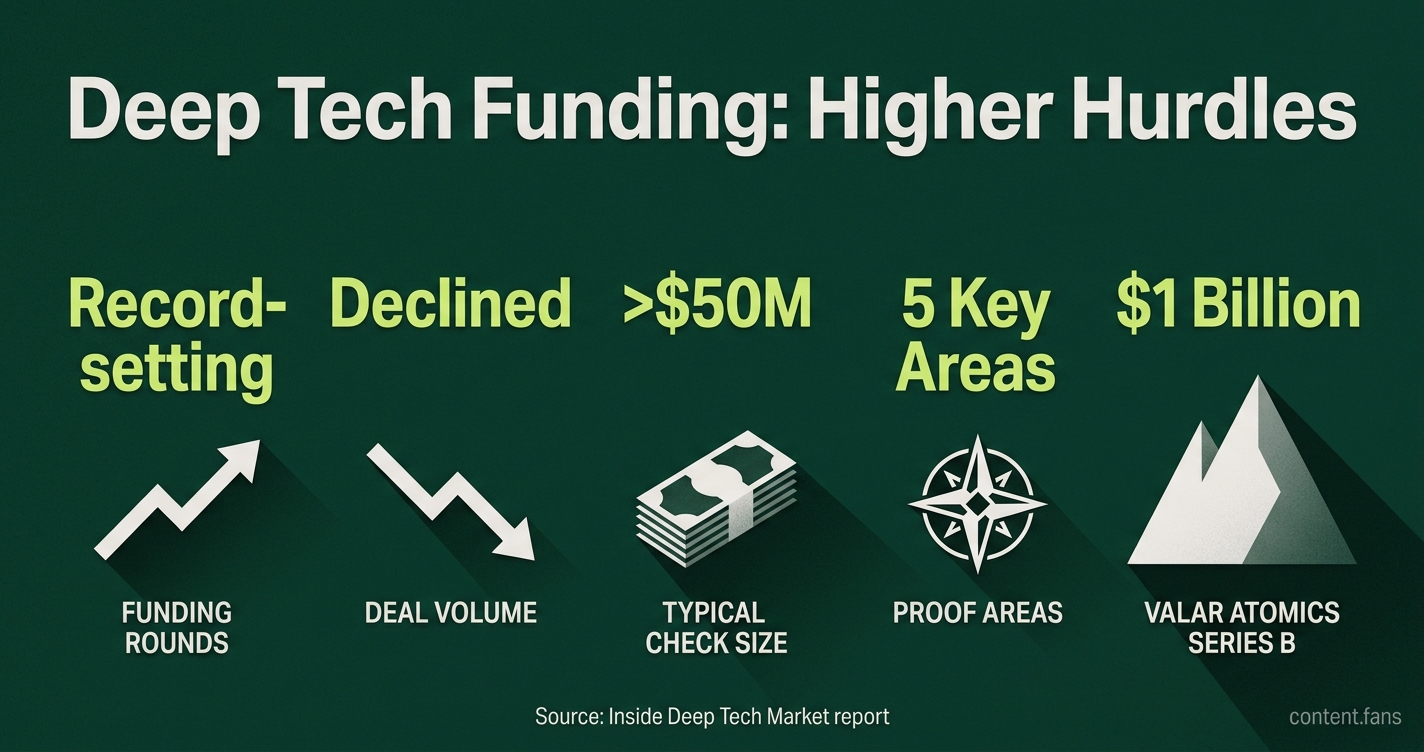
The funding landscape for deep tech startups is polarizing, with record-setting rounds for a select few while overall deal volume declines. Investors are raising the bar, demanding higher proof thresholds before committing capital for long, hardware-intensive development cycles, according to the Inside Deep Tech Market report.
A prime example is Valar Atomics, whose $1 billion Series B, paired with a $200 million credit line, shows how blended financing can bridge the gap from prototype to production. The company plans to use the funds for reactor deployment, operations, and vertically integrated fuel production, signaling a major step toward commercial scale link.
How deep tech startups raise capital in 2026
Market data reveals a stark bifurcation: while deal volume has declined significantly, total funding has increased substantially. This indicates a flight to quality, where investors back fewer companies with much larger checks, often exceeding $50 million. Consequently, fundraising timelines have stretched, with industry reports suggesting significantly longer diligence cycles.
Investors are consolidating capital into fewer, promising ventures, forcing founders to provide concrete evidence across five key areas: technical feasibility, process repeatability, successful pilot deployments, manufacturing readiness, and early commercial traction. A deficiency in any of these buckets, especially for hardware-first companies, significantly increases perceived investment risk.
Map money to milestones, not months
Rather than funding a specific time period or runway, the modern approach is to tie capital to concrete, de-risking milestones. This milestone-driven strategy functions as a risk ladder where each funding tranche is aligned with a single, falsifiable claim. The goal is to unlock a specific proof point before raising again.
Key milestones include:
- Technical Feasibility: Proving the core technology works in a controlled environment.
- Repeatability: Establishing a stable, reproducible process or protocol.
- Pilot Validation: Demonstrating the solution works at a customer site under real-world conditions.
- Manufacturing & Regulatory Readiness: Proving the ability to produce at scale and navigate compliance pathways.
- Positive Unit Economics: Showing that each deployment can be profitable.
To make these milestones actionable, they should be defined with specific metrics, a clear experimental setup, and a target date, creating a reproducible evidence packet for investors. Regular quarterly reforecasting is essential to maintain credibility as timelines and scope inevitably evolve.
Tranche structures inspired by Valar Atomics
The Valar Atomics deal highlights the growing importance of blended capital structures. By combining equity with a credit facility, founders can reduce dilution during capital-intensive scaling and build in flexibility for project overruns. A sophisticated tranche structure might include:
- Core Equity: For irreversible R&D and engineering expenses.
- Contingent Equity: Options tied to specific achievements, such as regulatory clearance.
- Debt Financing: Senior debt or project finance for physical assets, manufacturing facilities, or projects backed by offtake agreements.
To further manage capital needs, founders can adopt strategies like modular design or fabless manufacturing to lower the cost of each development stage. The key principle is to raise only what is necessary to reach the next major value inflection point, thereby protecting ownership while accounting for potential delays.
Investor interest remains heavily concentrated in sectors like defense, robotics, and AI infrastructure, where procurement pathways are often clearer. For startups in other areas, securing mid-sized rounds is a significant challenge without strategic corporate backers. In today's market, demonstrating precisely how new capital will de-risk a specific technical or market challenge is no longer just a best practice - it is the prerequisite for receiving a term sheet.
Why are deep tech startups raising record rounds despite fewer deals overall?
The market has split into fewer, larger transactions. While overall deal count has dropped significantly in recent data, total funding has surged substantially, with deep tech now capturing 36% of global VC capital - up nearly 3x since 2016. Large rounds represent a significant portion of total capital. This concentration reflects the reality that capital-intensive companies require substantial checks to reach technical inflection points, with Celesta Capital noting that deep tech is no longer a niche category but the dominant force in venture funding.
What constitutes the "higher proof threshold" that investors now demand?
Investors have shifted from funding narratives to milestones, requiring falsifiable technical evidence rather than promising science. Founders must demonstrate clear technical de-risking through controlled proof-of-concept results, stable repeatability of protocols, and defined failure modes. Additionally, investors now expect evidence of revenue or procurement pathways - particularly in defense, space, and industrial systems - alongside AI or software-defined layers that differentiate hardware plays. As outlined in FedTech's readiness guide, companies must mature technology, manufacturing, regulatory, and financing roadmaps in parallel from the first white-board session, with quarterly tracking of Technology Readiness Levels (TRL) and Manufacturing Readiness Levels (MRL) to validate progress.
How should founders structure milestone-based funding for capital-intensive development?
Deep tech requires risk-reduction sequencing where each tranche unlocks the next proof point rather than merely extending runway. Founders should plan for extended fundraising cycles and structure capital in stages: pre-seed focuses on team competence and first experiments; seed requires replication and stable protocols; Series A-B demands confirmation of economic models and pilot deployments. Each milestone should be small enough to answer with one test, sequenced by cost of delay, with clear evidence packets documenting setup, raw data, and caveats. BGF's deep tech playbook recommends raising only what is needed to reach the next value inflection point while building flexibility for delays, and suggests reducing capital intensity through modular development or fabless models where possible to improve success odds.
Why are strategic investors and non-dilutive capital critical in this environment?
Deep tech financing increasingly requires blended capital structures that combine equity, grants, strategic corporate investment, and debt to minimize dilution and de-risk technology. Strategic investors provide domain expertise, procurement pathways, and technical validation that pure financial VCs cannot offer, while government contracts and defense procurement serve as critical demand signals. The recent Valar Atomics announcement exemplifies this approach: the company closed a $1 billion Series B led by Sequoia Capital alongside a separate $200 million credit facility led by Erebor Bank with J.P. Morgan and Hercules Capital. This mixed structure provides both growth capital and operating liquidity without excessive equity dilution, reflecting the reality that capital-intensive ventures must tap multiple funding pools simultaneously.
What lessons does Valar Atomics' $1 billion Series B offer for scaling deep tech?
The financing signals a shift from prototype to industrial-scale manufacturing, highlighting that deep tech success requires capital structures designed for vertically integrated hardware deployment. Valar's approach demonstrates that founders must plan for manufacturing readiness alongside technical development, with the company specifically earmarking funds for reactor deployment, long-term operations, and fuel production. The round also illustrates regulatory and execution risk management: despite the massive valuation, Canary Media reported that the reactor design had not yet received U.S. Nuclear Regulatory Commission approval, reminding founders that capital availability does not eliminate technical or regulatory hurdles. Finally, the involvement of Sequoia partner Shaun Maguire taking a board seat underscores that active investor oversight and governance become critical as companies transition from development to commercial fleets.