
Dapple raises $30M seed for AI infrastructure OS
Serge Bulaev
Dapple has raised $30 million in a seed round to build an operating system for AI infrastructure, which is much higher than the average seed funding for similar startups. Analysts suggest this large investment may signal more money going to companies that aim to make AI easier for businesses, though high costs for GPUs and cloud services remain a concern. Dapple faces competition from other companies offering AI control platforms, and big tech companies may have an advantage due to their large budgets. Most businesses use many automation tools and now want a single platform to manage them. Reports suggest only a small portion of companies have fully adopted advanced AI workflows, and Dapple may need to grow quickly while managing its spending carefully.

Dapple has closed a substantial seed round to build its AI infrastructure OS, a platform designed to unify enterprise AI operations. The Chicago-based startup aims to provide a single control layer for compute, data, and orchestration across hybrid and multi-cloud environments, simplifying complex workflows for businesses.
Large seed round reshapes early-stage benchmarks
Dapple's seed round is significant because it far exceeds typical funding levels for AI startups at this stage. This mega-seed suggests investors are prioritizing companies that can simplify enterprise AI, signaling a trend toward higher valuations and more intense scrutiny on scalability and margins.
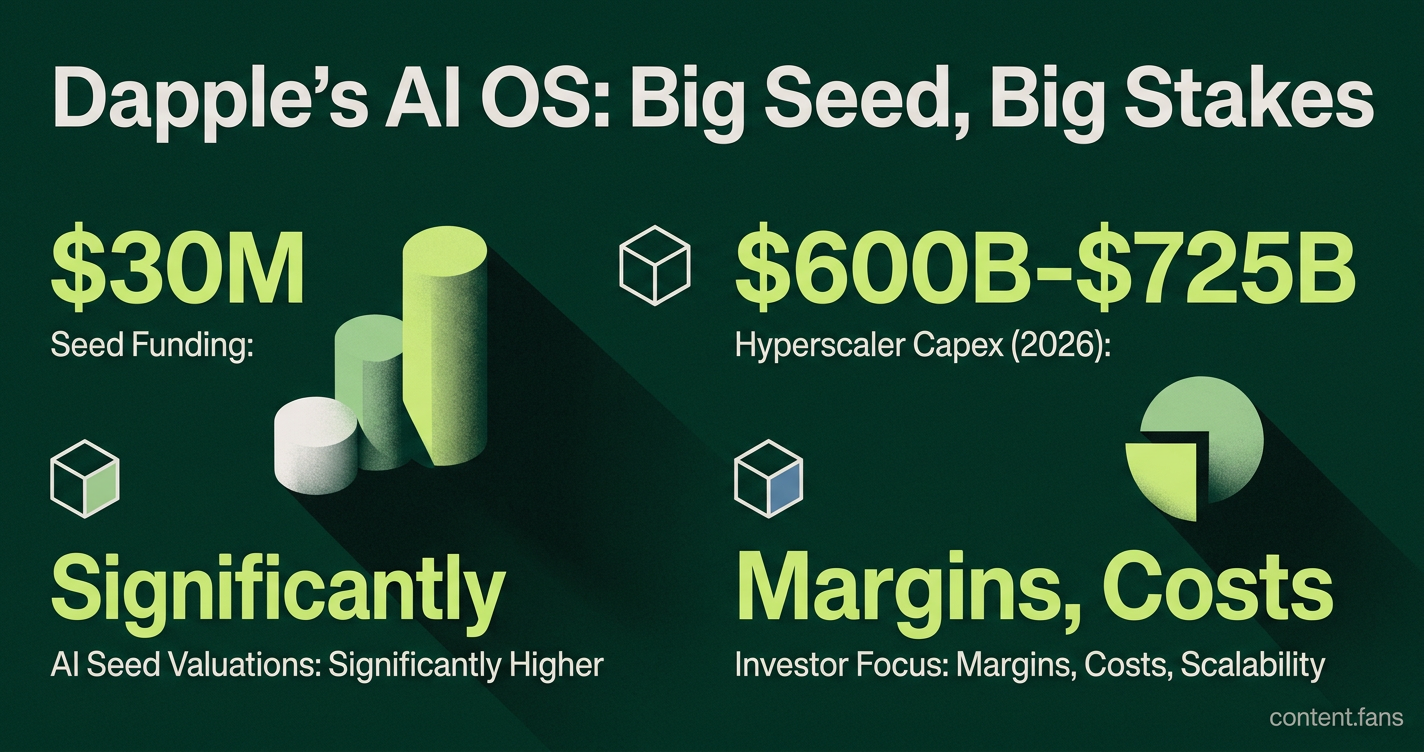
This funding level significantly outpaces industry averages for AI ventures. According to an AI Business Review analysis, AI seed valuations are trading significantly higher than their non-AI counterparts. However, investor diligence is shifting from vision to concrete metrics, with a recent TechCrunch report showing a new focus on gross margin, inference costs, and scalability. Such large initial investments create several key pressures:
- Setting higher valuation benchmarks, comparable to historical Series A rounds.
- Accelerating fundraising cycles, which shortens timelines for technical validation.
- Driving early, aggressive hiring of senior talent to justify high cash burn.
- Increasing pressure to secure long-term GPU capacity agreements.
A crowded field of prospective "AI OS" rivals
Dapple enters a competitive landscape for AI operating systems. The company faces direct rivals like Shakudo and Noxus, both highlighted in an F6S category listing of "Data & AI Operating System" vendors. Competition also comes from infrastructure heavyweights such as VAST Data and Databricks, along with the hyperscalers (AWS, Google, Microsoft) competing for the same control-plane budget. NVIDIA continues to dominate at the hardware-software boundary.
Published hyperscaler capex estimates for 2026 vary widely, with cited figures ranging from $600B-$725B according to industry reports. Goldman Sachs mentions $700B as a level needed for spending cycle comparison, not as a confirmed planned total. This massive scale advantage could challenge the ability of independent platforms like Dapple to gain significant market traction.
Enterprise appetite for unified control planes
The demand for a unified AI control plane is growing as enterprises struggle with fragmented systems. Industry reports indicate that a significant majority of organizations juggle multiple automation tools and operate in hybrid IT environments. As a result, buyers are actively seeking a single platform that can orchestrate agents, workloads, and policies across disparate systems.
Key desired platform traits include:
- Workflow orchestration capable of managing dynamic, multi-model tasks.
- Robust governance features, including audit logs, versioning, and policy enforcement.
- Deployment portability across public cloud, private cloud, and edge environments.
- A dual interface with low-code tools for business users and API-first extensibility for developers.
Industry reports suggest that early adopters of such unified platforms see significant increases in operational agility. However, broad adoption is still in its early stages, with a cited 2026 source reporting 11% of organizations have agentic AI workflows running live, with 38% still in pilot.
What comes next in the AI infrastructure race
The AI operating system market is consolidating around a handful of key vendors competing across different layers of the stack. Hardware-focused players are improving performance per watt and inference latency by integrating system software with optimized memory. Meanwhile, startups like Dapple must balance rapid product development with disciplined financial management to navigate the high expectations set by its substantial seed funding and avoid common valuation traps.