
Danone Expands Regenerative Agriculture, Reports 42% Ingredients From Transition Farms
Serge Bulaev
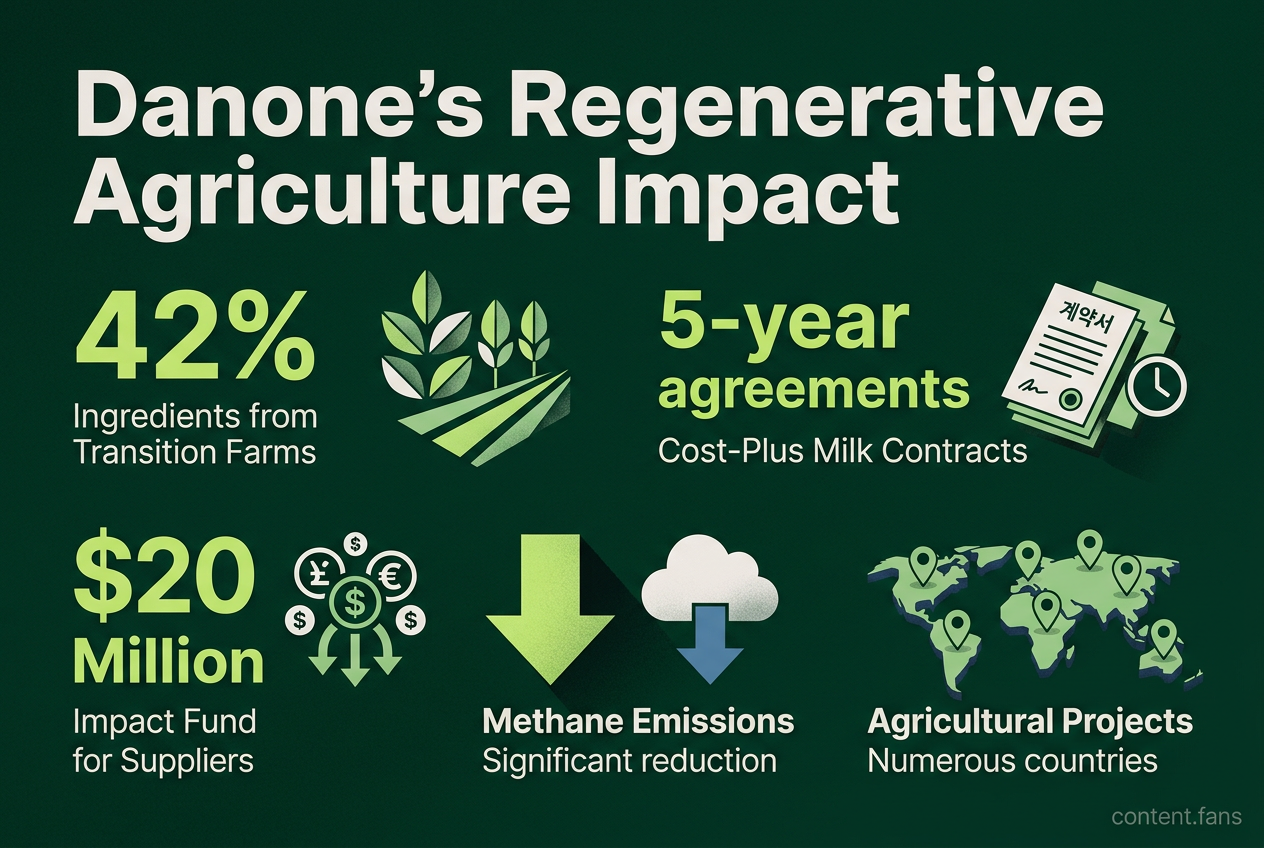
Danone reports that 42 percent of its key ingredients in 2025 may come from farms using regenerative practices, which is above its target. The company suggests that working with farmers on soil health, training, and financial support appears to help reduce climate risks and stabilize costs. Early results show cuts in methane emissions and more projects in different countries, though these numbers are still early and mostly company-reported. Studies suggest that regenerative farming might also help farmers' incomes and make food supply chains stronger.

Danone is proving that regenerative agriculture is a core procurement strategy for building climate resilience and supply chain security. The company reports that a significant portion of its priority ingredients came from farms transitioning to these practices, according to industry reports on its sustainability initiatives.
Emerging evidence from Danone's program and broader industry analysis shows a clear business case: strategically investing in farmer training, financial incentives, and rigorous measurement helps companies mitigate climate risks, stabilize sourcing costs, and improve farmer livelihoods.
Why Danone links soil health to risk management
Danone's Regenerative Agriculture Program, built on the pillars of protecting soils, empowering farmers, and improving animal welfare, is explicitly designed to reduce business risk. On its policy page, the company argues this structure minimizes exposure to weather volatility and input cost spikes. According to industry reports, a substantial majority of direct milk volumes are now covered by farm-level monitoring tools, giving buyers early warnings of potential supply disruptions.
Danone is expanding its regenerative agriculture program as a core business strategy to de-risk its supply chain from climate shocks and stabilize costs. By directly supporting farmers in improving soil health, the company builds resilience, ensures a more reliable supply of ingredients, and supports long-term profitability.
From agronomy training to cost-plus contracts
The program combines hands-on support like transition coaching and soil testing with innovative financial models. Danone North America's cost-plus milk model moves suppliers to five-year agreements after a trial period. According to U.S. Farmers & Ranchers, this provides farmers with a customized soil plan and a price premium that insulates them from volatile fertilizer and feed costs.
Additional funding is also being mobilized. Trellis reports that rePlant Capital has earmarked 20 million dollars from an impact fund for Danone suppliers, and Foundation for Food & Agriculture Research initiatives provide significant funding to support hub farms that demonstrate best practices.
Early business outcomes
While preliminary, the reported outcomes are directionally significant:
- A significant reduction in methane emissions from fresh milk against baseline measurements, according to industry reports
- Multiple agricultural projects established across numerous countries, diversifying sourcing
- Key ingredient volumes from farms in transition have shown substantial growth over recent years
These company-reported figures align with broader trends. A TechnoServe report on "regenerative transformation" confirms that such programs improve the "livelihoods and resilience of smallholder farmers" and enhance supply chain traceability, suggesting a synergy between investing in farm economics and data systems.
Independent perspectives on resilience and margins
Independent analysis supports the business case for these practices. Modeling by Regrow argues that regenerative agriculture reduces yield loss risk during climate shocks and helps companies retain their supplier networks. The World Economic Forum notes that healthier soils improve water retention and lower dependence on synthetic fertilizers, easing cost pressures.
Furthermore, Science Societies' CSA News found that farms using regenerative methods often achieve higher profitability due to lower input costs. While yield dips can occur, research shows regenerative plots can be significantly more profitable than conventional ones, underscoring that gross margin is a more critical metric than yield alone.
Building a credible measurement stack
Credible, transparent measurement is essential for success. The World Business Council for Sustainable Development urges companies to track both ecological and economic indicators, from soil organic matter to profit per hectare. Danone's internal three-level framework for grading farm progress reflects this guidance. However, independent verification is a key next step, as Taylor & Francis research stresses the need for third-party audits when market premiums are tied to verified outcomes.
Takeaways for procurement leaders
For procurement leaders, Danone's experience offers a clear playbook for using regenerative agriculture to mitigate risk:
1. Combine agronomic training with multi-year offtake or cost-plus contracts to help farmers de-risk the transition.
2. Blend corporate, public, and impact finance to fund the adoption of new equipment and practices like cover cropping.
3. Invest in outcome-based measurement to track soil health, yield stability, and farm income over multiple seasons.
Danone's model demonstrates that when these levers align, regenerative agriculture becomes a powerful operational strategy for building both climate resilience and supply security.
How is Danone financing the switch to regenerative practices?
Danone bundles cost-plus milk contracts, multi-year purchase guarantees and third-party transition loans.
- A cost-plus model pays dairy families a margin above verified production costs, replacing commodity-price swings with five-to-ten-year agreements
- rePlant Capital has ring-fenced $20 million of its $50 million food-and-ag impact fund for Danone growers who need up-front cash for cover-crop seed, compost or low-till equipment
- Public-private grants provide significant funding to underwrite "hub-farm" trials so that neighbors can copy successes without repeating mistakes
The result: measurable risk sharing instead of one-off sustainability bonuses.
What share of Danone's ingredients now comes from transition farms - and why does it matter for supply reliability?
Danone said 42% of its key ingredients were sourced from farms engaged in regenerative agriculture, while a substantial majority of direct milk supply was covered by farm-level assessment tools; the published materials do not support the exact 'Level-1 in transition' wording for that percentage figure.
Food-industry analysts note that suppliers enrolled in soil-health, water-stewardship and biodiversity protocols show improved environmental performance and greater supply reliability compared to conventional operations.
In other words, a significant portion of the core basket is already de-risked from climate-related volume shocks.
How does regenerative agriculture translate into financial resilience for Danone itself?
Treating regen as a hedge rather than a CSR line item changes the maths.
Industry reports suggest that gains in soil organic matter on partner dairy farms can raise pasture water-holding capacity and reduce synthetic-nitrogen needs, providing cost savings despite volatile fertilizer prices.
Because Danone locks in volumes at pre-agreed differentials, margin volatility linked to spot milk, corn or fertilizer price spikes falls, protecting gross margin in the volatile dairy segment.
Which measurement tools let Danone verify that the farms are really improving?
Danone's "Farm Level Assessment" module, implemented across a substantial portion of direct milk supply, combines:
- annual soil-health scorecards (organic matter, compaction, biodiversity counts)
- satellite + on-farm sensor data uploaded to a third-party verifier
- economic dashboard tracking profit/ha, input-cost inflation and living-income benchmarks
Results are cross-checked against WBCSD's shared-indicator library so that claims in Dannon, Activia or Horizon cartons can be audited back to field-level evidence, lowering green-wash risk before regulators or retailers ask.
If regenerative farming sometimes lowers yields, how does Danone keep growers from walking away?
Short-term yield dips in the first transition years are common; Danone offsets this with:
- guaranteed floor prices that ignore the yield dip
- zero-interest transition loans serviced by rePlant, removing the need for banks to value "soil health" as collateral
- free agronomist visits via "hub farms" where early adopters demo cover-cropping, composting and rotational grazing to nearby peers
Industry reports suggest supplier exit rates have fallen significantly after the roll-out of the cost-plus programme, suggesting economic security is turning experimental growers into long-term allies.