
Convey Secures $38M Series A to Expand Enterprise AI Platform
Serge Bulaev
Convey, a company in San Francisco, announced on June 17, 2026, that it raised $38 million to grow its AI platform. This platform may let non-technical workers quickly set up AI helpers to do repetitive tasks, like data entry or invoice processing. The funding suggests more companies want tools that make it easy to automate work while keeping controls in place. Investors note that the platform appears to work with popular business systems even if they are old. Convey says the new money will help add more features and hire more staff as it expands.

On June 17, 2026, San Francisco-based Convey secured a $38M Series A round to expand its enterprise AI platform, which enables non-technical workers to create AI "digital teammates." This major funding, detailed in a SiliconANGLE report, will accelerate the platform's growth. The company confirmed the raise on its own blog, citing rising demand for governed, low-code automation.
Who backed the Series A
The Series A funding for Convey underscores a significant enterprise trend: the move toward accessible AI automation. The capital will fuel the growth of its low-code platform, which allows business users to create autonomous AI agents for tasks like data entry and invoice processing without engineering support.
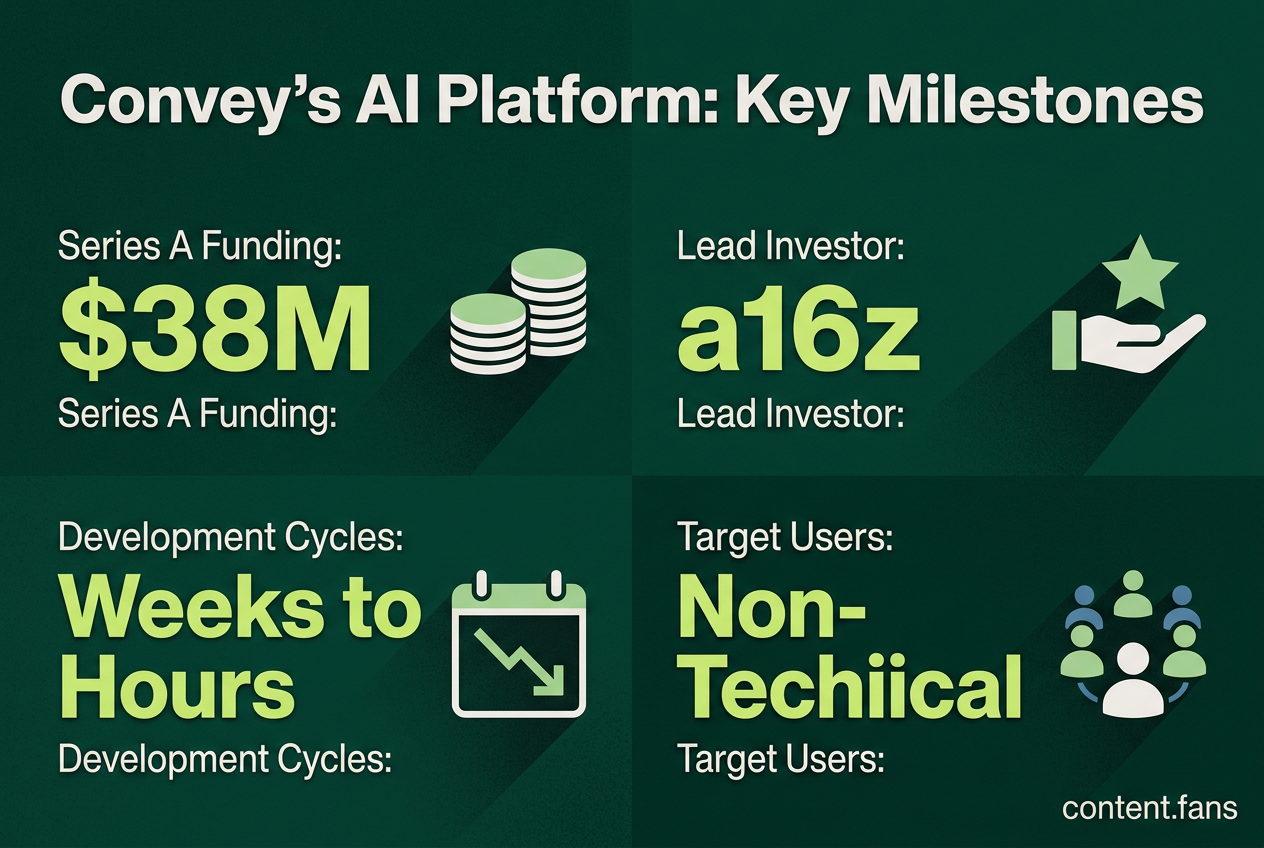
- Lead investor: Andreessen Horowitz (a16z)
- Participants: Khosla Ventures and Pear VC
The Series A round was led by premier venture capital firm Andreessen Horowitz (a16z), with participation from Khosla Ventures and Pear VC. This investment builds upon a previous, undisclosed seed round. Investors highlighted Convey's key advantage: its ability to seamlessly integrate with core enterprise systems like Salesforce, NetSuite, and Workday, as well as legacy platforms lacking modern APIs.
How the platform works
The platform operates on a simple but powerful model where a business user can describe a workflow or provide a screen recording. The AI teammate then autonomously learns and executes the multi-step process. Common use cases include automating invoice processing, campaign reporting, data entry, and support ticket triage. Crucially, each AI teammate is managed through existing enterprise identity and access controls, allowing IT to enforce standard governance policies.
Market context: low-code AI gains traction
Convey's funding arrives as the market for low-code and no-code AI tools gains significant traction. These platforms are proven to slash development cycles from months to weeks or even hours for simple tasks. While analysts point to potential risks like governance gaps and vendor lock-in, the benefits of rapid experimentation and reduced IT backlogs are compelling CIOs to adopt these tools. The trend indicates a strategic shift toward balancing agility with robust oversight, rather than sacrificing control for speed.
Enterprise rollout pattern
Industry best practices recommend a phased rollout to validate ROI and ensure compliance. A typical deployment follows these steps:
- Identify Opportunities: Pinpoint high-volume, repetitive tasks within finance, operations, or HR.
- Integrate Systems: Connect to core business systems using pre-approved connectors or APIs.
- Define Guardrails: Establish rules for which actions the AI teammate can perform autonomously.
- Pilot and Measure: Run a pilot in an assisted mode to track cycle times and exception rates.
- Scale and Govern: Expand deployment once accuracy thresholds are met, maintaining continuous access reviews.
What happens next
With the new capital, Convey will focus on expanding its go-to-market teams and deepening platform integrations. The company's roadmap includes enhancing its library of governance templates and vendor scorecards to simplify adoption, particularly for organizations in regulated industries. The company is expected to grow its workforce significantly to support this expansion.
What is Convey and why did it raise $38 million?
Convey is an enterprise AI platform headquartered in San Francisco that lets non-technical operators create and manage digital teammates - autonomous AI agents that can handle complex business workflows. On June 17, 2026, the company announced it closed a $38 million Series A round led by Andreessen Horowitz, with participation from Khosla Ventures and Pear VC. This substantial early-stage funding indicates strong investor confidence in the rapidly growing low-code/no-code AI tooling market.
Who are the primary users of Convey's platform?
The platform is specifically designed for CIOs, product leaders, and operations teams who need to automate processes without hiring expensive engineering talent. These users can create AI teammates through simple descriptions or screen-sharing sessions - no coding required. The system targets back-office functions like invoice processing, financial reconciliation, campaign reporting, and lead qualification.
How quickly can users deploy a new digital teammate?
According to Convey's own benchmarks, onboarding a new AI teammate takes approximately three hours from start to finish. This rapid deployment is possible because the platform learns workflows by watching users perform tasks or through natural language descriptions, rather than requiring complex programming or API integrations.
What enterprise systems does Convey integrate with?
Convey's digital teammates can connect to both modern cloud applications and legacy systems that lack modern APIs. The platform explicitly supports integration with popular enterprise tools including Salesforce, NetSuite, Workday, Outlook, Teams, Google Workspace, Excel, PowerPoint, and custom software. This broad compatibility helps organizations incorporate AI automation into their existing technology stack without major infrastructure changes.
How does Convey address enterprise governance concerns?
The platform includes built-in governance controls that allow IT teams to manage identity, access permissions, and security guardrails for each digital teammate. Enterprise users can define what tasks teammates can perform autonomously versus which require human approval. This approach addresses the common enterprise concern about governance and security that accompanies low-code/no-code AI deployments, making the technology more acceptable to risk-conscious organizations.