
Congress Unveils Draft AI Bill With 3-Year State Preemption, Audits
Serge Bulaev
Congress has released a draft bill that proposes federal rules for artificial intelligence, including a three-year pause on new state laws about developing AI. During this time, states may still make rules about how AI is used, but not about how it is created. The bill suggests mandatory third-party audits and safety plans for advanced AI models, but details about who should audit and how plans should be made are still being discussed. Some lawmakers and groups worry this pause might stop states from passing transparency or bias rules. The bill's future may depend on political changes and ongoing debates in Congress.

A sweeping bipartisan draft AI bill released by Congress aims to create a unified federal framework for artificial intelligence, proposing a three-year preemption on state laws governing AI development and mandating third-party audits for high-risk models. This 269-page discussion draft, from Representatives Jay Obernolte and Lori Trahan, seeks to prevent a fragmented regulatory landscape by establishing clear national standards.
What does the bill's 3-year state preemption clause do?
The proposal would temporarily block states from creating or enforcing laws that specifically regulate the development of artificial intelligence models. According to early reporting by MLex, the executive-order materials describe efforts to preempt or challenge state AI laws, with separate legislative moratorium proposals discussing five- or 10-year durations. However, a summary in Nextgov clarifies that states would remain free to legislate on the use or deployment of AI systems within their borders. This distinction means states could still ban AI for facial recognition or require disclosure for AI-generated campaign ads. Despite this, groups like Public Knowledge have voiced concern that the "sweeping preemption" could stifle crucial state-level transparency and anti-bias legislation.
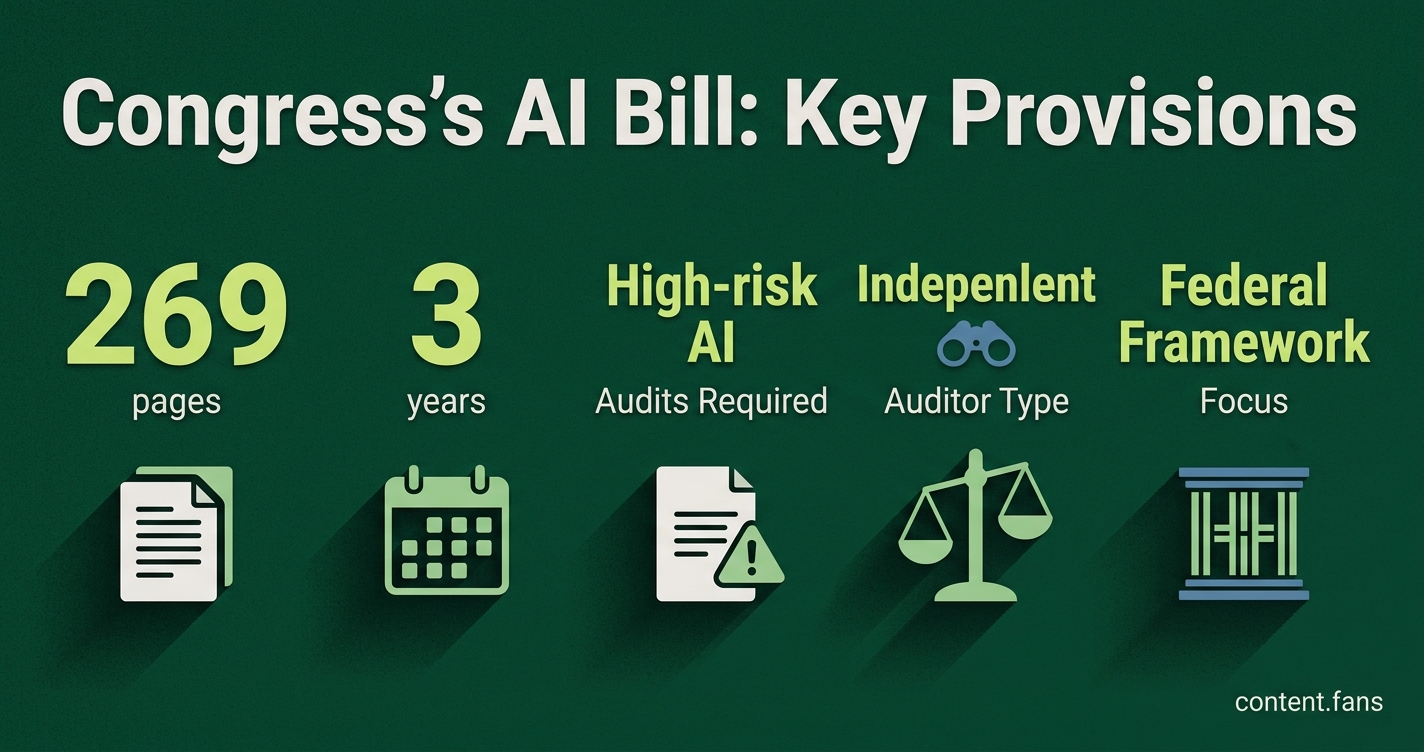
The proposed legislation establishes a national standard for artificial intelligence by temporarily preventing states from regulating AI model development for three years. It also mandates that developers of advanced "frontier" models undergo independent third-party audits and create plans to mitigate catastrophic risks, aiming for a unified U.S. approach.
How would mandatory third-party audits work?
Developers of powerful "frontier" AI models would be required to submit to external audits and file catastrophic-risk mitigation plans with the government. Under the proposal, companies must contract with independent, certified auditors who would verify their safety protocols. Policy briefs from organizations like RAND and the Center for American Progress suggest these auditors would need strong firewalls against conflicts of interest and the capacity to run independent "red team" tests to identify vulnerabilities. For businesses, this means preparing to document high-impact models, draft internal risk playbooks, and budget for recurring external assessments.
What factors could influence the bill's future?
The bill's path forward faces various political considerations as Congress navigates the legislative process. With Congress working through complex AI policy questions, there is no consensus on a comprehensive AI statute. As analyses from MoFo and Brookings indicate, potential shifts in party control of either the House or Senate could change committee leadership. These new gatekeepers could decide to shelve the Obernolte-Trahan framework, significantly alter its preemption and audit provisions, or prioritize an entirely different approach to AI regulation.
Can states still regulate AI during the proposed freeze?
Yes, but only in specific ways. The proposed freeze is narrowly focused on the development of AI models, not their deployment or use. This means states could continue to pass and enforce laws targeting how AI is applied in society. For example, rules requiring disclosure for AI-generated election content - which, according to R Street, at least 26 states already have - would likely remain unaffected. States could also continue to regulate AI in hiring, loan applications, and law enforcement, provided the rules govern the application of the technology rather than its underlying creation.
What key issues are still open for public comment?
The draft's authors have specifically requested feedback on several unresolved policy questions, signaling that these areas are still subject to significant change. Legislators are seeking input on the following points:
- Should the three-year preemption clock start when the bill is signed into law or after federal rulemaking is complete?
- How detailed must catastrophic-risk plans be for different classes of AI models?
- What qualifications should independent auditors have, and which body should be responsible for certifying them?