
Companies Build Local AI to Counter Cloud Uncertainty, Export Rules
Serge Bulaev
Local AI teams may face more uncertainty when using cloud models due to new U.S. export rules that affect some AI systems. Some companies in Asia and Europe appear to be using more open-source models to avoid these policy changes. The guide suggests building AI that can work offline by using containers, reducing resource needs through quantisation, and having backup systems. Teams might also use local updates, track important metrics, and avoid using U.S.-made hardware to stay within legal rules. Running AI locally could take more effort at first, but it may help companies stay resilient if cloud access is disrupted.

Building local AI infrastructure is a critical strategy for companies seeking to mitigate risks from cloud provider uncertainty and shifting U.S. export rules. Regulatory actions have targeted certain AI systems, prompting global engineering teams to increase adoption of open-source models for greater policy independence. This guide outlines the key architectural steps for building a resilient, locally runnable AI infrastructure capable of operating offline or within restricted networks.
1. Establish Container-First Environments
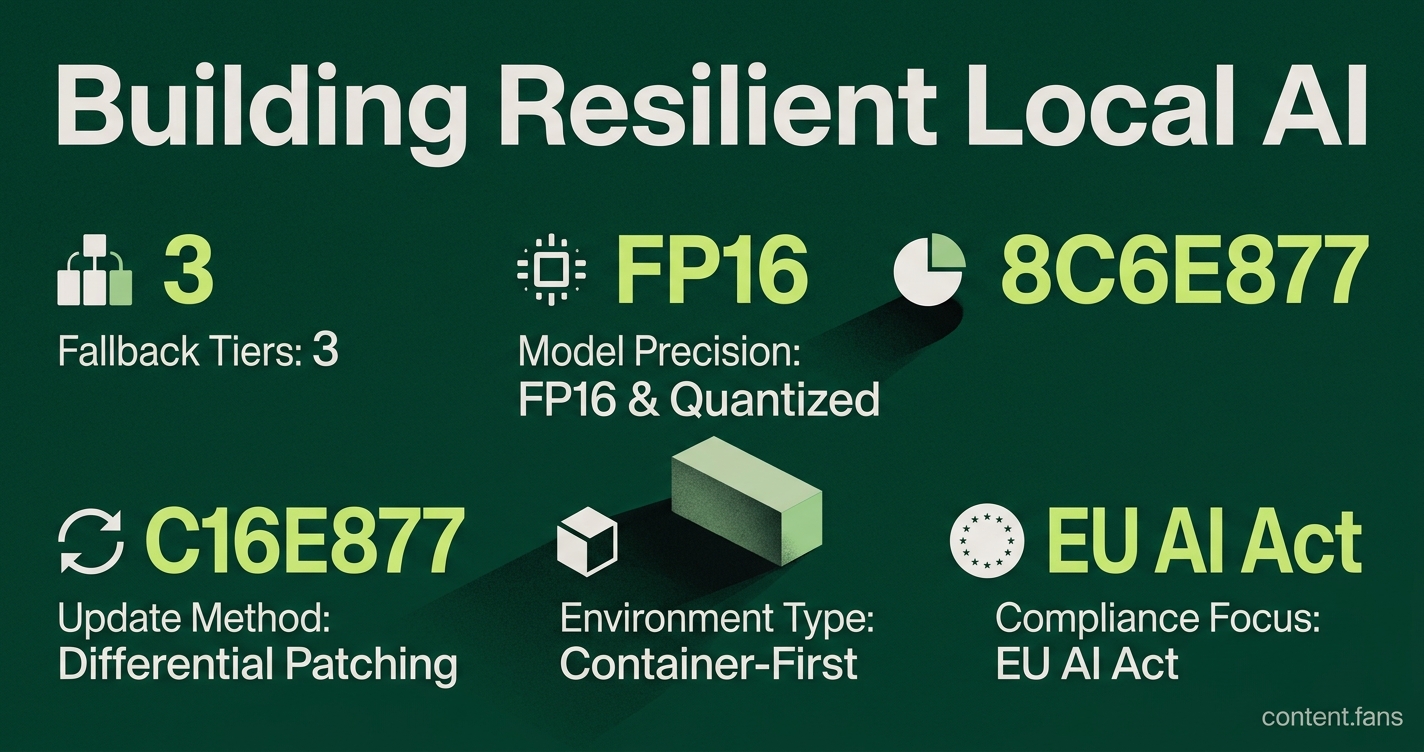
Building resilient local AI involves several key architectural steps. It starts with creating reproducible, container-based environments to ensure consistency, followed by quantizing models to reduce resource requirements, establishing a tiered fallback system for reliability, and implementing secure, cloud-independent mechanisms for updates and governance.
A reproducible base image is essential for eliminating deployment errors, particularly when network access is unavailable. Standardize environments using multi-stage Dockerfiles (e.g., built on python:3.11-slim) and pin all library versions in requirements.txt. To avoid oversized images, store model weights separately and mount them at runtime.
2. Implement Quantization for Resource Efficiency
Reduce VRAM requirements significantly by using quantized GGUF or GGML weights (e.g., Q4 or Q8). Maintain both full-precision (FP16) and quantized versions of a model to enable graceful degradation, allowing the system to fall back to CPU inference when GPU resources are unavailable or overloaded.
3. Design a Three-Tier Fallback Hierarchy
A robust fallback system ensures continuous operation. Structure it in three tiers:
- Primary: Full-precision (FP16) model running on a GPU.
- Secondary: Quantized model running on a CPU.
- Last Resort: A simple rules-based engine or heuristic model.
This architecture allows services to switch tiers automatically, maintaining availability during hardware failures, power cuts, or thermal throttling.
4. Create Cloud-Independent Update Mechanics
To manage updates in an offline environment, use differential patching. This technique prevents the corruption of multi-gigabyte model files by only applying changes. Verify each patch with a local signature check before applying it. For fully air-gapped systems, schedule secure physical media updates (e.g., quarterly USB deliveries).
5. Define Governance and Key Performance Indicators (KPIs)
Establish strict governance by tracking operational and compliance KPIs. Monitor performance metrics such as p95 latency, tokens per second, and hardware utilization. For compliance, track demographic parity, maintain complete audit trails, and ensure rapid detection of anomalies to align with standards like the EU AI Act.
6. Maintain Hardware and Jurisdictional Awareness
Be aware that using U.S.-origin GPUs for training can trigger regulations like the Foreign Direct Product Rule, as detailed by BIS link. To achieve full strategic independence, teams should evaluate and source alternative accelerators from other jurisdictions.
7. Ensure Observability in Offline Environments
Maintain system visibility by directing all logs, metrics, and traces to a local observability stack (e.g., Prometheus and Grafana). Enhance security by running services in non-root containers with read-only filesystems to limit the impact of potential vulnerabilities. Additionally, rate-limit inference endpoints to protect against denial-of-service attacks.
While building an offline replica for each critical AI workflow requires a significant upfront investment, it is a crucial act of strategic resilience. This approach creates a powerful buffer against sudden API deprecations, network outages, and disruptive regulatory changes, ensuring long-term operational stability.