
Companies Adopt Forward-Deployed Engineers to Fast-Track AI Rollouts
Serge Bulaev
Forward-deployed engineers (FDEs) are becoming important for companies as they move AI projects from tests to real use. FDEs work closely with customers, helping turn business needs into working AI solutions and quickly fixing problems. Reports suggest that having these engineers inside customer teams may help projects move faster and avoid getting stuck in early stages. Companies seem to value FDEs for their technical skills and ability to communicate with clients, and pay for these roles is often high. However, some experts warn that if FDEs' insights do not get shared with the rest of the company, some problems may not be solved fully.

Forward-deployed engineers (FDEs) are mission-critical hires for AI vendors, helping transition complex projects from prototype to production. These specialized, hybrid engineers work directly within customer environments to ship features and close the final mile of AI implementation. This hands-on approach prioritizes rapid, tangible impact over abstract platform development and is increasingly seen as a decisive factor in successful AI rollouts.
What sets the role apart
A forward-deployed engineer (FDE) is a hybrid technical expert embedded directly with a company's customers. They translate business needs into functional AI systems, solve complex deployment challenges on-site, and act as a bridge between the client's environment and the core product development team.
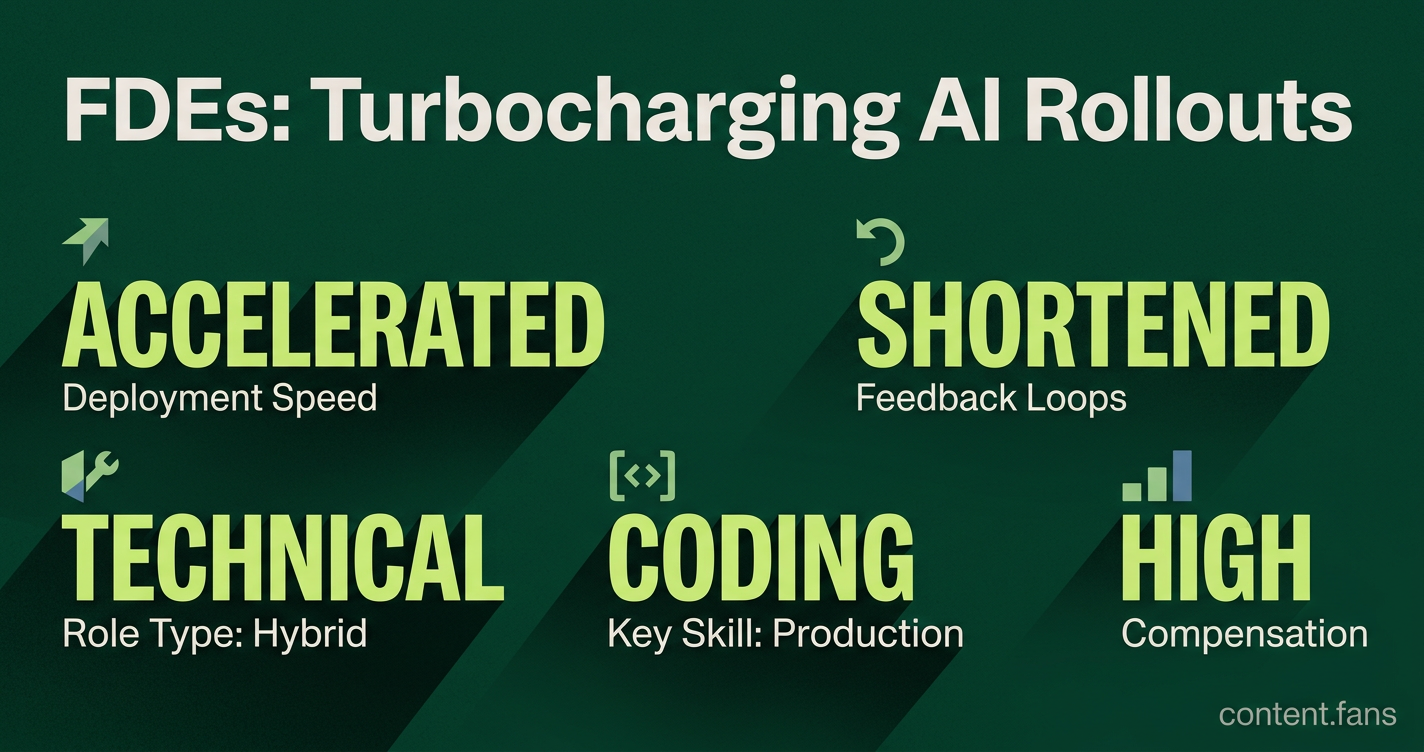
Industry practitioners describe FDEs as elite, hybrid technical roles where daily work involves translating business needs into technical tasks, building end-to-end systems, and troubleshooting production incidents. The Paraform explainer adds that AI-specific duties include prompt engineering, retrieval-augmented generation (RAG), and implementing hallucination guardrails.
Why speed matters
The primary benefit of the FDE model is accelerating deployment. Constellation Research calls FDEs a "turbo charger" for AI, arguing that without them, many projects "never leave the pilot stage." By being embedded with clients, FDEs dramatically shorten feedback loops. They can identify and resolve issues within hours, pushing real-world performance data directly back to the core development team for faster product maturation.
Hiring ripple effects
The demand for FDEs has created significant hiring trends. Companies seek 'T-shaped' professionals with deep software engineering expertise and excellent client-facing skills. This specialized profile commands high compensation. Industry reports indicate that total compensation at many firms can reach significant levels for mid-level roles and exceed even higher amounts for senior staff, with base ranges showing variance based on company stage and geography.
Key competencies employers emphasize:
- Production-grade coding in Python or TypeScript
- Cloud deployment and systems integration across APIs and data pipelines
- Fluency with LLM APIs, RAG pipelines, and agent frameworks
- Stakeholder communication with both technical and executive audiences
- End-to-end ownership, including on-site debugging and post-launch monitoring
Org design trends
To integrate FDEs effectively, organizations are adopting new structural models. Two common patterns have emerged:
- Embedded Pods: One or two FDEs are assigned to a specific customer account while maintaining a direct reporting line to the central engineering team.
- Hybrid Reporting: FDEs report to both product engineering and a customer-facing leader, such as a head of revenue or customer success.
Both models are designed to maximize learnings from the field while ensuring those insights are integrated back into the core product, preventing knowledge silos.
A premium on actionable insight
While the FDE model is powerful, analysts caution it can become a crutch if field insights are not systematically fed back into the core platform, creating a tax on an immature product. However, the high salaries and growing adoption of these roles indicate that for now, organizations view forward-deployed engineers as an essential investment for deploying AI reliably and safely in complex enterprise environments.
What exactly is a forward-deployed engineer (FDE) and how does it differ from traditional engineering roles?
A forward-deployed engineer is a cross-functional, customer-embedded engineer who works inside the customer's environment to make AI systems run in production. While typical product engineers write code for a broad user base, FDEs solve highly specific customer problems on-site, ship production code, and own end-to-end adoption. Industry practitioners define the role as an "elite, hybrid technical bridge" between a generic AI platform and a customer's exact data, workflow, and security landscape. In short: build, debug, and champion AI features where the customer actually works, rather than from HQ.
How do FDEs speed up AI rollouts and tighten feedback loops?
Industry practitioners describe FDEs as accelerants that help companies move past pilot stages. Because the engineer is physically or virtually co-located with the customer:
- Typical prototyping-to-production cycle shrinks from months to weeks.
- Real usage data (latency spikes, hallucinations, integration failures) is visible within hours, not weeks.
- Product roadmap feedback is immediate; lessons are packaged and pushed back to the core platform team at the end of every sprint.
Salesforce leadership explicitly says this model helps customers "get to value faster" while simultaneously "creating a feedback loop to help the product mature."
What skills and hiring criteria should we use for FDEs in 2026?
The hiring bar is T-shaped - deep engineering plus wide customer ownership.
Must-have hard skills
- Production-grade coding (Python/TypeScript)
- LLM fine-tuning, prompt engineering, RAG pipelines, and hallucination guardrails
- Cloud deployment (Docker, Kubernetes, VPC networking)
- Observability tooling (latency, cost, output quality dashboards)
Must-have soft skills
- Executive-level stakeholder communication
- Comfort with ambiguity and rapid iteration
- Willingness to own end-to-end deployment success and train customer teams
Industry reports show significant compensation premiums for these roles, with total compensation reaching substantial levels for mid-level positions at frontier labs, and senior levels commanding even higher packages.
How should we redesign our organization to support FDEs?
Forward deployment works only if the org chart changes:
- Embedded pods: One FDE aligns with (but does not report to) a customer account team while retaining a dotted line to Product/Engineering.
- Feedback plumbing: A formal loop between FDEs and the core product team ensures that field learnings become reusable platform features.
- Hybrid reporting: Performance reviews weight both customer outcomes (deployment speed, adoption) and upstream product contributions.
The result is a bridge organization that behaves like an AI services team without losing the leverage of a centralized software platform.
Are FDEs a permanent fixture or a transitional phase?
Current literature treats them as strategic but temporary accelerants. Palantir pioneered the model, and current adopters note that mature products eventually absorb the custom glue work FDEs provide. Constellation Research warns: "without continuous productization, companies risk creating a permanent FDE tax." In practice, expect FDE headcount to peak during early commercialization and taper once hard-won customer requirements are codified into self-service features.