
Commerce Dept. expands export controls to advanced AI model weights
Serge Bulaev
The U.S. Commerce Department has expanded export controls to cover advanced AI model weights, which may restrict their transfer like high-end computer chips. In Europe, the new EU AI Act sets rules for general and high-risk AI models, and following these rules early appears to help companies get contracts faster. Companies now face higher costs to follow different rules in the U.S., EU, and China, and experts suggest these costs may outweigh other savings. There is also a proposal for a big tax on very large U.S. AI firms to share profits with citizens, which might change who benefits from AI. It seems that the future of AI market control depends on how strict and fast regulators act and how industry adapts to these new rules.

The recent expansion of export controls on advanced AI model weights by the U.S. Commerce Dept. signals a shift in the global battle for AI dominance, moving from ethics debates to the trenches of regulation. The core issue is clear: whoever controls the enforcement levers - export controls, procurement conditions, and technical standards - will shape the future of the AI market as profoundly as the technology itself.
The export control squeeze
The U.S. Commerce Department now treats the weights of powerful AI models as dual-use technology, similar to high-end computer chips. This policy restricts their transfer across borders, subjecting advanced AI systems to new export control rules designed to manage national security risks associated with their proliferation.
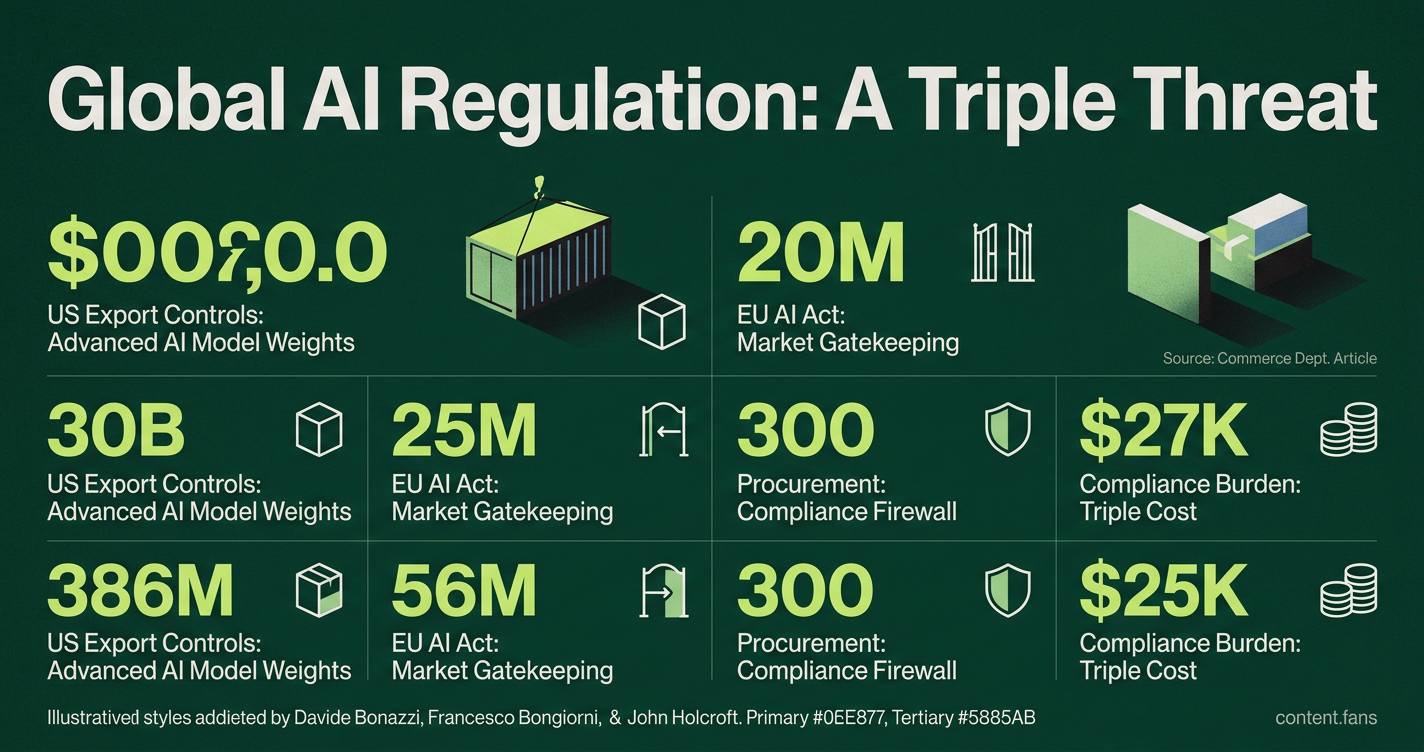
Washington's regulatory reach has widened significantly. The Commerce Department's January 2025 decision (effective Jan 13, 2025) extended dual-use rules to the weights of advanced AI models. While the Commerce Department has updated export controls on AI chips, the extension to model weights represents a significant expansion of regulatory oversight. This regulatory shift has established new precedents and added significant audit burdens that are becoming standard operating costs for AI labs.
Standards shift from guidance to gatekeeping
In contrast, European lawmakers are using standards as a form of market gatekeeping. The EU AI Act entered force in August 2024 with a phased rollout. While systemic-risk guardrails are in place, the comprehensive high-risk regime is still being implemented. AI providers that adopt the Act's voluntary Code of Practice early are gaining a competitive edge through faster procurement approvals and lower litigation risk.
Procurement as compliance firewall
Procurement policies are becoming a key compliance firewall. For major buyers, a model's provenance is now as critical as its performance. While NIST AI 100-1 provides a voluntary framework, federal agencies are increasingly requiring detailed documentation and security testing, though these requirements are not universally mandated as binding requirements for all AI labs. Standard approval cycles depend on regulatory compliance rather than proprietary systems.
Triple compliance costs hit vendors
AI vendors operating globally now contend with a 'triple compliance' burden, navigating divergent audit regimes in the United States, the European Union, and China. This has created a permanent cost category for legal and operational teams, which includes:
- Continuously mapping export-control exposure.
- Stress-testing business scenarios against regulatory divergence.
- Architecturally segregating deployments by jurisdiction.
Industry experts warn that these compliance costs are beginning to outpace the savings from falling token prices, effectively neutralizing the economic benefits of model commoditization.
Stakes: public wealth funds and trusted supplier lists
The stakes in this regulatory battle extend directly to who captures AI's economic gains. The American AI Sovereign Wealth Fund Act imposes a one-time 50% stock (equity) tax on qualifying U.S. AI firms with at least $200 million in annual AI revenue. The fund structure aims to redirect a portion of AI profits to the public before 'trusted supplier' lists lock in dominant incumbents.
Possible scenarios
Looking ahead, several scenarios could unfold:
- Fragmented Global Markets: Divergent export controls and recall powers could lead to region-locked AI ecosystems, limiting interoperability.
- Rise of 'De-Risked' Vendors: Companies that invest heavily in early compliance may capture global market share, even with lower profit margins.
- Public Wealth Capture: Legislation like sovereign wealth funds could redirect a portion of AI profits to the public, shifting private investment toward data and application layers.
The final outcome will be determined by the aggressiveness of regulators and the speed at which the industry integrates governance into its core products. The rule-writers of today are not just drafting laws; they are shaping the economic foundations of the future.