
Colorado Act, EU AI Act Reshape Financial AI Regulation
Serge Bulaev
Recent laws like the Colorado AI Act and the EU AI Act may change how financial companies use AI by requiring new disclosures and more careful tracking of how AI makes decisions. Chatbots are handling millions of customer questions, showing that banks appear to be quickly adopting AI for customer service. Studies suggest that more fintech content is now short, technical updates, likely driven by AI tools. Some banks and firms are using AI assistants to help advisers find information faster, which might mean AI is supporting experts rather than replacing them. There is also a trend toward treating AI-generated content as official communication that must be reviewed before use, suggesting new compliance processes are forming.

The regulatory landscape for AI in financial services is evolving, with the Colorado AI Act and EU AI Act introducing significant new rules. As financial firms accelerate AI adoption, evidenced by chatbots handling millions of interactions, these laws establish critical guardrails for AI-driven communications and decision-making.
This analysis examines five key developments that define this new era: landmark regulations, emerging compliance workflows, shifts in content marketing, the massive scale of AI in customer service, and new tools for financial advisors.
1. Colorado Mandates Public AI Disclosures
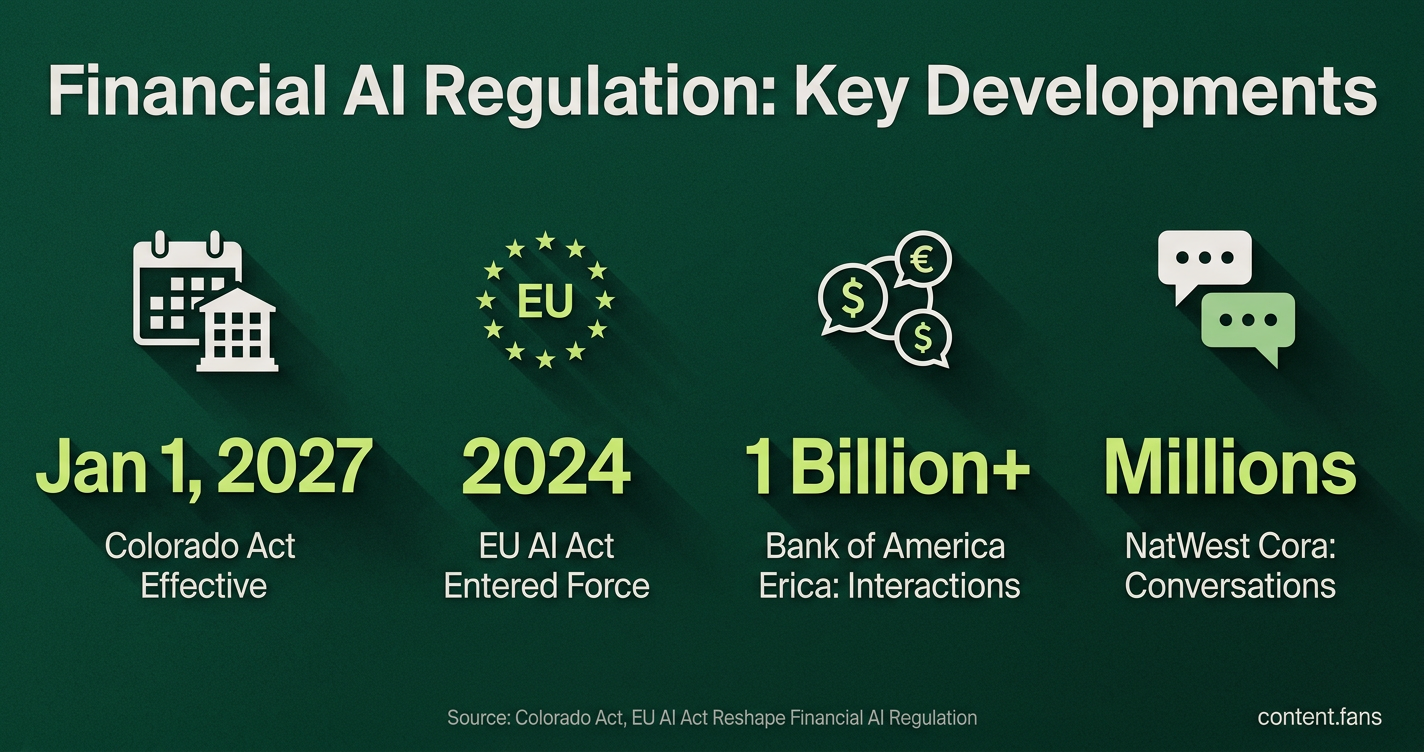
Under SB 189, Colorado's AI Act becomes effective January 1, 2027, and for financial institutions the law includes consumer-facing notice/disclosure duties and website statements, but not the earlier mandatory annual impact assessment and AG reporting regime. Consequently, AI-generated marketing and customer service content now fall under the same stringent compliance protocols as traditional advertising.
These regulations fundamentally change AI governance by requiring financial firms to provide explicit customer disclosures when using high-risk AI. They also mandate rigorous documentation of data, model oversight, and human review processes, treating AI-generated content as official communication subject to full regulatory scrutiny and record-keeping rules.
2. EU AI Act Sets Compliance Deadlines
The EU AI Act entered into force in 2024, but high-risk obligations are phased in on different timelines rather than all becoming applicable on a single date. This requires banks to meticulously document data lineage, human oversight protocols, and all customer-facing communications. Proactive legal teams are advising marketers to develop standardized disclosures explaining the extent of human involvement in AI-powered processes.
3. AI-Driven Content Shifts Marketing Strategies
The influence of AI extends beyond efficiency, actively reshaping fintech marketing strategies. Industry reports indicate that short-form, technical content like product updates now constitutes a significant portion of output, representing a substantial increase from previous years. Topic clusters focused on automation have also grown considerably, indicating that AI is guiding editorial focus toward real-time, product-aligned content rather than just accelerating copywriting.
4. Conversational AI Manages Customer Service at Scale
Leading banks are demonstrating that AI can manage massive customer service volumes. A collection of 2024 case studies from UXDA highlights significant adoption:
- Bank of America's Erica: Has exceeded 1 billion interactions
- NatWest's Cora: Millions of conversations
- Wells Fargo's assistant: Millions of interactions
The scale confirms conversational AI's capacity for handling routine inquiries. This success is attributed to continuous model training and deep integration with core mobile banking applications (AI case studies).
5. AI Assistants Augment Advisor Expertise
AI is proving to be a powerful tool for augmenting human expertise, not just replacing it. For example, Morgan Stanley deployed a GPT-4 powered assistant that achieved high adoption rates among its advisor teams. The tool accelerates research by surfacing internal data in seconds, dramatically cutting time spent searching document portals. This strong adoption underscores significant demand for AI tools that enhance advisor productivity and support expert decision-making.
The New Compliance Workflow
Legal guidance reinforces that AI-generated content must be treated as official "firm communications." Industry reports highlight the requirement for pre-use approval, ongoing supervision, and archival retention for all AI drafts. This signals a move toward integrated compliance systems where content platforms can automatically flag AI-generated text for mandatory audit review before publication.
Strategic Outlook
Financial institutions that successfully navigate this new environment will be those that integrate proactive disclosure, governed workflows, and compliant personalization. By mastering these elements, firms can scale their AI-driven communications effectively without violating the new regulatory frameworks. These trends serve as critical indicators for the future of AI in financial services.