
Cognition AI raises $1B+, hits $492M run-rate with Devin AI
Serge Bulaev
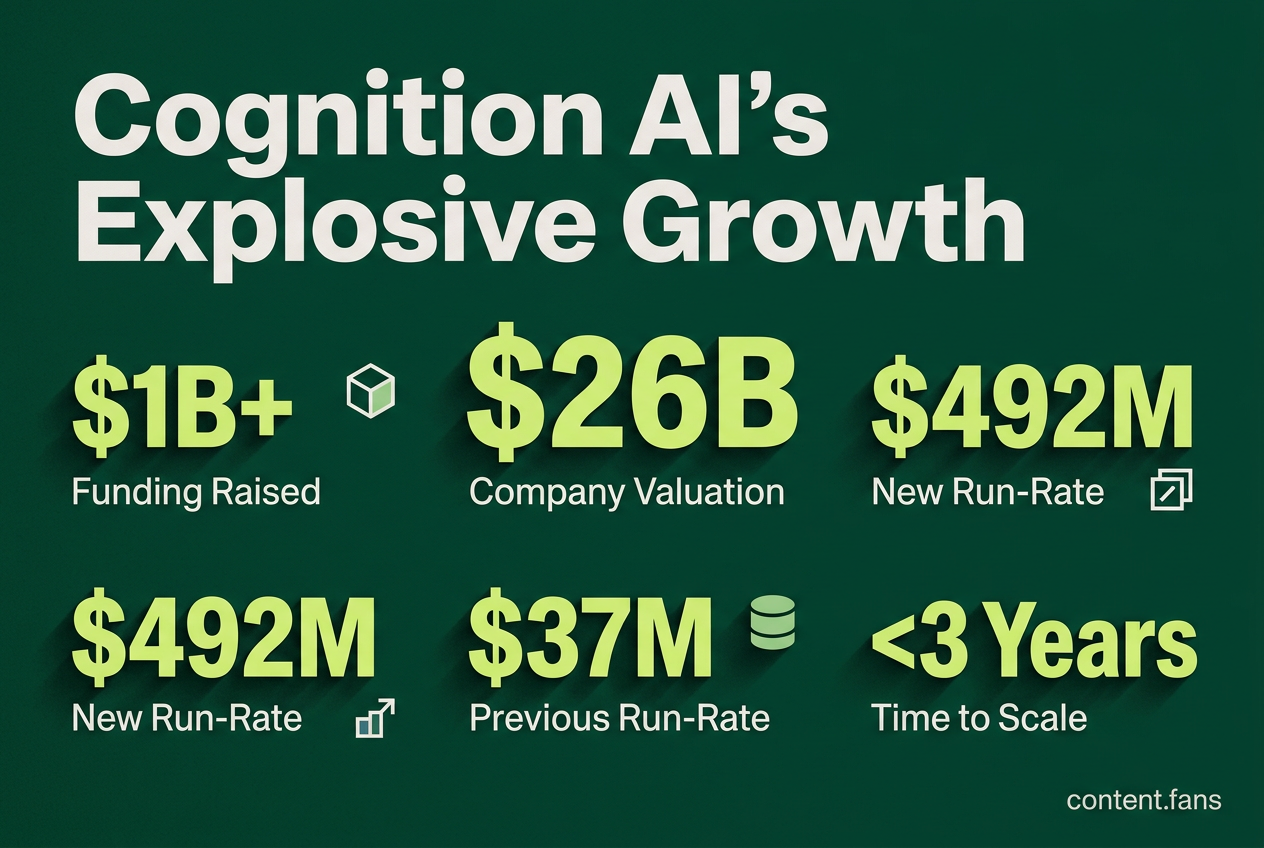
Cognition AI has reportedly raised over $1 billion at a $26 billion valuation, with revenue run-rate jumping from $37 million in May 2025 to about $492 million now. This growth suggests strong investor interest in developer-focused AI, but there are still questions about profits and long-term success. Cognition's main product, Devin AI, may be finding early success in the market, though the company faces competition from big tech firms and other AI tools. Experts warn that costs may rise faster than revenue, and investor focus may shift to startups with steady income and compliance. Trust in AI tools among developers appears to be an issue, which might affect future sales and renewals.

New investor documents show Cognition AI raised over $1 billion at a $26 billion valuation, skyrocketing its revenue run-rate from $37 million to a reported $492 million. This massive funding highlights intense investor confidence in developer-focused AI, although it also raises questions about long-term profitability and market sustainability.
This rapid ascent places the San Francisco-based startup among an elite group of private software firms to achieve a substantial revenue run rate within three years of its founding. Analysts suggest this performance signals strong product-market fit for its flagship AI coding agent, Devin AI.
Growth signal and competitive lens
Cognition AI's explosive growth is fueled by its flagship product, Devin AI, an autonomous coding agent demonstrating strong product-market fit. The company's funding and valuation reflect intense investor appetite for specialized AI developer tools that promise significant productivity gains, positioning it as a major market contender.
The company operates within a cognitive AI market that industry reports suggest is experiencing rapid growth. This "moderately fragmented" landscape sees Cognition AI competing as a fast-growing challenger against incumbents like IBM, Microsoft, and Google.
Offering products like Devin AI, DeepWiki, and Windsurf to automate development, Cognition faces direct competition from AI coding assistants and indirect pressure from broader AI platforms. This competitive environment demands strong differentiation as major players integrate similar AI features into their existing developer tools.
Sustainability and the unit-economics puzzle
However, rapid growth presents a significant challenge: costs for compute, talent, and compliance can easily outpace revenue. Industry analysts note that expanding AI usage often precedes efficiency gains, leading to higher operational bills. To maintain healthy margins, AI coding vendors are generally advised to focus on key strategic levers including value-based pricing, cost optimization techniques, and customer segmentation.
Furthermore, industry observers note evolving investor priorities, with a greater focus on startups demonstrating predictable revenue and robust compliance, not just top-line growth. This trend suggests Cognition will face increased scrutiny of its capital efficiency, even with its substantial new funding.
Investor sentiment in 2026
While developer adoption of AI tools is high, industry reports suggest a significant trust gap persists among developers regarding AI outputs. This could steer procurement toward tools with proven accuracy and strong governance. Despite this, capital remains available, with substantial private AI investment continuing according to industry reports.
Market spending is expected to shift toward specialized applications like developer tools that offer clear ROI and seamless workflow integration. Enterprises are likely to continue investing in coding assistants as long as vendors can consistently demonstrate meaningful productivity gains.
What to watch next
- Gross-margin trends as Cognition scales usage-based pricing across Devin AI.
- Competitive responses from cloud incumbents bundling coding copilots with infrastructure contracts.
- Developer trust metrics and the impact on renewal rates for paid plans.
Ultimately, Cognition AI's massive funding round confirms strong market confidence in developer-focused AI. However, it also raises the stakes, demanding exceptional performance in capital efficiency, competitive differentiation, and long-term sustainability.
What triggered Cognition AI's meteoric revenue growth in about one year?
Devin AI, the company's fully autonomous software-engineering teammate, scaled from early enterprise pilots to production-level deployments inside Fortune 500 codebases. Usage-based pricing plus immediate, measurable productivity gains created substantial revenue growth without adding an equal surge in seats, pushing annualized ARR to significant levels according to industry reports.
Who are Cognition AI's real competitors now that it has achieved this substantial valuation?
Despite the impressive numbers, Cognition is still a fast-growing entrant, not a measured market leader. Direct rivals include Microsoft Copilot, Google Codey, AWS CodeWhisperer and well-funded newcomers such as Replit Ghostwriter and Cursor. Indirectly, the company vies with IBM Watson, SAP AI Core, and Oracle OCI Generative AI for the same enterprise AI transformation budgets.
How sustainable is Cognition's margin profile given AI coding's heavy compute load?
Industry reports suggest the firm has moved from raw GPU burn to tiered, value-based pricing; enterprise contracts reportedly include usage caps and success-fee add-ons that lift gross margins above typical SaaS levels. Internal prompt-caching and model-distillation techniques are said to significantly cut per-interaction cloud spend, improving unit economics as revenue scales.
Why did investors pour more than $1 billion into a single round rather than stage smaller checks?
Current investor sentiment reportedly favors concentrated bets on workflow-integrated platforms over scattered point solutions. With the cognitive AI market experiencing substantial growth, late-stage funds preferred to secure a large, defensible position in one of the fastest-growing software categories according to industry analysts.
What risks could derail Cognition AI's path to profitability?
- Trust deficit: Industry surveys suggest many developers have concerns about current AI coding output reliability.
- Rising retention costs: specialized AI talent remains scarce and expensive, driving burn if growth slows.
- Regulatory drag: emerging code-provenance and security rules may require expensive compliance layers.