
Cognite Co-founder Details Why Industrial AI Projects Fail
Serge Bulaev
Many industrial AI projects do not succeed after early pilot tests. Geir Engdahl from Cognite suggests the main problems are messy data, slow integration, and a lack of trusted systems for scaling up. He says success may depend on clear rules, good data, and operator trust, not just better algorithms. New tools like knowledge graphs appear to help by making data easier to understand and audit. Some experts believe that by 2028, companies without these systems may fall behind, as using AI for operations could lead to higher profits.

Many industrial AI projects fail to move beyond the pilot stage, a problem Cognite co-founder Geir Engdahl attributes to operational gaps, not flawed algorithms. In an Exclusive interview: Geir Engdahl on why industrial AI fails on the plant floor, he highlights that the real challenge is scaling a single demo into thousands of reliable, audited deployments. Success, he told Superintelligence, hinges on trusted live data, robust governance, and operator confidence, signaling that the core challenge is operational.
Why proofs-of-concept stall
The core reasons industrial AI projects stall after the proof-of-concept phase are fragmented data, an inability to scale models reliably, and a lack of governance. These operational hurdles prevent even accurate algorithms from being trusted and integrated into live, high-stakes industrial environments.
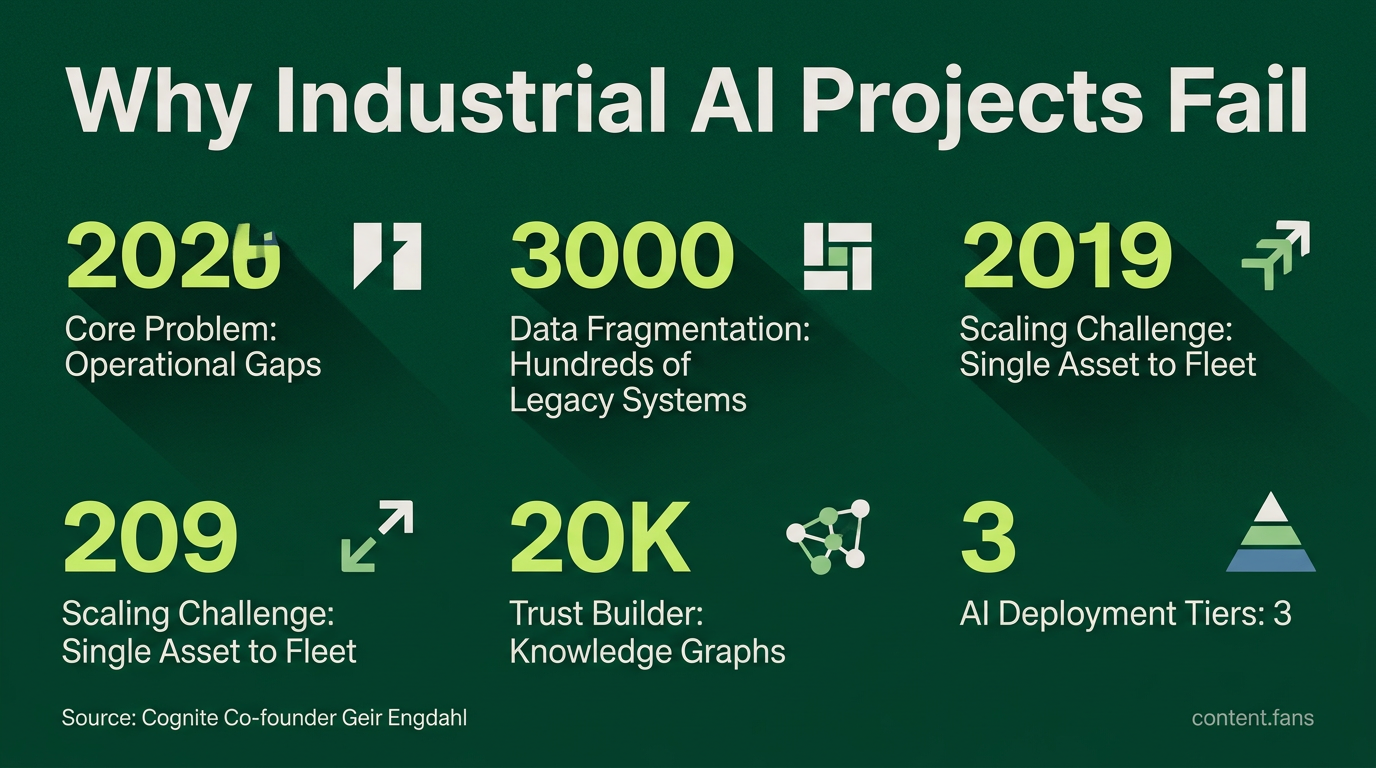
The journey from a successful proof-of-concept (PoC) to full-scale production is where most industrial AI initiatives falter. Engdahl identifies two primary blockers: messy data and the challenge of scale.
Heavy-asset companies often operate on "hundreds of legacy systems" with no common data model, making integration slow and unreliable. This data fragmentation renders AI outputs probabilistic - a significant risk in operations where errors are not tolerated. A recent Cognite blog advises teams to establish a "safehouse for models" to ensure AI workloads consume governed, real-time sensor data rather than being isolated on laptops. Without this data pipeline, no model can be trusted.
Scaling a model from a single asset to an entire fleet is the next hurdle, which Engdahl describes as significantly more challenging. A model tuned for one pump rarely works for all of them without continuous monitoring, versioning, and rollback plans for each deployment. Without these safeguards, operators will revert to manual control.
Governance and explainability tools emerge
To solve the trust and data fragmentation problem, industrial knowledge graphs are emerging as a critical governance layer. These tools connect assets, processes, and documentation into a unified semantic model, enhancing AI explainability and data provenance. By providing a trusted, continuously updated web of facts, they help reduce AI hallucinations and accelerate root-cause analysis.
Crucially, knowledge graphs allow engineers to trace any AI recommendation back to its source data, such as a specific sensor tag or maintenance log, which enforces accountability. They also provide role-based access controls and a complete change history - features essential for auditors to approve autonomous systems.
When to recommend and when to automate
Engdahl proposes a three-tiered framework for AI agent deployment to build operator trust:
1. Decision Support: Use AI broadly to assist humans with tasks like alarm triage and maintenance planning.
2. Auditable Automation: Automate low-risk, repeatable actions, ensuring every action is logged and auditable.
3. Closed-Loop Control: Reserve direct, autonomous control for narrowly defined scenarios only after a rigorous safety assessment.
He warns that bypassing these guardrails erodes operator trust, a primary reason pilots are abandoned after the initial implementation team departs.
Production SLAs make or break adoption
Once a pilot moves into production, success metrics must shift from model accuracy to operational reliability. Key performance indicators become data stream uptime, alert latency, and user adoption across all shifts. As highlighted in the Cognite blog, this requires enforcing production-grade Service Level Agreements (SLAs) that define accountability. Core operational duties include ensuring continuous data flow and proactively monitoring sensor health, demanding that AI teams adopt the same rigorous discipline as process control engineers.
Competitive pressure builds
The push for industrial AI adoption is accelerating due to clear competitive advantages. Industry reports suggest that a growing number of manufacturers are adopting AI for quality management and process optimization. Research indicates that companies embedding AI for process optimization can achieve meaningful increases in operational efficiency.
Engdahl notes that firms without embedded AI optimization may face competitive disadvantages as the technology matures. This market pressure is forcing industry leaders to shift focus from flashy demos to governed, scalable AI deployments built on knowledge graphs and backed by robust SLAs.
Why do most industrial AI projects die after a promising pilot?
Geir Engdahl describes it as significantly more challenging to turn a proof of concept into a running production asset. The pilot may hit high accuracy on historical files, yet stall the moment it meets real-time, multi-site reality. Typical killers are:
- Untrusted real-time data - sensors drift, historians lag, formats vary
- Siloed systems - the model cannot reach DCS, CMMS, ERP or operator displays
- No governance layer - no one knows which data version is authoritative
- Zero operational accountability - when the alarm sounds at 3 a.m., no SLA or on-call rotation exists
The result: after the vendor case study is published, the model is quietly switched off.
What makes industrial data so much messier than enterprise data?
Industrial plants run on hundreds of legacy systems that never agreed on a common data model. Each historian, SCADA node, MES and maintenance spreadsheet speaks its own protocol and time stamp convention. Engdahl notes that "industrial businesses are physical", so even a perfect SQL join can fail when a sensor is re-cabled or a valve tag is renamed on paper but not in the database. Data quality drifts daily - a stuck flow meter can feed the same value for days, making yesterday's training set instantly misleading.
How do knowledge graphs close the trust gap for operators?
Cognite's experience shows that industrial knowledge graphs act as the governance scaffold between raw signals and AI outputs. Instead of presenting a black-box alert, the graph:
- links every recommendation to provenance (sensor ID, calibration date, last maintenance order)
- stores asset criticality scores and failure costs, so the system can rank actions
- records change history and role-based access, keeping audits simple
In one refinery deployment, RCA (root-cause analysis) audit time dropped significantly because engineers could trace any AI suggestion back to tagged evidence and shift logs.
Where should AI agents be allowed to act on their own?
Engdahl draws a clear line: recommend widely, automate narrowly, control rarely.
| Risk level | Agent role | Example |
|---|---|---|
| Low | Full automation | Reschedule non-critical lab analyses |
| Medium | Recommend + require approval | Suggest pump swap based on vibration trend |
| High / Safety | Advisory only | Flag pressure anomaly but never close a valve |
All actions run in auditable lanes with pre-approved guardrails and human override buttons.
What will happen to factories that resist AI adoption?
Industry observers suggest: companies without embedded AI-driven process optimization may face competitive disadvantages as the technology matures. Early movers already report:
- Significant efficiency gains in bottleneck processes
- Meaningful cost reductions in specific lines
- Reasonable payback periods on AI optimization projects
With margins tightening and supply chains remaining volatile, AI is becoming increasingly important, not a nice-to-have.