
Coca-Cola uses AI to boost retail sales 8%, cut costs
Serge Bulaev
Coca-Cola is using AI mainly to help grow sales and not just to cut costs, according to company leaders. The company uses AI tools to help managers decide on product restocking, pricing, and which products to offer in different stores. Early tests suggest that AI-powered messages to retailers may have increased sales by 7-8% and made sales forecasts more accurate. Similar AI use in vending machines appears to have raised revenue by about 6% and reduced truck visits by 15%. These results are reports and may not be fully audited, but they suggest that AI can make everyday business decisions better without cutting jobs.

In a strategic move to boost retail sales, Coca-Cola uses AI to optimize pricing, stocking, and product mix. According to President and CFO John Murphy, the company views artificial intelligence as a "growth enabler rather than a cost reducer," focusing on using the technology to sharpen its portfolio and make smarter decisions. The beverage giant is deploying decision-support models that feed retail data, weather patterns, and sales history into machine learning algorithms to generate store-level recommendations for its managers.
Inside Coca-Cola's AI-Powered Retail Playbook
Coca-Cola's AI strategy centers on its Retail Growth Management (RGM) platform. This system uses machine learning to analyze store-level data, weather, and sales history, generating real-time recommendations for inventory, pricing, and product assortment to help managers drive sales and improve forecast accuracy.
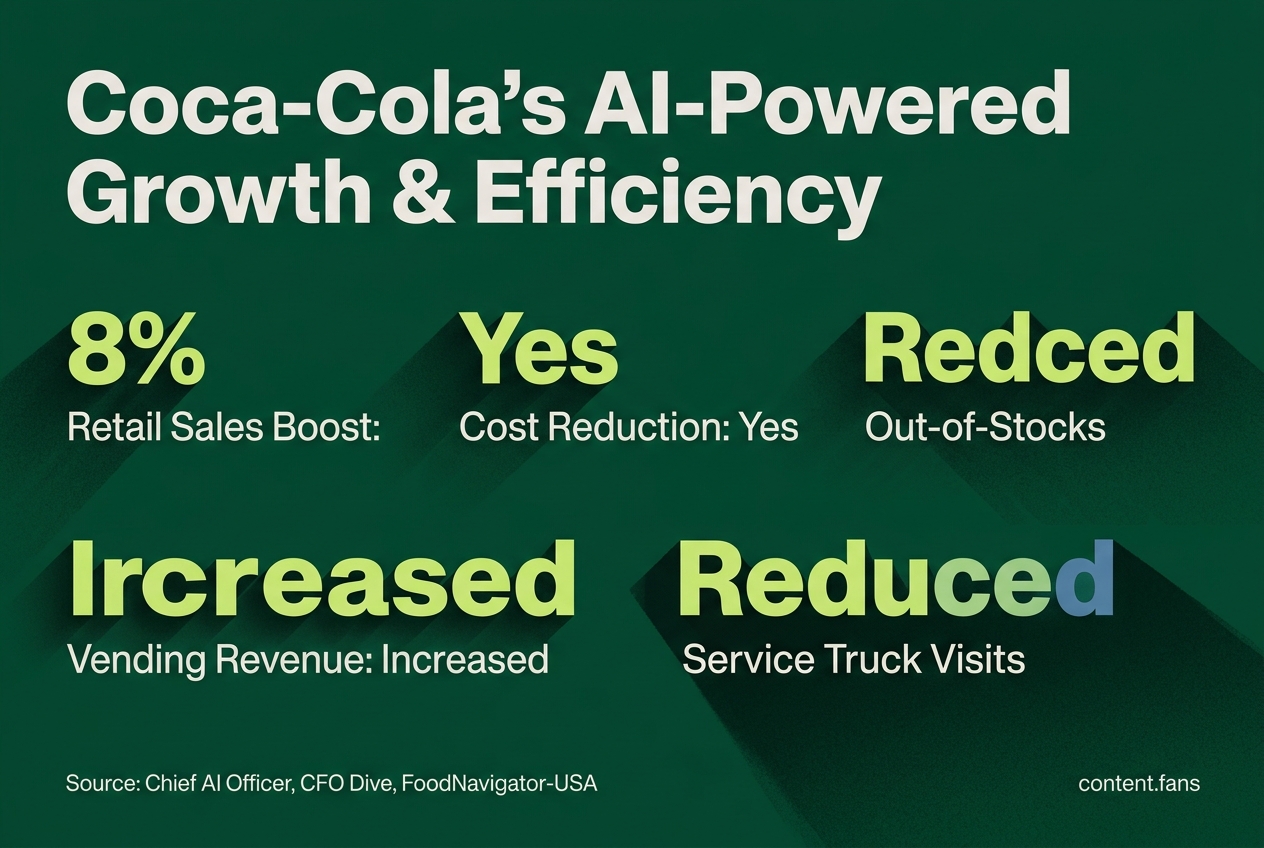
A key test involved sending AI-driven WhatsApp messages to independent retailers with alerts like "Restock 1.5-L Coke Original today." According to industry reports, this initiative led to significant sales increases and improved demand forecast accuracy Chief AI Officer. These results demonstrate how AI can reduce out-of-stocks and optimize inventory without increasing labor costs.
Coca-Cola applied similar analytics to its Australian vending machine fleet, reportedly increasing revenue while reducing service truck visits. This showcases how insights from micro-retail environments can inform the company's broader RGM strategy.
Aligning Premium and Value Packs
AI is also central to Coca-Cola's price-pack architecture. Murphy told analysts the technology helps "hone in on what's going to deliver the most value for our buck." According to industry reports, the company uses scenario modeling tools to analyze how different product configurations perform under various demand scenarios, as noted in a CFO Dive report. This allows teams to balance profit margins against sales velocity before launch.
This data-driven approach enables the company to strategically target different consumer needs. According to industry reports, this allows for marketing premium smaller formats for on-the-go purchases while offering competitively priced multi-serve options for budget-conscious households. This dual focus on premium and value segments is now a core part of its RGM planning, according to a FoodNavigator-USA interview.
Reported Outcomes So Far
While many results are based on pilot programs and secondary reports, the initial data points to significant gains from Coca-Cola's AI initiatives:
- WhatsApp Restocking Pilot: Significant lift in retail sales
- Forecast Accuracy: Notable improvement in prediction capabilities
- Australian Vending: Revenue increases and reduction in service runs
These figures, though not officially audited, suggest that targeted AI interventions in assortment and availability can have a direct and positive impact on revenue.
A Strategic Shift from Cost-Cutting to Growth
Unlike many CPG peers who discuss AI primarily for cost discipline, Coca-Cola has a different narrative. Murphy positions AI as a "new secret sauce" for smarter capital allocation, not employee replacement. This growth-oriented mindset influences how the company invests in innovation, localized marketing, and high-margin product categories where AI can uncover new opportunities.
The company is also applying AI to its creative operations. Its Create Real Magic platform, which attracted over a million users, reportedly cut asset localization times significantly, allowing for faster retail activation. By linking marketing content creation directly to shelf execution, Coca-Cola is closing the loop between its marketing efforts and its RGM strategy.
What exactly is Coca-Cola calling "Retail Growth Management" and how does AI fit in?
Coca-Cola defines Retail Growth Management (RGM) as the discipline that decides what to sell, where to sell it, and at what price. AI now sits at the center of each lever: demand forecasting, inventory replenishment, price-pack architecture, and route-to-market planning. Instead of annual resets, managers receive weekly recommendations via WhatsApp messages driven by machine-learning models that weigh historical sales, weather, and nearby events. These short-cycle adjustments are what the company credits for the significant sales improvements reported in pilot stores.
Is Coca-Cola using AI mainly to cut jobs?
No. CFO John Murphy has gone on record saying he sees AI "more as a growth enabler than a cost reducer." While efficiency gains do appear in operations, the public messaging is that freed-up labor hours are redirected toward premium and value innovation, not layoffs. The deployment prioritizes higher-margin category expansion and localized marketing content rather than headcount reduction.
How does AI help Coca-Cola target both premium and value shoppers at the same time?
The models ingest shopper-panel data, social sentiment, and real-time POS scans to segment occasions, not just people. A single household may be flagged as "premium" for weekend entertaining and "value" for weekday lunchboxes. Pricing engines then simulate elasticity curves for every SKU in each micro-segment, allowing the same store to run high-margin single-serve glass on end-caps and multi-can value packs in the cold vault without cannibalization. This dual-track strategy is what Coca-Cola calls "precision relevance across income segments."
What measurable impact has the WhatsApp restocking pilot delivered?
According to secondary coverage, retail managers who followed the AI-generated restock prompts saw significant sales improvements versus control stores. Forecast accuracy also improved substantially, cutting both out-of-stocks and excess inventory. While the figures come from external articles rather than an official earnings release, they represent the most specific RGM performance indicators currently in circulation.
How does Coca-Cola's AI stance compare with the broader CPG industry?
2025-2026 CPG deployments appear to balance cost containment with growth, resilience, and AI-enabled operational improvement; cost-focused automations like reporting and SKU optimization are common, but the evidence does not show they are the majority focus. Coca-Cola's narrative stands out by tying AI to revenue growth: scenario-modeling tools let finance simulate ROI of marketing investments in real time, aiming for what Murphy calls a "new secret sauce" in capital allocation. In short, while many peers chase savings, Coca-Cola is positioning AI as the engine for premium innovation and share gain.