
Coca-Cola expands AI to boost retail sales 7-8%, marketing 20%
Serge Bulaev
Coca-Cola appears to be using artificial intelligence to improve sales and marketing. Their AI system may help decide which product sizes and prices to offer in stores, and early tests suggest this could raise sales by about 7 - 8%. The company also says AI tools help them make marketing faster and more relevant, with some reports suggesting a 20% increase in marketing engagement. Leaders suggest these changes are meant to support growth for all types of shoppers, not just to cut costs. Analysts say if these results continue, other companies might try similar AI projects.

Coca-Cola is expanding its use of artificial intelligence, moving the technology from a backroom experiment to a core driver of its retail and marketing strategy. Senior leaders confirm that machine learning now guides daily decisions, with a clear focus on boosting revenue rather than cutting jobs. The beverage giant's stated goal is to enhance brand relevance for both premium and value-conscious consumers while simultaneously increasing sales volume and profit margins.
Inside the AI Retail Growth Management Playbook
Coca-Cola's AI-driven Retail Growth Management (RGM) system uses predictive models to optimize in-store product mix, pricing, and shelf placement for each retail location. The platform analyzes historical sales, weather, and location data to forecast demand, helping drive incremental revenue and improve inventory management for its partners.
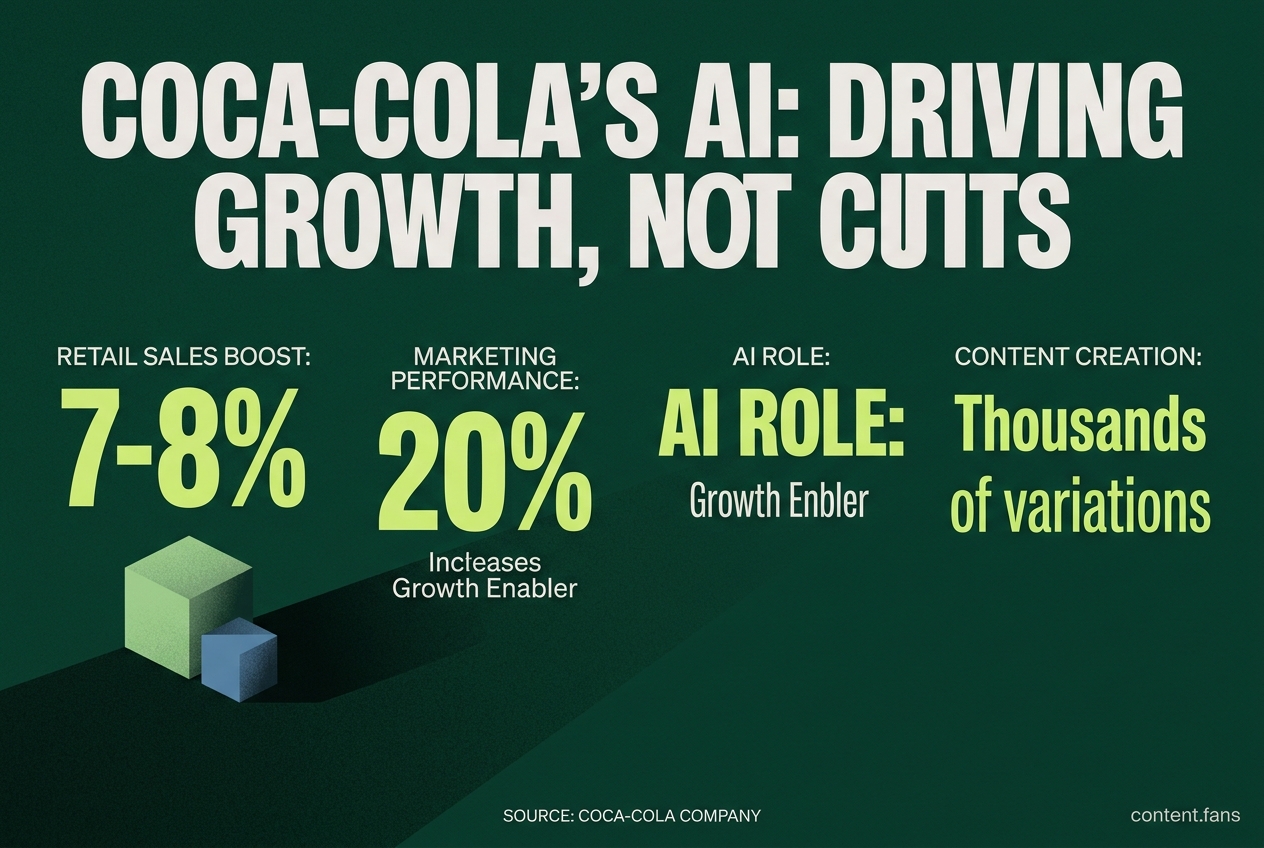
At the core of this retail strategy is the RGM system, which leverages predictive models to tailor product sizes, pricing, and shelf assortments for every retail partner. CFO John Murphy, in a FoodNavigator-USA report, called RGM a "growth enabler" for serving both premium and value shoppers. Early tests of an AI-powered price pack channel optimization tool showed significant improvements in retailer acceptance of recommended products, according to industry reports.
Furthermore, the company's tech division developed a sophisticated demand-forecasting algorithm that integrates sales history with weather and geolocation data. Initial pilots in three countries showed that stores using the AI-driven forecasts achieved meaningful sales increases compared to control groups.
Key RGM performance metrics include:
- Improved retailer acceptance of suggested SKUs in pilots
- Sales lift from AI-powered inventory recommendations
- Global rollouts structured around measurable revenue gains per outlet
Coca-Cola Frames AI as a Growth Enabler, Not Just for Cost Cuts
The company's AI strategy extends deeply into marketing. Coca-Cola has replaced static annual consumer segmentation with a dynamic, real-time behavioral model. This machine learning-driven approach provides marketing teams with continuously updated audience insights. Generative AI is also accelerating content creation, enabling teams to produce thousands of localized variations from core assets for campaigns - reportedly much faster than before and yielding improved consumer engagement.
Company leadership points to the "K-shaped economy" as a key driver for this strategy. According to CFO Murphy, AI allows Coca-Cola to simultaneously deliver premium products for high-income consumers and affordable options for budget-conscious households. This confirms the technology's role is to enable sophisticated market differentiation - through optimized pricing, promotions, and creative - rather than to reduce headcount.
Industry analysts see Coca-Cola's AI initiatives as a benchmark for the consumer-goods sector. If the promising results from pilots are sustained at scale, competitors will likely follow with similar generative marketing and RGM programs. The company is currently scaling its data and analytics infrastructure across its global bottling network, signaling that future growth depends on the rapid deployment of AI insights from the cloud to the retail shelf.
How is Coca-Cola using AI to grow retail sales?
Coca-Cola is running AI pilots that blend weather, geolocation, and historic sales data to recommend exactly when and what a store should reorder.
In three countries where the pilot tool was deployed, outlets that followed the AI guidance posted improved sales performance compared to control outlets. In parallel, AI-generated SKU suggestions pushed through Coca-Cola's B2B retailer app made partners significantly more likely to buy the recommended products.
What role does AI play in Coca-Cola's marketing?
Marketing teams now generate AI-created campaign assets and spin them into thousands of regional variations in a fraction of the usual time.
These materials have driven improved consumer engagement versus past campaigns, according to company measurements. Coca-Cola has also replaced its old static consumer segments with real-time behavioral segmentation powered by AI, letting the brand respond instantly to shifting sentiment or events.
Is Coca-Cola using AI to cut jobs?
No - leadership is framing AI as a growth engine, not a headcount reducer.
CFO John Murphy stated clearly he sees AI "more of a growth enabler than a cost reducer," and the company's public examples center on better pricing, richer product mix decisions, and higher-margin category expansion, not on automation that eliminates roles.
How does the company balance premium and value consumers simultaneously?
AI runs parallel tracks: it identifies which shoppers will pay extra for sustainable or premium offerings, while also flagging where value packs or price promotions are the winning play.
This twin focus helps Coca-Cola stay relevant across the K-shaped economy, where high-income and price-sensitive groups diverge.
Which sources have the most detail on Coca-Cola's current AI moves?
- The FoodNavigator-USA analysis offers insights into how Coke is aligning premium and value strategies under one AI platform.
- The InfotechLead coverage provides details on the company's digital transformation achievements and AI initiatives.