
Coca-Cola expands AI to boost retail growth, not cut costs
Serge Bulaev
Coca-Cola is using artificial intelligence (AI) mainly to help grow its retail business, not just to cut costs. The company says AI may help them make better pricing decisions and suggest the right products for different stores, which could increase sales in both premium and value product segments. Early results suggest AI tools, like sending personalized product suggestions to retailers, might lead to more orders and faster price changes. Coca-Cola appears to focus on using AI to support its workers and keep its products appealing to both budget and higher-income shoppers. Overall, the company suggests AI can help them adapt quickly and make smarter business choices, but it does not claim to replace jobs.

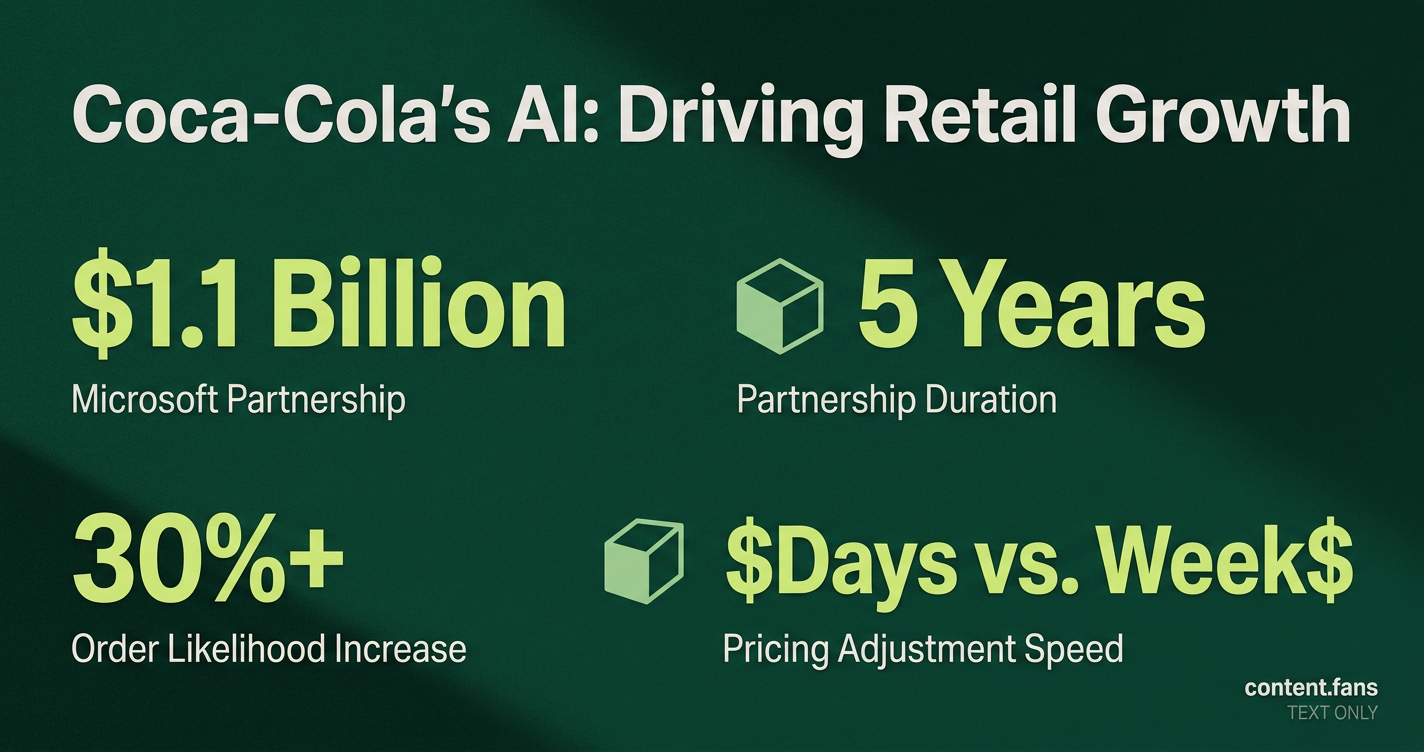
Coca-Cola is expanding its use of artificial intelligence (AI) to drive retail growth, a strategic shift that prioritizes revenue generation over simple cost reduction. Coca-Cola signed a five-year, $1.1 billion partnership with Microsoft to use cloud and AI services, with stated goals of improving customer experiences, operations, innovation, competitiveness, efficiency, and growth opportunities. President and CFO John Murphy confirmed the goal is to leverage AI for smarter pricing, optimized product packaging, and data-driven retailer recommendations to boost sales across all market segments.
This growth-focused approach signals Coca-Cola's intent to use data and algorithms to enhance commercial execution and empower its workforce, not replace it.
The strategy uses AI to navigate a "K-shaped economy," where consumer spending diverges. According to industry reports, this allows Coca-Cola to stay relevant to budget-conscious shoppers while also capturing premium sales. AI algorithms analyze real-time sales and consumer data, enabling managers to dynamically adjust product assortments and pricing for specific outlets or sales channels.
Why Retail Growth Management needs AI
According to industry reports, Coca-Cola is scaling machine learning capabilities piloted in Latin America that allow it to "quickly react to market changes" and optimize pricing. Executives confirm that AI algorithms now support field teams in three primary areas:
- Price-pack architecture that suggests the right can size and price by neighborhood store.
- Retailer prompts that recommend SKUs based on order history and local demand.
- Scenario models that test spending plans before marketing dollars are deployed.
Coca-Cola's AI strategy focuses on Retail Growth Management. The company uses AI to refine its product pricing and packaging for specific stores and sends AI-generated order suggestions to retailers. This data-driven approach helps teams make smarter decisions to increase sales and adapt to market shifts.
Early commercial outcomes
Early results highlight significant commercial gains. CEO James Quincey revealed that retailers who receive AI-generated WhatsApp suggestions are "over 30 percent more likely" to order recommended products, creating incremental revenue. Industry reports show this model is highly scalable, with AI recommendation engines expanding to significant numbers of retailers in Mexico and achieving meaningful engagement rates.
The company also credits AI-powered dashboards with accelerating pricing adjustments. Teams in Latin America can now update recommended prices in days instead of weeks, allowing for rapid responses to fluctuating input costs or currency changes to protect both volume and margins.
Balanced portfolio for premium and value segments
CFO John Murphy emphasizes that AI helps maintain a "consumer-centric" portfolio. It identifies opportunities for higher margins on premium, single-serve products while ensuring larger, multi-serve packages remain affordable. This approach reflects a disciplined resource allocation strategy - investing where algorithms predict the highest return. Murphy has called this data-driven method a potential "secret sauce" for future investment decisions.
While many competitors in the food and beverage industry focus on using AI for cost savings like waste reduction, Coca-Cola's public messaging prioritizes growth enablement. This positions the company as a leader in shifting the narrative around AI's business value. Early pilots suggest this strategy can deliver tangible revenue growth without the controversial headline risk of job cuts.
How is Coca-Cola actually using AI in retail?
Coca-Cola's AI applications center on Retail Growth Management (RGM). The company is piloting tools that optimize price-pack architecture (right mix of size and price by channel) and AI-generated messages to retailers that recommend which SKUs to restock based on past orders and local market data. Early pilots show retailers receiving AI suggestions are over 30 % more likely to buy the recommended items, driving measurable incremental sales. An in-house platform called Fuel Light 360 is used for scenario modeling and deciding where to place marketing or promotional dollars.
Is Coca-Cola using AI to cut jobs?
According to CFO John Murphy, the answer is no. He has said "I see it as more of a growth enabler than a cost reducer". The company's recent communications make this explicit: AI is positioned to create more relevant products, pricing and promotions, not to eliminate headcount. This sets Coca-Cola apart from the common industry storyline that AI is primarily a labor-saving device.
What results has Coca-Cola reported so far?
- Latin America pilots: faster pricing decisions and volume/revenue improvements after AI-driven adjustments to local market conditions.
- Mexico scale-up: an AI-driven campaign scaled from pilot retailers to a significant number of locations with meaningful engagement rates on AI-generated messages.
- Retailer conversion: 30 %+ lift in SKU purchases when AI restocking suggestions are delivered via WhatsApp.
While third-party summaries sometimes cite various sales gains, the strongest evidence remains Coca-Cola's own statements and official filings.
How does Coca-Cola's AI approach differ from the rest of the beverage industry?
Across the beverage industry, many companies use AI for both growth and cost control. Short-term justifications typically rest on waste reduction, forecasting accuracy and inventory spoilage cuts. Coca-Cola, however, front-loads growth: its first public KPIs are retailer conversion, pricing precision and simultaneous expansion of premium and value portfolios. The company's partnership with Microsoft signals an infrastructure investment in long-term capabilities.
What does Coca-Cola plan next for AI?
John Murphy has linked the next phase of AI to resource allocation discipline: algorithms that show "what's going to deliver the most value for our buck". Expect continued roll-out of the price-pack-channel optimization tool to more markets, deeper retailer personalization, and broader use of Fuel Light 360 for end-to-end commercial scenario planning. The stated goal is a balanced growth algorithm that keeps Coca-Cola relevant to consumers across income levels while lifting margins and capital efficiency.