
CMOs Expect AI to Drive Cost Savings, Workforce Redesign by 2026
Serge Bulaev
AI is quickly changing how marketing teams work, taking over tasks like writing ads and predicting customer needs faster than people ever could. Marketing bosses now expect AI to save money and reshape jobs by 2026, with many already using these tools every day. Teams are working together in new ways, relying on clean data and smart feedback to experiment more and avoid mistakes. AI lets companies personalize messages and plan better, leading to big returns. As roles shift and budgets adjust, the companies that adapt fastest to AI will stay ahead.
As CMOs expect AI to drive cost savings and workforce redesign by 2026, AI-native marketing is rapidly shifting from theory to practice. Algorithms now execute tasks like copywriting, ad bidding, and churn prediction at superhuman speeds, fundamentally altering daily marketing operations. The pressure is mounting as early adopters are already deploying AI agents across their marketing funnels, creating a clear competitive advantage.
What Separates Early Movers in AI-native marketing
AI-native marketing drives efficiency by automating repetitive tasks like ad creation and media buying while enabling predictive planning to optimize spending. This leads to immediate cost savings and prompts a workforce redesign, shifting human roles from execution to strategic oversight, data governance, and creative direction for AI systems.
The marketing leaders pulling ahead in the AI race are building their strategies on four key pillars:
- Data Liquidity: Flowing unified, labeled data directly into predictive models and LLMs, eliminating manual data handling.
- Pod Structures: Integrating strategy, creative, and engineering into cross-functional teams to turn insights into immediate action.
- AI Fluency: Shifting from static planning to supervising dynamic feedback loops, which frees up valuable time for experimentation.
- Governance: Establishing ethics boards to proactively address bias, privacy concerns, and deepfake risks before campaigns go live.
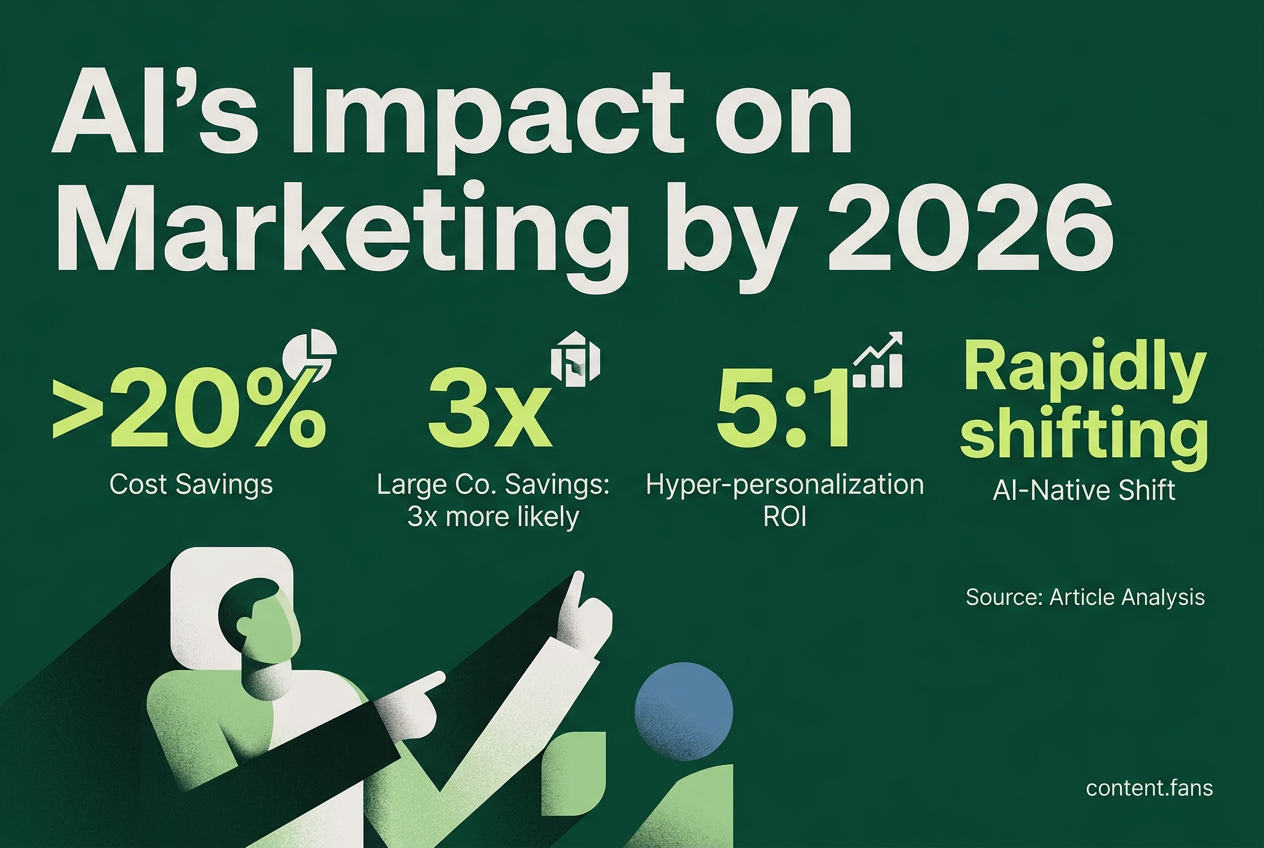
This urgency is underscored by research showing that marketers from largest companies are almost 3x more likely to drive cost savings, with 37% expected to drive >20% in next two years. The demand for tangible ROI is forcing leaders to treat AI as essential infrastructure, not an experimental add-on.
From Hyper-personalization to Predictive Planning
AI's impact extends from hyper-personalization to predictive planning. Generative AI can create thousands of message variations tailored to individual user context and behavior. The financial incentive is powerful; according to a Keyrus analysis, this level of hyper-personalization yields ROIs exceeding 5:1. It's no surprise that a growing number of marketers are now integrating AI into their daily work.
Beyond personalization, teams use AI for predictive simulations to test campaign variables - like channel mix and creative tone - before launch, ensuring resources are allocated to the most promising strategies. Post-launch, these models continuously monitor performance and make real-time adjustments.
Talent, Tech, and the New Org Chart
The shift to AI is reshaping talent, technology, and organizational charts. Traditional roles are evolving: analysts are becoming model stewards, creatives are now prompt curators, and engineers focus on creating reusable AI agents. Leading companies like Apple and WPP are formalizing this shift by creating senior AI leadership roles that bridge marketing and IT, reporting to both the CMO and CIO.
Budgets are also reallocating, with funds previously earmarked for media now supporting synthetic data infrastructure, vector databases, and prompt engineering. However, overall spending doesn't necessarily increase. Automation of repetitive tasks allows smaller, more agile teams to manage a wider scope and reinvest the savings into strategic experimentation.
This transformation is not hypothetical. Svedka successfully used generative AI for a Super Bowl commercial, while Inovalon has transitioned from account-based targeting to person-based predictive models. The AI-native playbook is already in the public domain; the only remaining variable is the speed of leadership's adaptation.
What exactly is AI-native marketing, and why are CMOs calling it a paradigm shift rather than an upgrade?
AI-native marketing means AI is wired into every workflow from day one, not bolted on later. Instead of campaigns that start with human briefs and end with post-campaign reports, the system continuously ingests data, predicts outcomes, and rewrites creative in real time. Many marketers now use AI daily, and a significant number of CMOs expect a substantial portion of today's marketing tasks to be restructured by 2027. The shift is fundamental because the machine becomes a co-owner of the brief, the budget, and the brand voice.
Where will the promised cost savings come from, and how large are they?
37% of marketers from largest companies ($20B+ revenue) expected to drive >20% savings in next two years. The low-hanging fruit is repetitive production work: multi-channel deployment, dynamic bidding, and first-draft creative. Palmer Ad Agency reports that AI-powered micro-segmentation and real-time competitor monitoring routinely lift media efficiency by double digits without extra headcount. Early movers have cut significant baseline operating costs while reinvesting the delta into higher-value strategy and data acquisition.
If headcount drops, what new roles and skills will marketing teams need?
Expect fewer classic channel managers and more "feedback-loop supervisors" who can frame goals,audit training data, and govern model drift. Job posts now list AI fluency as a baseline expectation, similar to requiring Excel a decade ago. Inovalon's switch from account-based to person-based marketing created hybrid pods where strategists, data engineers, and generative-asset designers sit together and iterate in hours, not weeks. Soft skills - ethics, storytelling, emotional intelligence - become differentiators because machines handle pattern recognition while humans provide direction and guardrails.
What concrete examples show AI-native campaigns already working at scale?
- Inovalon runs predictive-intent engines that decode buyer motive and timing for hyper-personalized healthcare messaging, moving from static ABM lists to dynamic, individual-level journeys.
- Svedka produced an entirely AI-generated Super Bowl spot, testing whether generative systems can deliver brand-safe creative under the ultimate deadline; industry watchers predict many 2026 Super Bowl ads will use generative AI.
These cases are early, but they prove the stack is production-ready today, not in some future roadmap.
What are the biggest blind spots leaders must watch to avoid costly missteps?
- Data integrity - Models are only as clean as the CRM they ingest; a biased input becomes a scaled mistake.
- Over-automation - Removing human veto points can turn a micro-copy test into a reputational risk overnight (think deep-fake visuals or off-brand tone).
- Integration debt - Legacy martech often can't serve real-time signals to AI agents; CIO-CMO lockstep is now mandatory, not optional.
- Ethical governance - 2026 audiences reward brands that anticipate needs but punish those that cross the "creepy" line; build an AI council with legal, privacy, and brand safety at the table before launch, not after backlash.