
Memory Chip Makers Lock In 3-5 Year AI Server Contracts
Serge Bulaev
Memory chip makers like Samsung and SK hynix are making 3-5 year contracts to supply memory for AI servers instead of short-term deals, according to several reports. This change may be happening because of memory shortages that started in 2024, and these contracts could help keep prices more stable. Some buyers seem to be paying deposits in advance to make sure they get enough advanced memory chips. The contracts might also help suppliers plan big investments, but extra supply may not arrive until 2027 or later. There are also reports that these deals are leading to big employee bonuses and may be affecting wage talks and national labor policies in Korea.

Memory chip makers are locking in 3-to-5-year contracts to supply memory for AI servers, a major shift from traditional short-term deals. This structural response to chronic shortages is reshaping the industry's business model as hyperscale buyers race to secure DRAM and HBM supply.
AI Demand Drives Shift to Long-Term Contracts
The immense computational needs of AI have forced a strategic pivot from volatile quarterly purchasing to stable, long-term supply agreements. This change gives AI server builders predictable access to critical memory components, while giving chip manufacturers the revenue certainty needed to fund multi-billion-dollar expansions of production capacity.
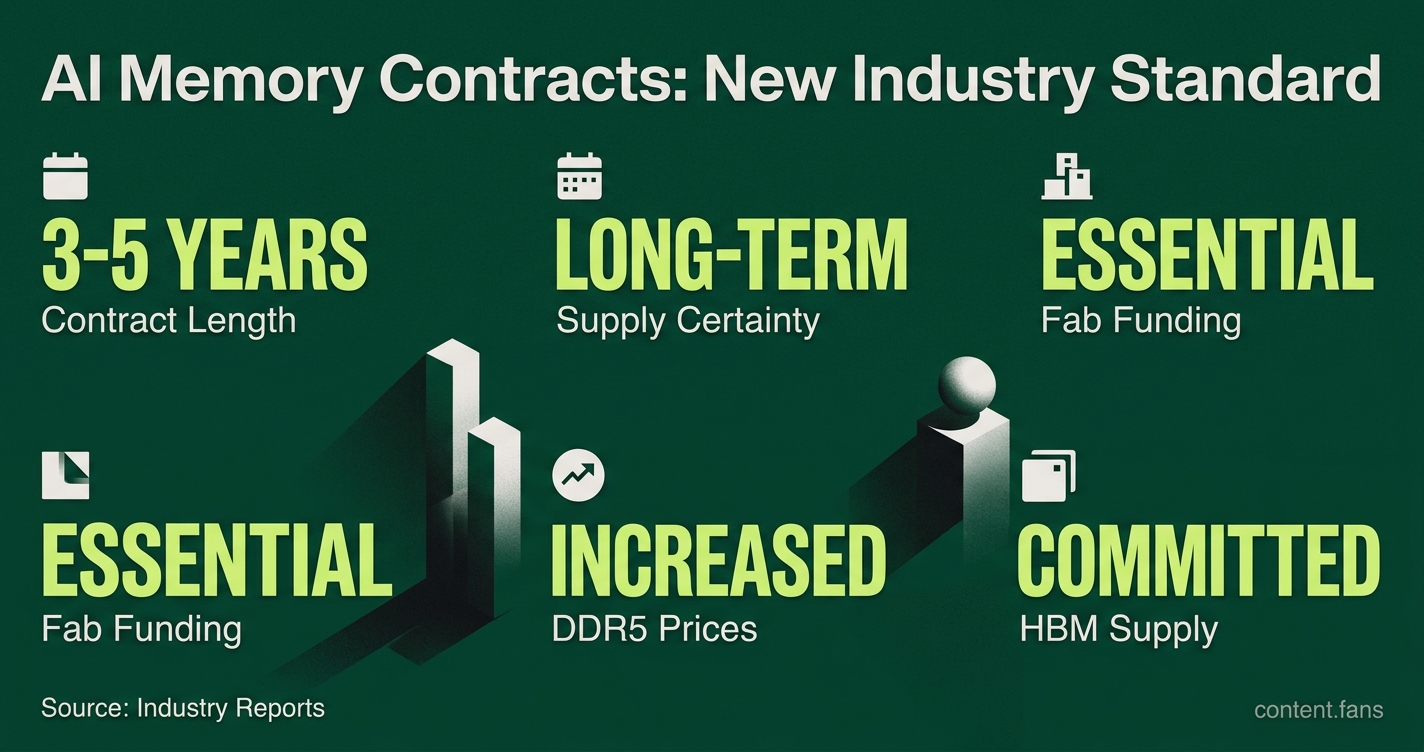
Leading manufacturers like Samsung and SK hynix are replacing quarterly orders with binding 3-to-5-year contracts that define volume, pricing, and non-delivery penalties. According to industry reports, some buyers are even paying upfront deposits to secure allocations of advanced High-Bandwidth Memory (HBM). These pre-commitments also provide a demand buffer against potential oversupply if new factory capacity ramps up faster than expected.
Securing Investment for Future Fabs
These long-term agreements provide the financial predictability necessary for manufacturers to secure funding for new fabrication plants (fabs). With improved earnings visibility, suppliers are more willing to commit to massive capital expenditures. However, industry analysts note that with multi-year construction timelines for new fabs, significant increases in supply are not expected to alleviate shortages until the latter part of the decade. Consequently, industry reports indicate that executives now see these contracts as essential prerequisites for funding multi-billion-dollar fab projects, not merely as a sales strategy.
Impact on HBM and DDR5 Pricing
The shift to long-term deals is creating a two-tiered price structure. HBM is dominated by a small number of suppliers and much of current supply appears to be committed via long-term contracts, though the exact proportion is not publicly verified. This dynamic establishes a high, stable price floor, leaving a limited amount of supply for the volatile spot market.
In contrast, DDR5 prices have seen dramatic increases. As manufacturers reallocated production lines to more profitable HBM, the supply of conventional DDR5 tightened. According to industry reports, this caused significant price increases for DDR5 contract prices in recent months as supply constraints intensified.
Broader Economic and Social Consequences
The guaranteed profits from AI memory contracts have created significant downstream effects, particularly in South Korea. Samsung's memory division employees received substantial bonuses, with industry reports suggesting significant payouts. This development sparked considerable public discussion about wealth inequality and corporate compensation structures.
Labor unions began citing bonus formulas tied to operating profits as a new standard for negotiations across other major Korean corporations (chaebols). The government ultimately intervened to mediate and prevent potential labor disputes, highlighting how these chip supply deals can influence national labor policy. This contractual era in memory manufacturing thus links supply chains, capital investment, and social expectations.
Why are memory chip makers switching from quarterly spot deals to 3-5 year AI server contracts?
Traditional quarterly purchasing is giving way to multi-year agreements that lock in volume, price and enforcement clauses. Samsung publicly states it is "pushing to convert quarterly and annual supply contracts into multi-year agreements spanning 3-5 years," while Kioxia frames the shift as a way to "secure long-term DRAM supply and strengthen a stable delivery system." The trigger is exploding AI demand: AI training and inference now absorb so much DRAM and HBM that big-tech buyers want supply visibility while suppliers want revenue certainty before they commit billions in new fabs.
What does this mean for fab investment and future supply?
Long-term contracts act like pre-orders for tomorrow's wafers. Because a new memory fab needs 2-4 years of construction and commissioning, suppliers can now green-light multi-billion-dollar capex knowing that contracted volumes will cushion the next downturn. The result is more disciplined, pre-committed capex instead of speculative buildouts. Yet analysts warn the relief is delayed: meaningful new capacity is unlikely before the latter part of the decade, so shortages may persist even as investment accelerates.
How are spot- and contract-prices behaving for HBM versus DDR5?
- HBM - Spot trading is thin; a significant portion of revenue flows through long-term agreements tied directly to AI accelerators. Contract prices have stayed structurally high on tight allocation.
- DDR5 - Spot prices lagged early in recent periods, then saw substantial increases as production lines were re-allocated to HBM. Contract prices also increased significantly over the same period but remained below spot peaks. The common driver is AI: every wafer shifted to high-margin HBM subtracts from conventional DRAM supply.
What societal reaction did Samsung's AI-driven bonuses trigger in South Korea?
Substantial bonuses for memory employees launched considerable public discussion on inequality. Polls and media captured mixed reactions among the wider public, while unions hailed the deal as a fair share of AI windfalls. The government mediated to avert potential strikes but simultaneously warned that tying bonuses to operating profit percentages could set a precedent across corporate Korea and complicate future wage bargaining.
Will these long-term contracts end the traditional memory boom-bust cycle?
They soften, but do not eliminate, cyclical swings. By aligning future capacity additions with pre-committed demand, suppliers reduce the risk of catastrophic oversupply. However, if AI growth suddenly cools, those same long-term minimum-volume clauses could amplify a cliff-like drop in new orders. In short, the industry trades higher predictability for reduced spot-market flexibility, creating a more stable yet still capital-intensive environment for the foreseeable future.