
Every updates AI engineering guide to 8 steps, adds plugin
Serge Bulaev
Every has updated its AI engineering guide from 4 to 8 steps, reflecting how AI may handle more execution tasks while humans focus on planning and review. The new guide comes with a plugin that reportedly includes 43 subagents and 38 skills, which link to different workflow phases. The update introduces a "sandwich" model, where people set the direction and finish tasks, and AI manages the middle steps. This change might help teams work faster and remember lessons better, but still lets teams adjust the process as needed.

Every has updated its AI engineering guide, expanding the workflow from four to eight steps to better integrate AI agents into development. The major upgrade formalizes a human-AI "sandwich" model and ships with a new plugin containing enhanced subagents and skills.
From Four Steps to an Eight-Stage Loop
The original four-step creative process has been expanded into a more granular, eight-stage process. Authored by Kieran Klaassen and Trevin Chow, the new methodology adds more structure to the beginning and end of the development cycle to improve outcomes.
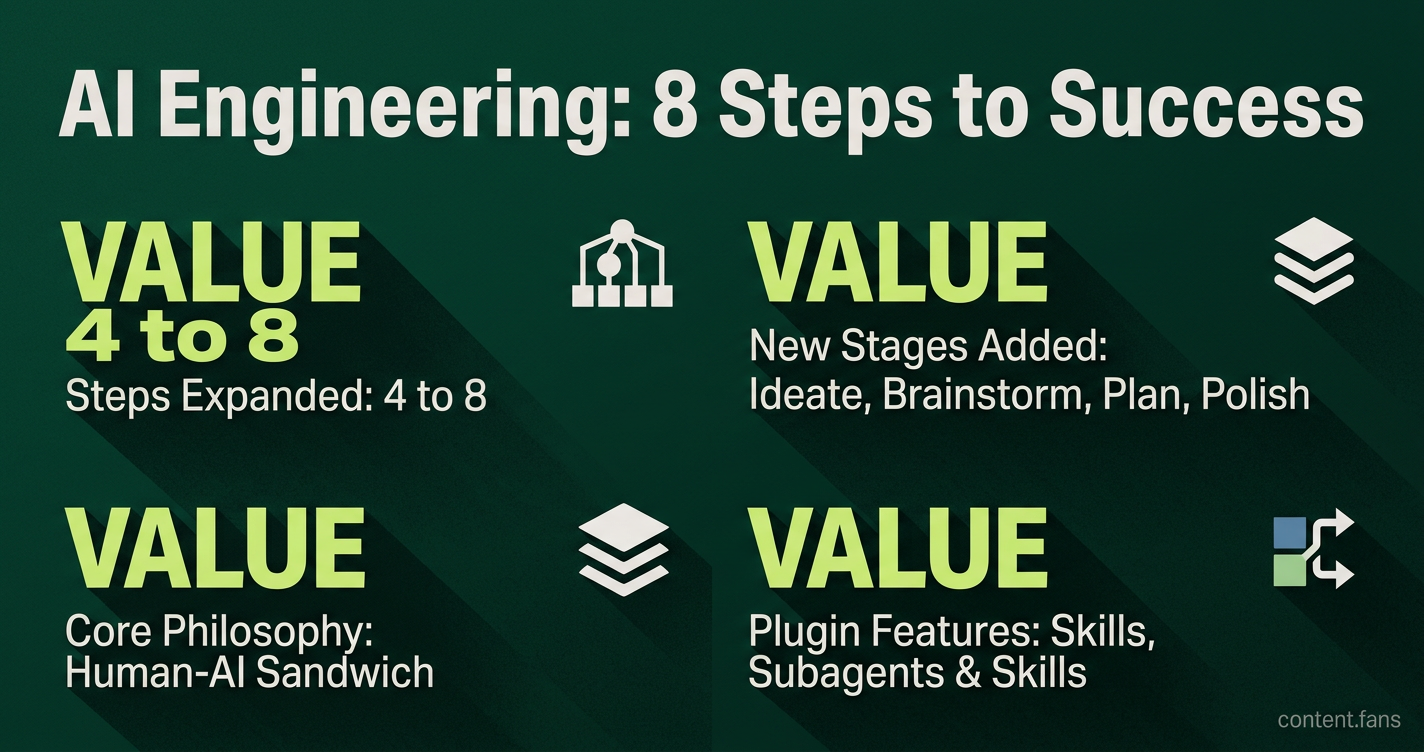
The updated Compound Engineering guide expands the original four-step loop to eight distinct stages. It adds Ideate, Brainstorm, and Plan at the beginning and a Polish stage before the final Compound step. This change emphasizes upfront planning and human refinement, with AI handling the core 'Work' phase.
The full lineup, according to the Every guide update, is now:
- Ideate
- Brainstorm
- Plan
- Work
- Review
- Polish
- Compound
- Repeat
Klaassen explains the change was driven by early adopter feedback, which found that rushing from idea to code often produced half-baked features. By adding Ideate and Plan upfront, teams can validate product-market fit and set clear objectives. The new Polish stage allows for human-in-the-loop refinement before shipping, a change that has shown significant improvements in reducing post-merge bugs.
Human Bread, AI Filling: The "Sandwich" Model
The update's core philosophy is the "sandwich" metaphor, where humans provide the strategic "bread" and AI agents provide the executional "filling." As detailed in the accompanying AI Sandwich podcast, this model has humans defining the direction, scope, and quality gates, while AI handles mechanical tasks like code generation and testing. According to Chow's release notes, this realigns senior engineers toward high-level decision-making instead of rote coding.
New Plugin Unlocks Workflow with Enhanced Subagents
To support the new framework, the Compound Engineering plugin now includes a significant number of subagents and slash-command skills. These commands map directly to the new workflow stages, offering explicit entry points for tasks like /plan or /polish.
The plugin is designed for flexibility, allowing developers to mix and match different AI models within a single session. For example, a developer might use a fast model for brainstorming, a strong reasoning model for planning, and a code-specialist model for the "Work" phase. This model-agnostic approach helps teams avoid platform lock-in.
The Compounding Advantage: Making the Next Feature Easier
The keystone of the entire process is the "Compound" step. By systematically saving lessons, reusable components, and effective prompts after each cycle, teams build a knowledge base that raises baseline quality over time. Early adopters report this prevents context loss and shortens follow-up cycles, with many teams experiencing significantly faster startup times for future features.
Join the Next Compound Engineering Camp
For teams seeking hands-on practice, Every is hosting a subscriber-only Compound Engineering Camp. Kieran Klaassen will walk through the eight-step loop and share advanced agent templates. A Compound Engineering Camp recording from a previous event is also available, demonstrating the workflow live. Seats for upcoming camps are limited, and subscribers can RSVP at Compound Engineering Camp - Every.