
OpenHuman unveils desktop AI with 1 billion token local memory
Serge Bulaev
OpenHuman is a new desktop AI app that may store up to 1 billion tokens of personal data, but this number has not been independently checked. The app keeps all information, like emails and notes, on the user's device and supports over 118 service connections. Early reviews suggest OpenHuman is private, easy to use, and powerful, but public feedback is still limited and mostly positive. Experts say storing data locally might lower costs and give users more control, but OpenHuman has yet to prove its reliability and scale through outside tests. The wide range of integrations appears to set it apart from other similar tools.

OpenHuman, a new desktop AI, has launched with a privacy-first approach, offering significant local memory capabilities. This system is designed to create long-term context for AI agents by securely ingesting personal data like emails, notes, and calendar events directly on the user's machine, eliminating the need for cloud-based storage.
How OpenHuman's Memory Layer Works
OpenHuman claims its desktop client can archive substantial amounts of text data, a figure yet to be independently audited. According to a YouTube hands-on review, the system automatically syncs data every 20 minutes and connects to numerous services via OAuth integrations powered by Composio.
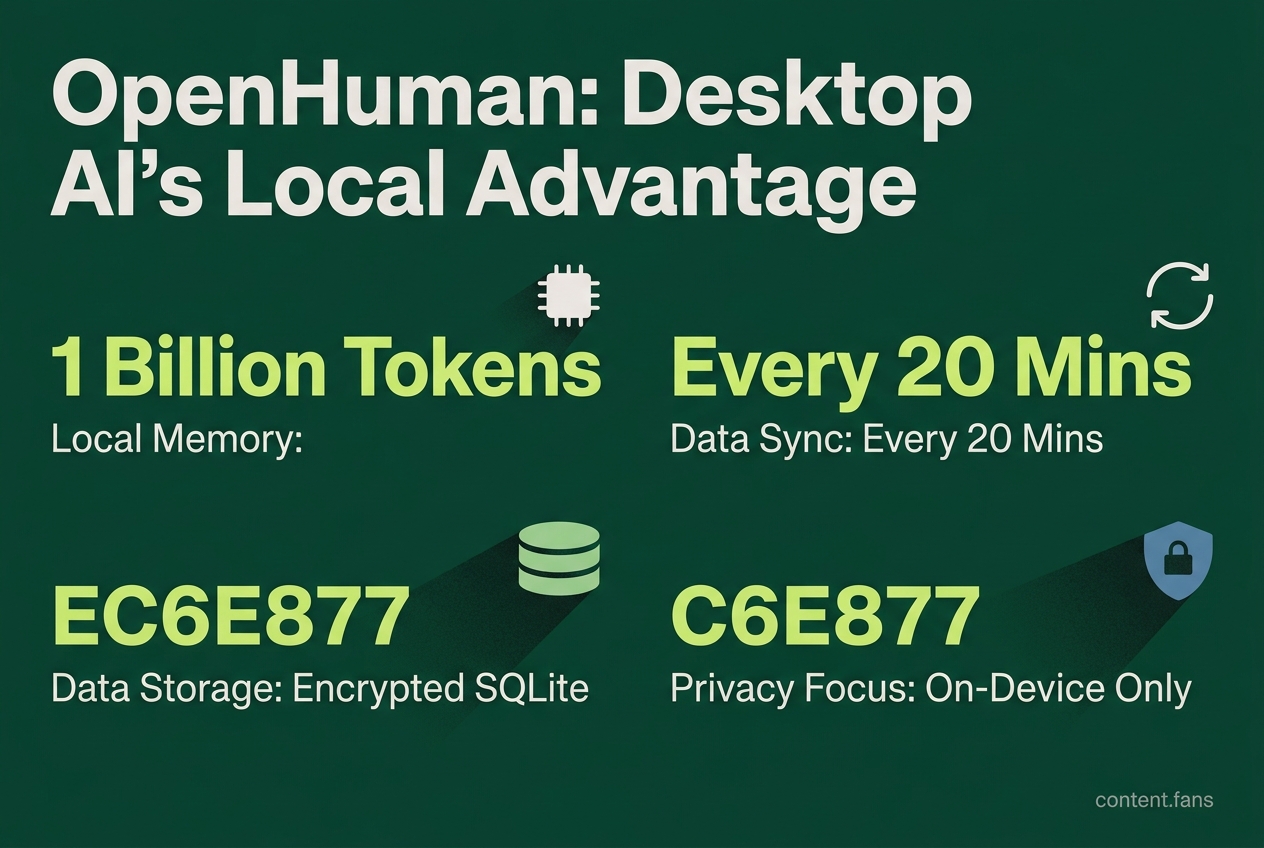
OpenHuman is a desktop AI app that creates a private, on-device memory of your digital life. It securely stores significant amounts of data - from emails to notes - in a local database. This allows AI agents to access long-term context without exposing your information to cloud services.
All artifacts are stored in a single, encrypted SQLite database on the user's device, including:
- Emails and attachments
- Calendar metadata
- Notes in Markdown or plain text
- GitHub commits and issue comments
This local-first design ensures data is accessible to the user but remains private from external services, potentially lowering costs associated with large language model queries.
Early User and Reviewer Feedback
While public feedback is still emerging, it has been consistently positive. Early reviews and user comments praise its privacy features, user-friendly desktop interface over command-line alternatives, and extensive integration library. The primary strengths highlighted by users are its desktop-native experience, the promise of substantial local memory capabilities, and its wide range of service connectors.
The Importance of Local Memory for AI Agents
On-device storage is a critical trend for AI agents, offering enhanced data control and potentially lower operational costs. By processing and storing data locally, OpenHuman eliminates the need for constant API calls to external services. This aligns with industry analysis that "conversation history, decisions, and tool calls" are more secure in a user-managed database. This model supports a tiered memory architecture - combining RAM, SSD, and user-controlled storage - to improve personalization and data privacy while giving users full control over their information for auditing or deletion.
How OpenHuman Stacks Up Against Competitors
OpenHuman competes with established memory frameworks like Mem0, Zep, and LangMem, which provide public performance benchmarks. Currently, OpenHuman lacks verifiable, third-party metrics, leading experts to label it "promising but early-stage" until its reliability and scalability are proven. Its primary competitive advantage is not raw performance but its extensive integration catalog. The numerous one-click connectors allow developers to build complex, multi-service workflows with minimal setup, a feature consistently highlighted in reviews as its key differentiator.
What This Means for Developers
For developers building privacy-focused AI assistants, OpenHuman offers a compelling, self-contained datastore to experiment with. Its emphasis on easy onboarding and true data ownership makes it a noteworthy tool that aligns with the growing demand for personalized, secure AI agents. While waiting for independent audits, builders can leverage its current features to explore the potential of local-first AI memory.
What exactly is stored in OpenHuman's local memory?
OpenHuman describes its Memory Tree and Markdown vault as local/on-device, while some backend-brokered components remain server-side. The system covers emails, personal notes, calendar events, GitHub commits, Slack threads and data pulled from its supported services. Instead of shipping this data to the cloud, much of the information lives in a local vector database, letting the agent retrieve past context without ever leaving your hardware.
How does OpenHuman compare to Zep, LangMem or Mem0 on performance?
According to the project's own benchmark summary, Memori (OpenHuman's memory module) scored higher than Zep, LangMem and Mem0 while using roughly 20 times fewer tokens than a full-context prompt. The standout numbers cited are:
- 92.5 LoCoMo score and 94.4 LongMemEval - both higher than the listed alternatives
- 6,900 tokens per query cost versus typical 140,000+ token full-context prompting
- +29.6 point jump on temporal reasoning over baseline methods
Please note these figures come from OpenHuman's marketing materials; independent validation is not yet publicly available.
Why does local storage matter for privacy?
Storing memory on-device keeps embeddings, conversation history and tool-call logs off third-party servers. That reduces exposure to cloud breaches and data-mining, but it shifts responsibility to you for encryption, backups and access control. Industry discussions highlight that local storage is only as private as the underlying operating-system protections and user-managed keys allow.
Which integrations are drawing the most praise from early users?
Reviewers on YouTube and LinkedIn keep spotlighting the OAuth integrations delivered through Composio. Popular connectors include:
- Gmail & Google Calendar - for meeting context
- Slack & Notion - for project artifacts and chat history
- GitHub - for commit messages and issue discussions
Background sync every 20 minutes means the agent quietly refreshes your memory without manual imports.
Is the product ready for everyday use or still experimental?
Many users describe OpenHuman as "early-stage but promising". Strengths repeatedly mentioned are the desktop-native workflow, approachable GUI and strong privacy framing. Typical cautions center on immature reliability and the need for better security auditing. In short, power users and developers are enjoying it today, but anyone needing bullet-proof stability should expect rapid iteration over the next few release cycles.