
PitchBook: Agentic AI Shifts SaaS to ERP-like Infrastructure
Serge Bulaev
PitchBook reports that agentic AI may shift from SaaS to more ERP-like infrastructure, meaning AI agents could become deeply embedded in company workflows. This might change how software companies are valued, with a focus on integration and long-term use instead of short-term revenue. Surveys suggest more companies plan to use AI agents soon, but widespread adoption may be slowed by governance and technical issues. Investors and companies appear to be tracking new metrics, such as task resolution rates and integration speed, instead of just revenue. PitchBook also notes that sales processes may become longer and more complex, but long-term value could increase if AI platforms become core to business operations.

A new PitchBook report details how the rise of agentic AI shifts SaaS to ERP-like infrastructure, embedding deeply into core company workflows. This pivot changes how investors value software, prioritizing a long-term strategic footprint over short-cycle revenue. This analysis suggests competitive displacement may slow as valuations hinge on deeper platform integration.
Why PitchBook compares agents to ERP
PitchBook's Q1 2026 memo, "SaaS Is Dead, Long Live SaS," argues that agentic AI platforms function more like foundational systems of record than the lightweight workflow tools of the past (PitchBook PDF). This comparison is based on two key trends:
- Capital concentration: According to industry reports, investment is flowing into larger enterprise deals, with global SaaS fundraising showing a significant quarterly decrease.
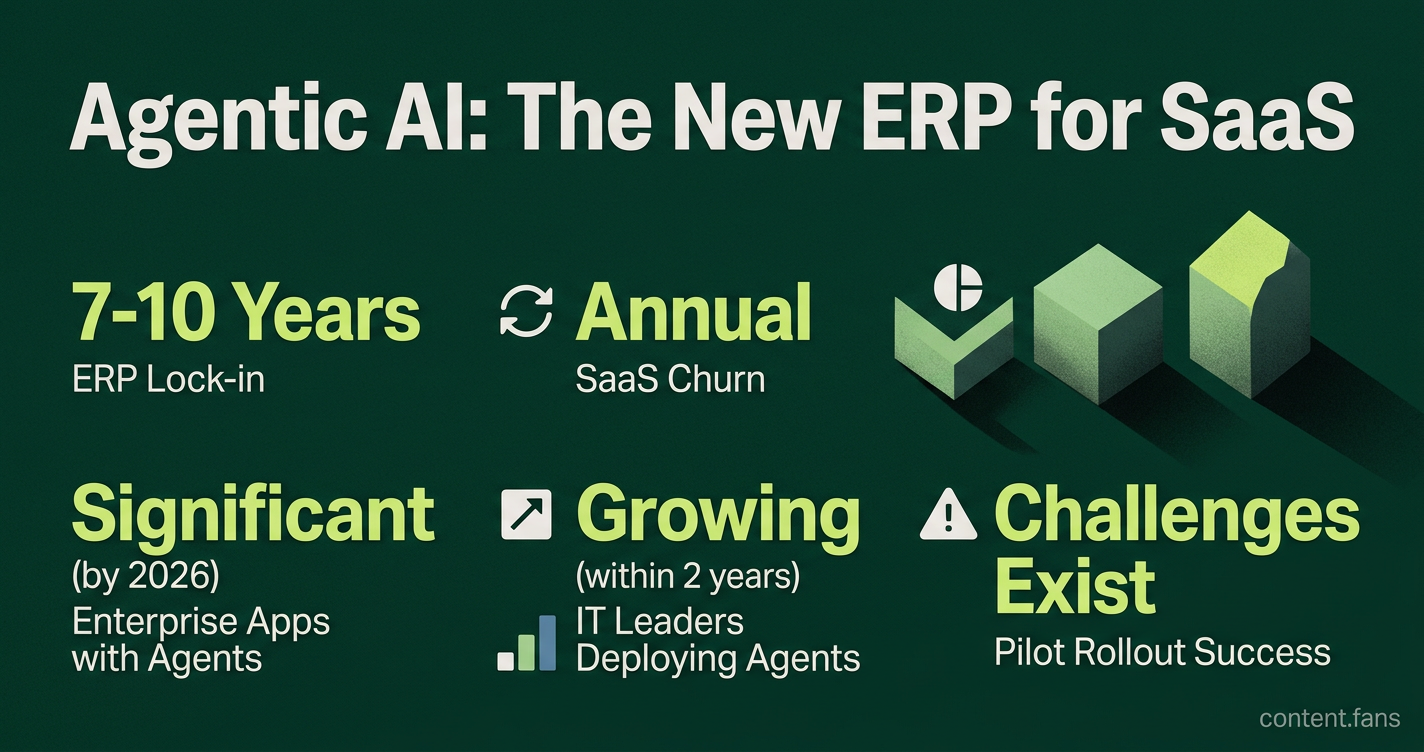
- Stickier adoption curves: Agentic AI may follow multi-year lock-in cycles similar to ERP replacements (7-10 years on average), rather than experiencing high annual churn.
Agentic AI is being compared to ERP systems because its adoption pattern mirrors that of traditional enterprise infrastructure. This includes deep integration into core business processes, long implementation cycles, and a high degree of "stickiness," which creates multi-year lock-in rather than the typical annual SaaS churn.
Investor scorecards may need new KPIs
According to industry analysis, traditional seat-based SaaS contracts are vulnerable to disruption by AI agents, whereas data-heavy systems of record prove more resilient. This suggests standard revenue multiples are insufficient. Instead, PitchBook recommends new KPIs that measure how quickly a platform:
- integrates with core databases
- accumulates proprietary operational data
- shortens time-to-production across workflows
Agentic AI Adoption: Early Signals and Roadblocks
Early analyst surveys signal strong momentum. Industry reports project that a significant portion of enterprise applications will have task-specific agents by 2026, representing a substantial jump from current levels. Similarly, recent polls find that a growing number of IT leaders plan to deploy autonomous agents within two years. However, McKinsey research highlights a common challenge: many pilots fail to achieve company-wide rollout due to governance and interoperability hurdles.
What integration work actually looks like
Successful enterprise integration is currently centered on three key areas:
- Connecting agents to existing APIs and identity services
- Orchestrating multi-agent systems rather than isolated bots
- Instituting monitoring for hallucination and compliance lapses
To streamline these efforts, sources point to emerging interface standards like MCP and A2A, which aim to reduce custom development, although their adoption is still in its early stages.
Alternative metrics that follow the workflow
Reflecting this shift, investors cited in a Forvis Mazars-PitchBook release are adopting new operational scorecards. Instead of revenue multiples, they are focusing on workflow-centric metrics such as:
- Task completion or resolution rate
- Human escalation frequency
- Cost per automated task
- Time-to-resolution
- Hallucination incidence
For example, a Fin AI framework identifies resolution rate as the most critical operational KPI. Google Cloud offers similar guidance, grouping metrics into reliability, usage, and business value pillars.
Strategic implications for go-to-market
PitchBook observes a strategic pivot in go-to-market approaches, with vendors adopting sales motions similar to ERP rollouts. This involves longer proof-of-concept phases, deep engagement with systems integrators, and bundled implementation services. While this may temper near-term revenue growth, the ultimate reward is higher long-term value from multi-year renewals once the AI platform is embedded in core business operations.