
CMOs embrace AI, but 2026 data shows slow operational integration
Serge Bulaev
The 2026 CMO Survey suggests that while most chief marketing officers believe AI is transforming marketing, only a few have made it central to their operational processes. AI now drives around a quarter of marketing activities, mainly in content creation and personalization, but only 8 percent of CMOs report having autonomous, AI-driven campaigns. Barriers like data privacy concerns, old technology, skill gaps, and measurement difficulties appear to slow wider adoption. Some case studies show clear benefits when AI is fully integrated, but many organizations still use AI mainly for small, tactical tasks. The field seems to be changing, but operational use of AI may continue to lag behind overall enthusiasm and adoption rates.

While CMOs embrace AI in principle, recent survey data reveals a significant gap between enthusiasm and execution. Artificial intelligence now informs a growing portion of marketing activities, representing a sharp increase from previous years. Yet, despite a near-universal belief in AI's transformative power, only a small minority of marketing leaders run fully autonomous, agent-driven campaigns, according to recent BCG coverage.
AI Adoption Skyrockets, but Execution Lags
The CMO Survey source provided here reports AI/ML use at 17.2% in 2025, up from 13.1% in Fall 2024, and generative AI use at 15.1% in 2025, up from 7.0% one year earlier (PDF data table). However, deployment remains concentrated in tactical areas like content production and personalization, which offer quick wins without requiring fundamental workflow changes.
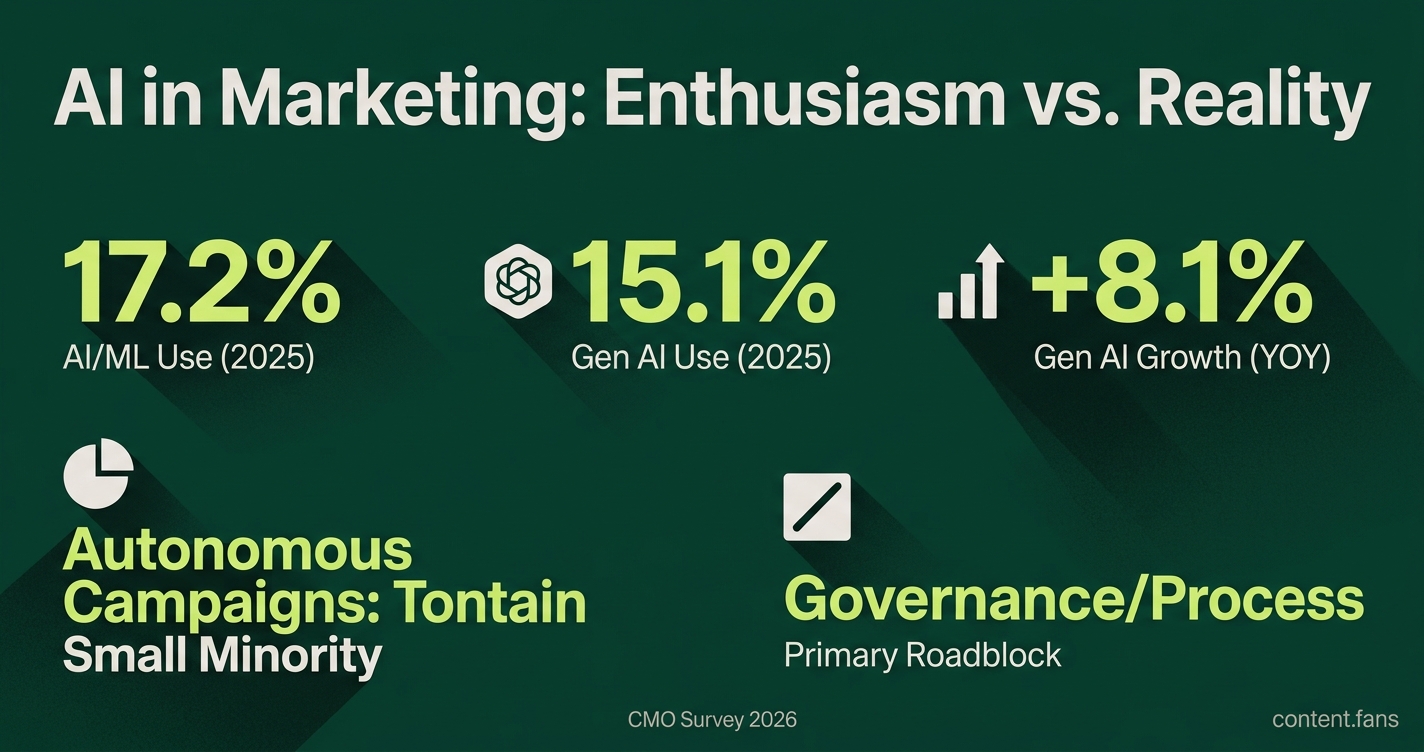
The slow operational integration of AI in marketing, despite high adoption rates for tactical tasks, is primarily due to organizational barriers. These include concerns over data privacy, the difficulty of integrating with legacy technology, significant employee skill gaps, and the challenge of proving a clear return on investment.
How Successful Teams Integrate AI End-to-End
Evidence shows that the greatest returns come from embedding AI across the entire workflow - from data ingestion to campaign delivery. Successful examples include:
- A SaaS firm significantly increased content output and reduced costs by integrating Jasper, Surfer SEO, and HubSpot into one system (LoudScale profile).
- Retailer Bestseller used Google Cloud Vertex AI to substantially reduce ad spend while decreasing manual bidding work (Naitive Cloud roundup).
- Natura Cosméticos automated CRM reporting across six countries using Databricks, providing same-day performance insights.
What's Blocking Deeper AI Integration?
Governance and process issues, not technology, are the primary roadblocks. A study highlighted by Morningstar found that friction from cross-functional reviews has increased significantly year-over-year. Key barriers include:
- Data privacy and security risks
- Complex integration with legacy martech stacks
- Gaps in employee skills and necessary training
- Difficulty proving ROI with existing attribution models
The Measured Payoff of AI in Marketing
Despite the challenges, the benefits are measurable. Industry reports indicate that teams effectively using AI report tangible gains, including higher sales productivity, better customer satisfaction, and lower marketing overhead costs.
These self-reported figures highlight the value at stake, even as most organizations confine AI to tactical support roles.
Bridging the Gap Between AI Hype and Reality
The marketing industry is in a state of transition. While AI adoption metrics climb with each survey, most CMOs still manage complex campaigns with human-first processes. The gap between AI excitement and deep operational integration will likely persist until organizations can align their data governance, system integration, and employee skills with the rapid evolution of AI tools.
What do CMOs really believe about AI?
The original CMO Survey sources provided here do not support the exact claim that 96% of CMOs say AI is driving an end-to-end transformation of their function, yet only a minority have moved past pilot mode. The CMO Survey source provided here reports AI/ML use at 17.2% in 2025, up from 13.1% in Fall 2024, and generative AI use at 15.1% in 2025, up from 7.0% one year earlier. CMO Survey Highlights
Where is AI actually being deployed inside marketing teams?
The top use cases have stayed tactical, with content creation, content personalization, automation, data analysis, and targeting being the most common applications. Only a small minority of CMOs run campaigns where multiple AI agents operate without daily human oversight. The rest still treat GenAI as an assistant for individual tasks. Mind the Marketing Gap
What measurable impact has AI delivered so far?
According to industry reports, companies that operationalized AI have recorded improvements in sales productivity, increases in customer satisfaction, and reductions in marketing overhead costs. These gains stem largely from compressing content cycles and automating reporting, not from fully autonomous workflows. CMO Survey 34th edition
What is blocking deeper, workflow-level integration?
Governance and control, not technology access, are now the main friction points:
- Data privacy and security (top concern at many firms)
- Cross-functional legal/compliance review friction rising significantly year-over-year
- Legacy martech/data stack integration cited as a major scaling barrier
- Skill gaps: A significant portion say employee training is still a hurdle
- ROI proof: Many struggle to show clear value under traditional attribution models
BCG analysis and Jasper State of AI in Marketing
What practical steps can marketing leaders take right now?
Start with governance and integration, not more tools:
1. Lock down data privacy controls before expanding use cases
2. Design lightweight legal/compliance review loops to keep approval velocity high
3. Pick one martech workflow (e.g., content production, lead scoring, or email lifecycle) and integrate AI end-to-end before adding a second
4. Invest in substantial training budgets to close skill gaps
5. Set new ROI metrics that capture productivity, speed, and risk reduction in addition to revenue attribution
These steps directly address the execution gap surfaced by recent data and help CMOs turn AI ambition into repeatable operational reality.