
CME Group and Silicon Data Plan GPU Compute Futures
Serge Bulaev
CME Group and Silicon Data announced plans to create futures contracts for GPU computing capacity, but these products are still waiting for regulatory approval and are not yet available for trading. The contracts may let companies manage the risk of changing GPU rental prices by using a daily price index from Silicon Data. This new market could help cloud providers, AI teams, and traders handle price swings and secure enough computing power. The launch might happen later in 2026 if regulators approve the idea, but the details and timing are still uncertain.

CME Group and Silicon Data have announced plans to establish a derivatives market for AI computing power. According to the official press release, the new market would turn computing capacity into a hedgable commodity. This would provide cloud providers, data centers, and AI developers a vital tool for managing price volatility and securing capacity. However, the initiative is still in its early stages and has not yet opened for trading, as it remains "pending regulatory review" by agencies like the U.S. Commodity Futures Trading Commission, according to industry reports.
Mechanics of the Proposed GPU Futures
These proposed futures will allow market participants to trade contracts based on the rental price of GPU compute hours. The contracts, priced against a daily index from Silicon Data, are designed to be cash-settled, enabling companies to hedge against the price volatility of essential AI computing resources.
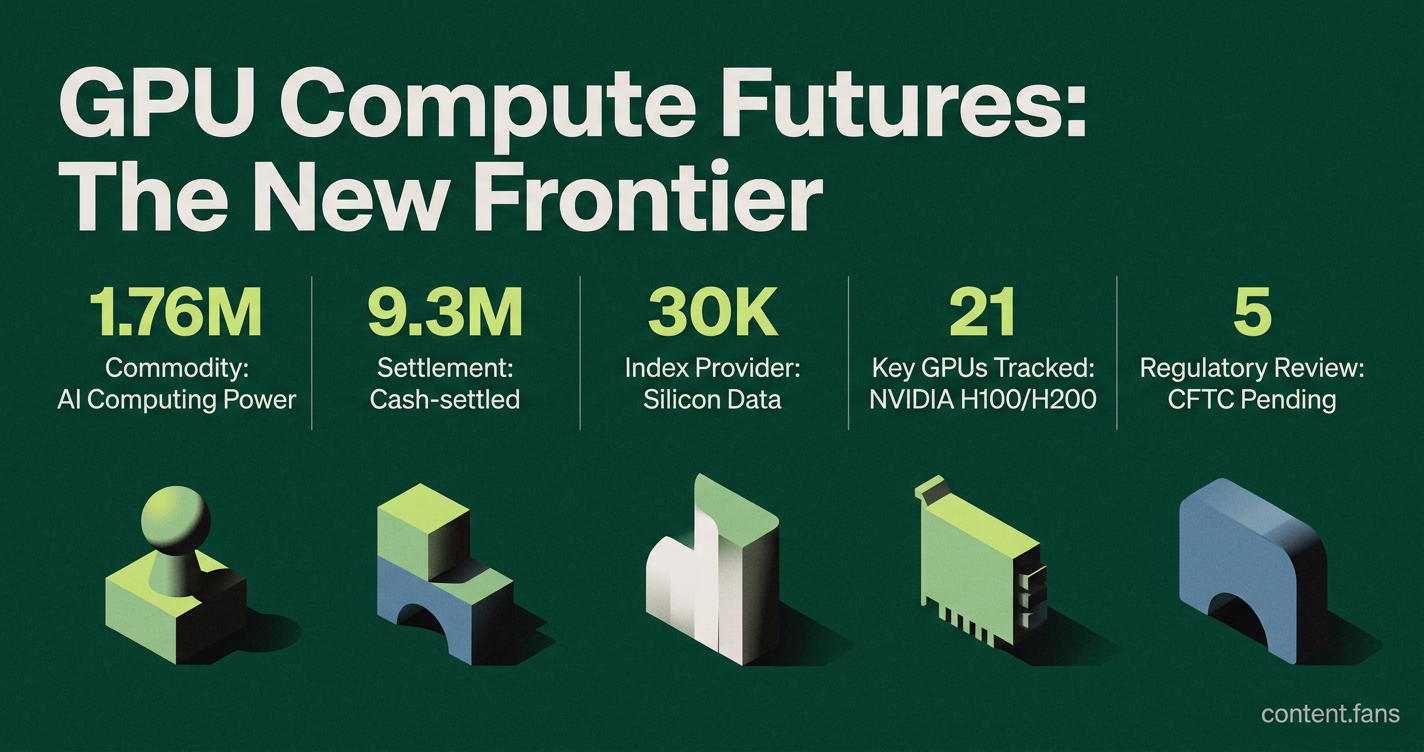
Silicon Data is tasked with providing daily benchmark indices that track the on-demand rental prices for high-performance GPUs, such as the NVIDIA H100 and H200 models. Each futures contract would be tied to a specific quantity of compute hours, allowing traders and companies to hedge their financial exposure to fluctuations in GPU rental rates.
Key proposed specifications include:
- Contract Size: Based on a standardized number of GPU hours (final amount TBD).
- Pricing Basis: Silicon Data's daily spot index of GPU rental rates across major cloud regions.
- Minimum Tick: To be denominated in U.S. dollars per GPU hour.
- Settlement: Financially settled in cash based on the index value on the contract's final day.
Market Drivers and Potential Participants
Over the last two years, soaring demand for AI accelerators has led to significant supply constraints and higher on-demand cloud pricing. The new indices could provide a crucial reference for fair value, allowing traders and infrastructure buyers to hedge against unexpected cost increases, as noted by Yahoo Finance.
The primary market participants are expected to be:
1. Cloud Platforms: Seeking to lock in profit margins on reserved GPU capacity.
2. Enterprise AI Teams: Aiming to budget more predictably for long-term model training projects.
3. Proprietary Trading Firms: Looking to gain exposure to the rapidly expanding compute asset class.
Regulatory Pathway and Timeline
CME Group has indicated a target launch pending regulatory review. For the product to go live, the exchange must file detailed contract terms with the Commodity Futures Trading Commission (CFTC). This process involves addressing key questions about the benchmark methodology, including how to normalize for different GPU architectures and regional price variations. Approval timelines can vary significantly, from a few months to longer periods requiring revisions and public feedback.
While the official rulebook is not yet available, the structure is likely to include margin requirements, position limits, and daily price limits to ensure orderly trading, similar to CME's existing energy and metals futures. Until regulatory approval is granted, these compute futures are an announced concept, not an active market.
What Do GPU Compute Futures Trade?
Each futures contract represents one day of on-demand GPU rental capacity for a specified card generation (e.g., NVIDIA H100, B200). The settlement price is based on Silicon Data's public index, which tracks the lowest hourly rates from major cloud providers. Buyers are essentially locking in a future rental price and will cash-settle the difference against the spot index, rather than taking physical delivery of hardware.
When Will GPU Compute Futures Be Available?
The partners have announced the product and are targeting a launch pending regulatory approval, but the market is not yet open, as all listings are pending CFTC approval. No updated timeline has been released, and interested parties should monitor CME Group's media room (https://www.cmegroup.com/media-room/press-releases.html) for updates.
Who Are the Primary Users of These Futures?
- AI Startups & Model Labs: To hedge against volatile training costs. A single H100 running eight hours a day can cost anywhere from $358/month on a futures-enabled marketplace to $1,675/month on a top-tier hyperscaler.
- Hyperscalers and Data Center Operators: To pre-sell capacity, guaranteeing revenue and helping finance new hardware.
- Trading Firms & Investment Funds: To gain direct financial exposure to the AI infrastructure market without owning physical assets.
How Do Futures Address GPU Price Volatility?
Currently, spot quotes for the same H100 card can differ by 4-7× across platforms; AWS on-demand sits near $6.98/hr while niche marketplaces list $1.49/hr interruptible. Early GPU-futures pilots on other venues have shown promising results in reducing price dispersion by letting suppliers hedge and release spare rigs into the spot pool. CME-listed contracts could similarly dampen daily swings once trading volume builds.
What Are the Hurdles to Commoditizing Compute?
- Architecture Diversity: Performance differs significantly between architectures (an H100 hour is not an AMD MI300X hour), with substantial performance gaps requiring complex, card-level weighting for any reliable benchmark.
- Regional Premiums: Differences in regional power costs and data-sovereignty laws mean the same GPU rented in Singapore can cost double the Ohio price.
- Software-Stack Maturity: Performance depends heavily on software, with CUDA delivering significantly higher performance compared to alternatives like ROCm. The index must account for these performance gaps.
To manage this complexity, initial contracts will likely focus on a single vendor family per listing until a broader benchmark governance is agreed upon with the CFTC.