
AI Price Hikes Prompt Antitrust Probes into Microsoft, Google, Meta
Serge Bulaev
Ongoing probes suggest that regulators may act if they find that these companies are blocking competition or locking in customers.

Regulators are increasingly scrutinizing the AI market as concerns grow about anti-competitive behavior from dominant tech companies. Officials are examining whether high switching costs, driven by proprietary APIs and expensive model retraining, may lock customers in and stifle market competition.
Regulators are increasingly concerned as large language models (LLMs) become embedded in critical business workflows. The ability of a few dominant vendors to unilaterally raise prices challenges whether current competition laws are adequate to ensure open and fair markets.
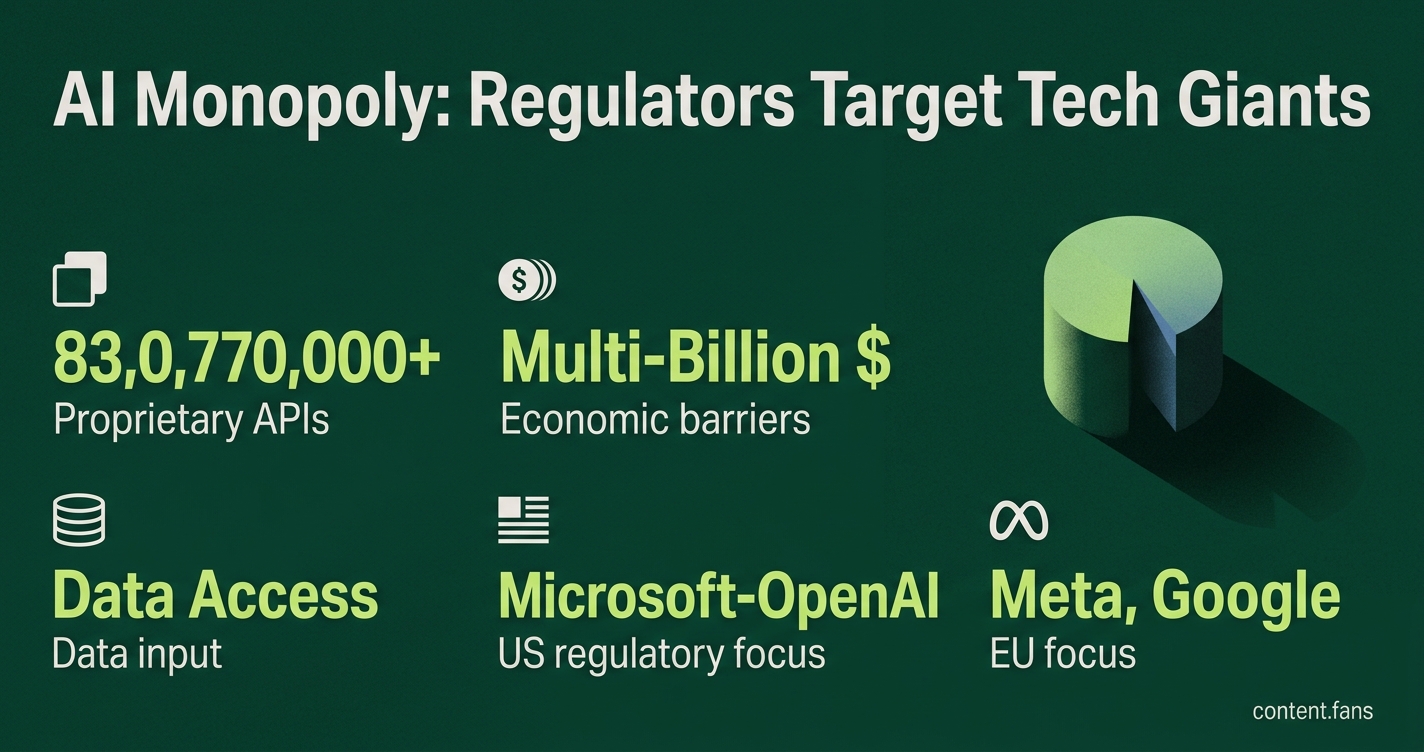
Why AI Market Dynamics Are Drawing Regulatory Scrutiny
Antitrust regulators are investigating whether dominant AI companies are using their market power to unfairly control the market. Concerns center on high customer switching costs, exclusive partnerships, and control over essential data and infrastructure, which could potentially block new competitors from entering the market and offering lower-cost alternatives.
Regulatory actions are already underway. In the U.S., the Federal Trade Commission is reportedly examining the Microsoft-OpenAI partnership investigation for potential anticompetitive effects. Separately, industry reports suggest that regulators are focusing on data access requirements, signaling growing attention to this area.
European regulators are taking similar action. Italy's competition authority targeted Meta for bundling its AI chatbot with WhatsApp, while the European Commission is probing Google's use of YouTube content for model training. These investigations highlight a growing consensus that access to data is an essential facility for fostering AI competition.
The economic barriers to entry in the AI market are substantial. According to the Centre for European Policy, multi-billion-dollar investments in GPUs, data, and power deter new competitors, allowing incumbents to absorb costs and control pricing. This market concentration is reflected in growing corporate spending on generative AI, which deepens customer lock-in and increases the technical and financial costs of switching providers.
Potential Policy Solutions to Promote AI Competition
- Interoperability Mandates: Requiring providers to allow seamless workload migration between cloud platforms without code rewrites.
- Data Portability Rules: Enabling customers to retrieve their fine-tuned models and training data in open, machine-readable formats.
- Transparency Obligations: Establishing national disclosure standards for AI models, as explored under Executive Order 14179.
- Targeted Input Remedies: Forcing dominant firms to share critical inputs, like search data provisions in regulatory cases.
The U.S. and EU are pursuing different regulatory paths. The U.S. currently favors a voluntary approach, with policy frameworks promoting federal datasets and coordination on regulatory approaches. In contrast, the EU AI Act imposes mandatory requirements, compelling providers of high-risk systems to publish technical documentation and training data summaries, with further disclosure rules expected.
Scrutiny extends to upstream supply chains. The Department of Justice is investigating Nvidia's dominance in the AI chip market over concerns that hardware scarcity drives up prices. Similarly, the FTC is monitoring exclusive cloud-service partnerships that could inflate costs for businesses trying to switch compute providers.
The Bottom Line: Conduct, Not Price, Is Key
To date, no formal antitrust complaints have directly targeted AI model pricing from companies like OpenAI or Anthropic. Enforcement actions suggest that price hikes alone are not the primary trigger. Instead, regulators are focused on patterns of behavior - such as restricting access to data, exploitative partnership structures, and tactics that create customer lock-in. Proving such conduct could lead to data-sharing or interoperability remedies.
The message for AI providers is clear: in a concentrated market, significant price increases will attract regulatory attention. Proactively documenting cost justifications and embracing interoperability and data portability can be critical strategies for mitigating antitrust risk.
When does an AI price increase become an antitrust concern?
A hike is flagged only when a dominant firm - one with significant market share in a relevant market - raises prices without a verifiable cost justification and after locking users in. European regulators have taken action against bundling practices where services are combined with no opt-out once users are integrated, illustrating that price alone is not the issue; power plus lock-in is.
How do switching costs in generative AI compare to classic platform cases?
Switching a large enterprise from one AI model to a rival now involves substantial costs in re-training, API re-coding and data-pipeline rebuilds, according to industry reports - significantly higher than switching costs measured for cloud databases in previous years. The per-token billing models that once looked flexible are giving way to annual committed-spend contracts, raising exit fees and mirroring the cloud-era egress-fee complaints that have triggered regulatory scrutiny.
What policy tools are already on the table to curb AI vendor power?
EU AI Act - mandatory model documentation disclosure and developing Code of Practice on data-portability clauses in SaaS contracts.
U.S. Policy Frameworks - recommend coordination on interoperability mandates and direct agencies to publish federal datasets in AI-ready formats so newcomers can train without relying solely on incumbents for data.
Both stop short of price caps; instead they lower entry barriers so rivals can discipline prices.
Are any regulators formally investigating OpenAI or Anthropic for excessive pricing?
No public cases currently name either company as defendants in pricing-focused enforcement actions. The FTC's AI partnerships probe is looking at whether Microsoft's investment relationships affect competitive dynamics, a theory that could indirectly impact market competition if the agency proves problematic market allocation. The EU's Meta and Google AI cases focus on tying and data scraping, not list prices, showing enforcers are starting with conduct that forecloses rivals rather than the price level itself.
What can enterprise buyers do today to protect themselves from future AI price spikes?
- Negotiate data-portability clauses that require weights, fine-tunes and conversation logs to be delivered in open, machine-readable formats within reasonable timeframes of termination.
- Cap annual increases and insist on benchmarking rights against competing providers.
- Adopt modular architectures - keep the prompt layer, vector store and UI in-house so the model can be swapped like a plug-in; industry reports suggest that enterprises using this design have significantly reduced migration time and achieved savings on renegotiated renewals.