
CIOs Face Ballooning AI Invoices; New Governance Tools Emerge
Serge Bulaev
CIOs are seeing their AI bills rise quickly, partly because vendors now mix flat fees with unpredictable usage charges. This makes it hard for companies to keep their spending within budget, and some experts warn that hidden costs in contracts may increase this problem. New tools and rules, like real-time dashboards and spending alerts, may help organizations track and control their AI costs. Using smaller or specialized AI models might lower expenses without losing quality. The future may involve more careful monitoring, spending limits, and matching the right model to each job to manage AI costs better.

CIOs face ballooning AI invoices as vendors pivot to complex usage-based pricing, making budget forecasts unreliable. This trend is forcing leaders to adopt new enterprise governance frameworks and cost-control tools to manage runaway AI spending. This analysis reviews these emerging solutions and offers a playbook for navigating the new landscape of AI economics.
Why Bills Outpace Budgets
The primary driver of budget overruns is a fundamental shift in vendor pricing. Many providers now combine flat platform fees with variable, pay-per-use components. Industry reports indicate this pivot to usage-based charging makes forecasting difficult. Furthermore, as Zylo warns, hidden AI add-ons within existing SaaS agreements obscure the true total cost, creating a need for more granular financial visibility.
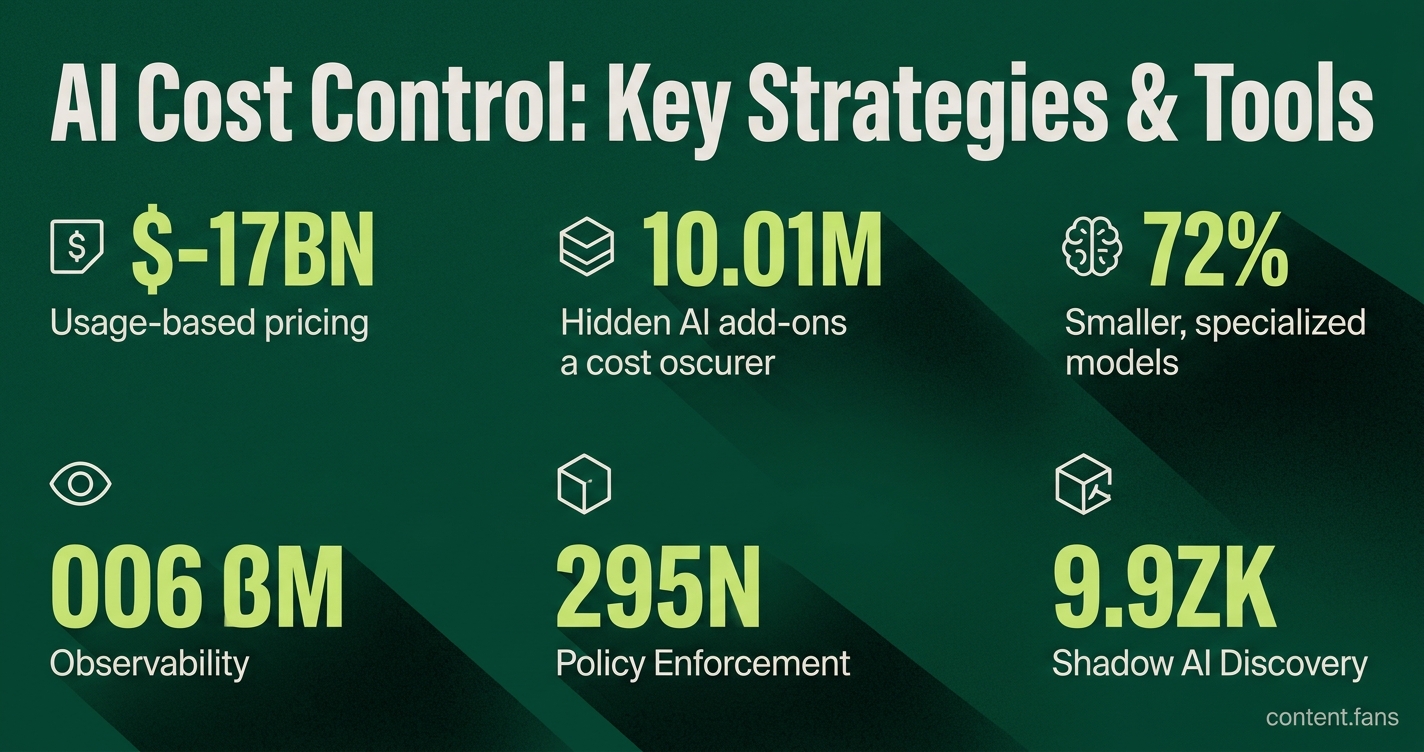
Enterprise AI costs are escalating due to a shift from fixed-fee licenses to unpredictable, usage-based pricing models. Vendors increasingly bill for AI services by the token or compute unit, while also embedding costly AI add-ons into other software contracts, leading to unforeseen and volatile expenditures.
A key strategy for cost containment involves leveraging smaller, specialized AI models. A 'mid-weight' or domain-tuned model can deliver significant value for specific tasks. For example, smaller parameter models may require substantially less compute power than larger frontier models, potentially achieving positive ROI for high-volume applications. Implementing intelligent routing policies - matching each job to the smallest sufficient model - can dramatically reduce inference costs without compromising output quality.
The Emerging Governance Toolchain
To regain control, a new AI governance toolchain is emerging. Solutions from vendors like Nexla focus on establishing proactive controls, such as using budget rules to trigger automated spending alerts. Others, like Globant, offer real-time dashboards to monitor token consumption per user and enforce project-level spending caps. This new governance stack generally consists of four critical layers:
- Observability: Tracking costs per request, team, and deployment environment.
- Policy Enforcement: Implementing quotas, model-routing rules, and automated shutdown of idle resources.
- Shadow AI Discovery: Identifying and cataloging unsanctioned AI tools to manage risk and cost.
- Outcome Mapping: Connecting AI expenditures to measurable business outcomes like productivity gains or revenue impact.
Winners, Laggards, and Strategic Bets
This shift creates clear winners and losers in the technology landscape.
-
Winners:
- Specialized Model Vendors: Companies offering efficient, mid-weight models are gaining traction by aligning performance with budget realities.
- FinOps for AI Platforms: Tools providing granular visibility into token usage and cost attribution are becoming indispensable, much like cloud cost management platforms did years ago.
-
Laggards:
- Pure Usage-Based APIs: Vendors with consumption-only pricing may face resistance from finance teams demanding predictable, hybrid billing options.
- Late Adopters of Governance: Organizations that continue with manual cost tracking risk significant budget overruns, which could jeopardize future AI initiatives.
Tactical Guidance for AI Initiatives
For AI initiatives, CIOs can take immediate tactical steps to prevent budget shocks. A crucial first move is to embed 'smallest-sufficient-model' principles directly into procurement policies. It's also vital to implement rigorous tagging for development, testing, and production environments to isolate costs. Furthermore, adopting an MLOps strategy from the outset helps control the total lifecycle cost by automating processes like model retraining. Finally, by linking AI spend to clear business metrics, as Zylo suggests, leaders can justify costs to the CFO and demonstrate how increased model usage can drive tangible value.
The tension between fostering AI-driven innovation and adhering to strict budgets will continue. However, a clear strategic playbook is emerging. By prioritizing visibility, enforcing quotas, and mandating the use of fit-for-purpose models, organizations can build a future where governance, not surprise invoices, dictates the pace of AI adoption.