
Cerebras IPOs at $66B market cap, backed by $20B OpenAI deal
Serge Bulaev
Cerebras Systems recently went public with a market value of about $66 billion, supported by a large contract with OpenAI worth over $20 billion. The company's stock price jumped on the first day, but then dropped slightly as investors considered possible risks. Much of Cerebras' value seems to depend on delivering hardware to OpenAI on time, and there may be challenges from supply limits and competition. Experts suggest Cerebras' technology may help it in some areas, but it still appears to be a niche player compared to bigger companies. It is uncertain if the company will keep its high value, which may rely on how fast it can deliver its systems and turn demand into real sales.

Cerebras Systems launched its anticipated IPO with pricing at $185 per share, implying a valuation in the mid-$20 billions at offering. The successful public offering thrusts the wafer-scale computing specialist into the spotlight, as strong investor demand initially overshadowed concerns about its limited revenue history and reliance on major partnerships.
Day-one trading swings
Cerebras' IPO saw strong first-day performance, with the stock price rising significantly from its offering price. This momentum was supported by reports of a multi-year inference/capacity agreement with OpenAI, though the exact terms and value of this partnership remain subject to market speculation.
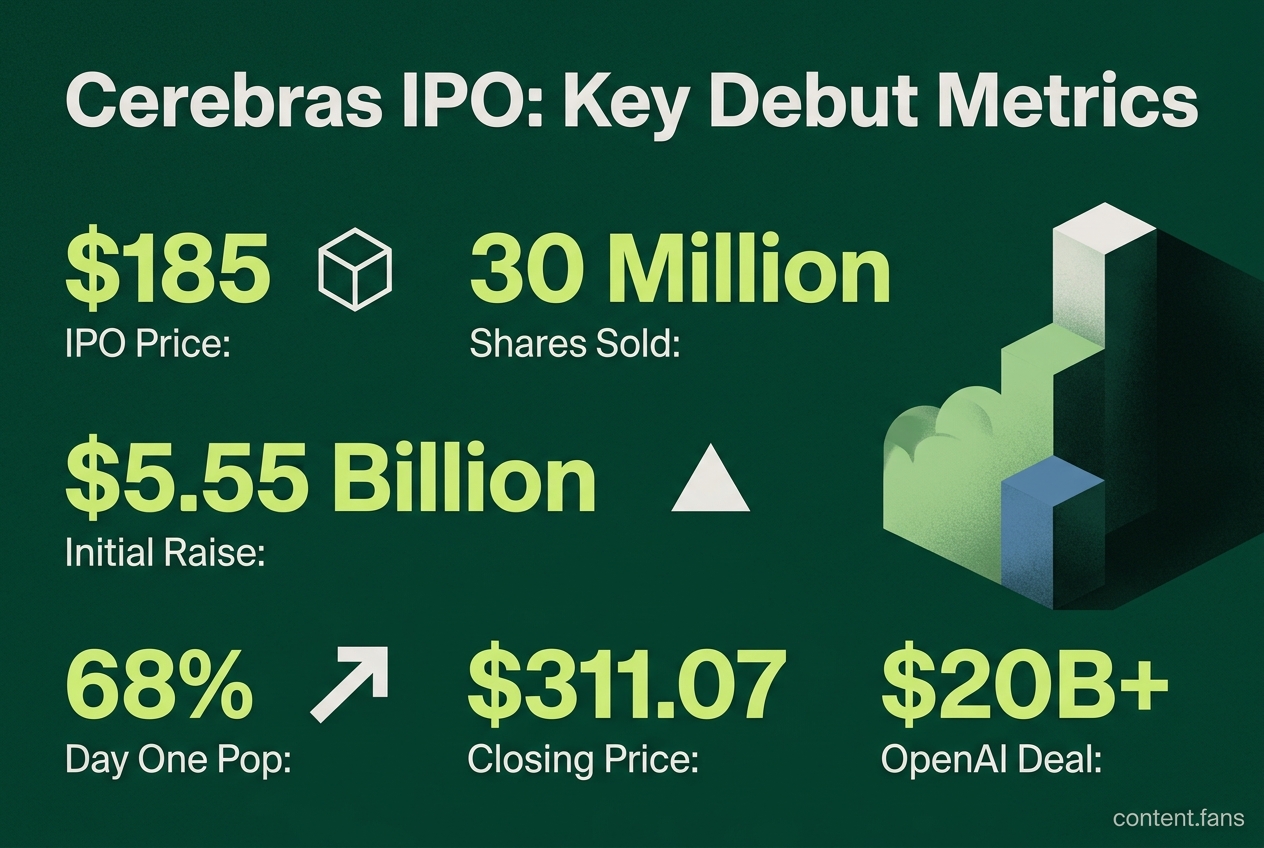
After selling 30 million shares at $185 each to raise about $5.55 billion before any overallotment option, the stock surged in its debut session. According to CNBC, shares closed at $311.07 - a 68% pop that pushed its market value toward significant levels. Following strong early trading, shares experienced some volatility in subsequent sessions as investors weighed the execution risks ahead.
The reported OpenAI partnership
Cerebras' valuation narrative includes a reported multi-year OpenAI inference/capacity deal, though specific financial terms have not been independently verified. A Reuters report discusses OpenAI's plans to work with Cerebras on AI inference capacity, with industry reports suggesting a substantial multi-year commitment for wafer-scale computing systems.
Execution risk in the spotlight
Because major partnerships involve forward-looking commitments, analysts caution that recognizing significant revenue depends on timely hardware delivery and stable demand. The stock's volatility in early trading reflected investor assessment of execution timelines. Furthermore, Cerebras operates in a competitive landscape that includes NVIDIA, AMD, and custom silicon from hyperscalers, suggesting that any delays could compress margins.
Key uncertainties for investors include:
- The precise deployment schedule for planned capacity expansions.
- Potential supply chain bottlenecks for the large silicon wafers central to Cerebras' technology.
- Competitive pressure from NVIDIA's offerings and other hyperscaler ASIC teams.
Market context and technical edge
Cerebras' core advantage lies in its WSE-3 processor, which according to industry reports features substantial AI processing capabilities and high on-chip bandwidth specifications. While these technical specifications may give it advantages in latency-sensitive inference tasks, experts still consider the architecture a specialized solution compared to broader GPU ecosystems. Company executives have indicated strong demand for their systems, highlighting both market interest and potential supply considerations.
Ultimately, whether the strong initial valuation holds depends on how quickly Cerebras can convert its architectural advantages and reported major partnerships into recognized revenue.
How did Cerebras' IPO perform on its first trading day?
Shares were priced at $185 and closed their debut at $311.07, a 68 percent gain, pushing the company's market capitalization to substantial levels according to CNBC.
- The stock showed strong performance, significantly exceeding the IPO price.
- Trading volume made it a notable U.S. tech IPO in recent years.
What is the reported OpenAI partnership?
Cerebras and OpenAI have reportedly signed a multi-year agreement for AI inference capacity, according to industry reports.
- The partnership involves substantial commitments according to various sources (Reuters).
- Implementation is expected to be staged over multiple years, representing a significant AI infrastructure deployment.
Why does the IPO valuation rely heavily on major partnerships?
Because forward contracts underpin a significant portion of expected revenue; historical revenue figures show growth but remain smaller than the scale of reported future commitments. Investors are effectively betting that Cerebras can deliver and monetize planned deployments on schedule.
What are the biggest risks now that Cerebras is public?
- Concentration risk: Major customers represent substantial portions of business; any delays or changes would materially impact forecasts.
- Manufacturing considerations: Industry reports suggest strong demand that could create supply considerations.
- Fierce competition: Analysts note NVIDIA's offerings and hyperscaler ASICs as direct rivals in the inference acceleration space.
Where does Cerebras fit in the AI hardware landscape?
- Architectural approach: According to industry reports, the WSE-3 delivers substantial on-chip memory bandwidth, significantly higher than traditional GPU architectures.
- Market positioning: Specialists view Cerebras as a "dedicated inference accelerator" rather than a broad GPU replacement, well-suited for latency-sensitive, large-scale models.
- Customer expansion: Beyond major partnerships, the company is expanding into enterprise and specialized AI projects, signaling revenue diversification efforts.