
Canada Proposes "Safe Social Media Act" for Teens, AI Chatbots
Serge Bulaev
Canada has proposed a "Safe Social Media Act" that may set the minimum age for most social media accounts at 16 and require AI chatbots to act responsibly toward Canadian users. The bill is still moving through Parliament and could be changed, especially around age verification and other details. The Act might require platforms to block users under 16 unless they can prove strong safety features, but how companies check ages is not decided yet. Experts and companies have raised concerns about privacy and anonymous use, and it seems the final rules may change during more debate. No date has been set for the law to take effect, and the timeline is still uncertain.

Canada's proposed Safe Social Media Act aims to create a safer online environment by setting a minimum age of 16 for social media use and imposing new safety duties on AI chatbots. This landmark legislation is currently moving through Parliament, with significant debate expected around its enforcement, age-verification methods, and impact on digital platforms.
Legislative Path So Far
The Safe Social Media Act is proposed Canadian legislation requiring online platforms to protect users, particularly minors. It mandates a default minimum age of 16 for social media, requires platforms to mitigate harmful content, and introduces specific safety protocols for AI chatbots, enforced by a new commission.
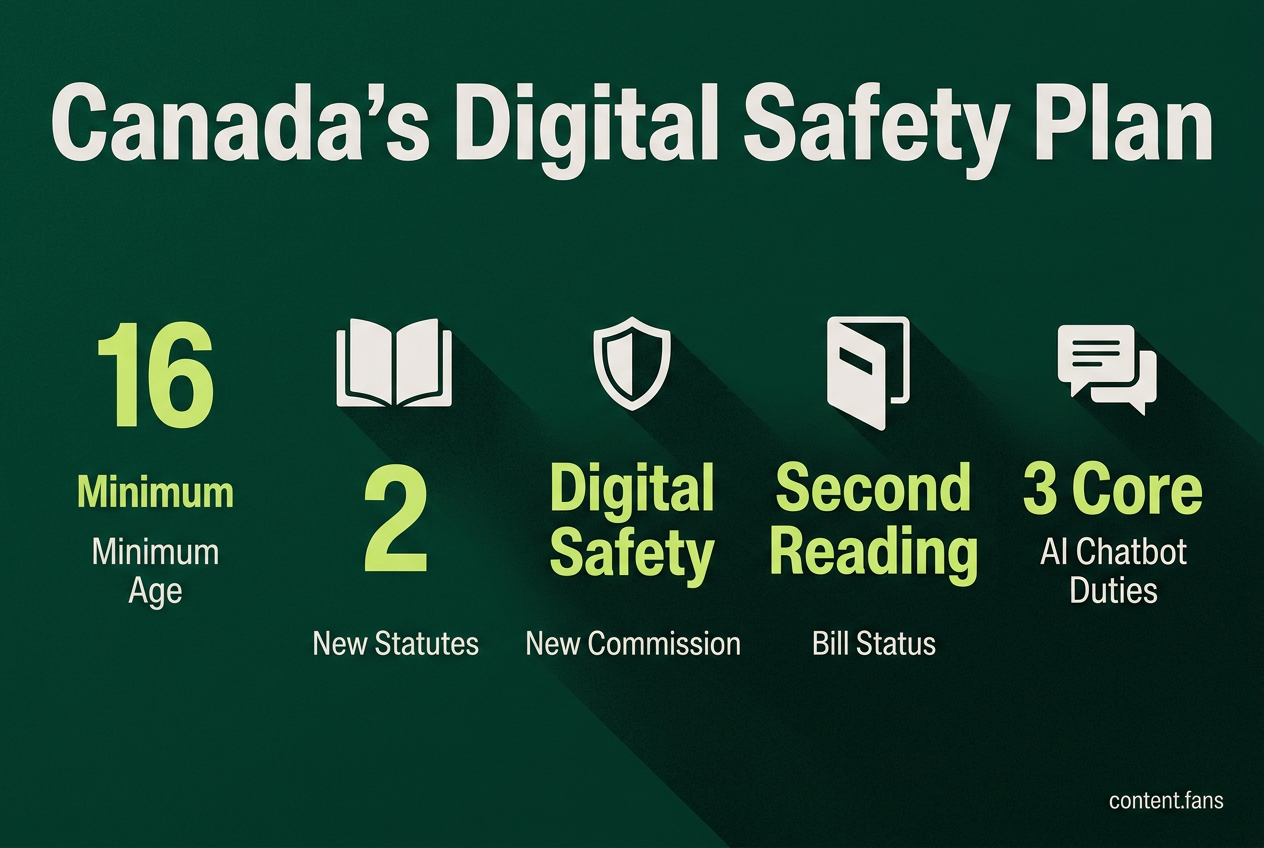
Introduced as Bill C-34, the legislation establishes two new statutes: the Digital Safety Act and the Digital Safety Commission of Canada Act. These would create a new regulatory body, the Digital Safety Commission, tasked with enforcement. Key milestones include:
- First Reading: The bill was introduced in the House of Commons on June 10, 2026.
- Current Status: The bill is now at second reading, with debates ongoing.
As the bill proceeds to committee study and Senate review, observers expect its final text and specific rules - especially regarding age verification - may undergo significant changes.
Safe Social Media Act and AI Chatbots: Core Duties
The bill creates safety duties for operators of AI chatbot services within its regulated framework. For the first time in Canada, these duties are explicitly extended to conversational AI systems. Core obligations include:
- Mitigating Harmful Content: Platforms must actively reduce the risk of users encountering harmful material, including sexual content and content promoting violence.
- Crisis Intervention: Systems must be designed to detect user expressions of suicidal ideation, self-harm, or intent to harm others. When detected, the AI must interrupt the interaction and redirect the user to crisis resources and human support.
- Preventing Deception: AI chatbots are prohibited from engaging in deceptive or manipulative behaviours, such as posing as a licensed professional or encouraging emotional dependence.
Platforms will also be required to transparently publish the thresholds that trigger these automated crisis interventions, though the bill does not mandate reporting individual chats to law enforcement.
What the Age-16 Limit May Mean for Platforms
A central component of the Act is the requirement for platforms to block access for users under the age of 16. The mechanics of how companies will verify age are not yet defined, leaving options like government ID checks, facial analysis, or device-level estimation on the table. Each method presents privacy and accuracy trade-offs that will be scrutinized during committee hearings.
However, the bill includes a potential exemption. A platform can grant access to users aged 13-15 if it can prove its service meets stringent "safe-by-design" benchmarks, which will be defined by the new Digital Safety Commission.
The proposal has drawn criticism. Meta has called the ban "counterproductive," advocating instead for enhanced parental controls. Meanwhile, policy critics and civil liberties groups have raised concerns that mandatory age verification could compromise user privacy and anonymous speech.
Enforcement and Next Steps
If passed, the Act will be enforced by the new Digital Safety Commission of Canada. This body will have the authority to conduct audits, investigate user complaints, and impose significant financial penalties. According to government documents, non-compliance could result in fines of up to 3% of a company's global revenue or C$10 million, whichever is greater (Canada.ca). For major tech firms, this could amount to billions of dollars.
Beyond fines, platforms will be required to publish detailed risk assessments, implement rapid takedown procedures for child sexual exploitation material, and clearly label all synthetically generated content.
The timeline for enactment remains uncertain. Parliament has not set a firm date, with officials stating only that they intend to modernize Canada's online harms legislation "as quickly as possible" pending further debate and consultation.