
Cambridge tests first AI-designed vaccine in human trial
Serge Bulaev
Cambridge scientists tested a new coronavirus vaccine in humans, where the main component was made entirely by AI. The Phase 1 trial in 39 healthy adults found no serious safety problems, and the vaccine was tolerated like existing ones. The immune response appeared modest and did not show big increases compared to before vaccination. Results suggest that AI may help speed up vaccine design, but more studies are needed to see if this approach will give broader or stronger protection.
Researchers at the University of Cambridge have completed the first human trial for an AI-designed vaccine, a landmark achievement for computational immunology. Developed with spin-out DIOSynVax, the Phase 1 study tested a 'universal' coronavirus shot in 39 healthy volunteers, validating the safety of AI-driven antigen design and showing its potential to drastically shorten research timelines.
How Did the AI-Designed Vaccine Perform in the Trial?
The Phase 1 trial in 39 healthy volunteers found the vaccine safe and well tolerated, with no serious or significant side effects reported, but this was an early safety study rather than a definitive confirmation of safety for human use. While the shot was well-tolerated, the resulting immune response was modest, an early but crucial step in validating AI-driven vaccine development platforms.
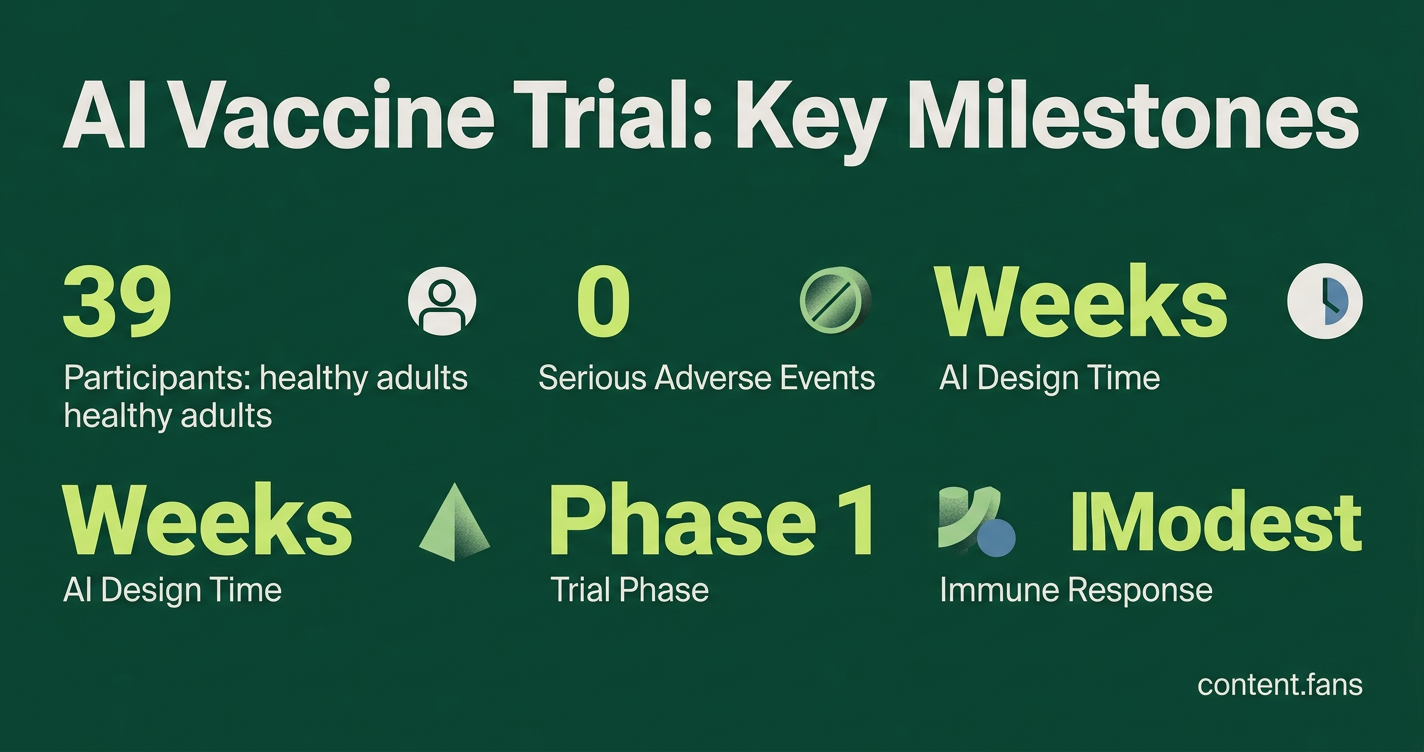
The trial found no serious adverse events. A release on EurekAlert confirmed "no significant safety concerns," with tolerability matching that of existing licensed vaccines. However, the immune response was modest. The vaccine generated cross-reactive immune responses against multiple coronaviruses, but the immune effect was modest and not robustly above pre-vaccination levels.
Key trial data includes:
- Participants: 39 healthy adults (aged 18-50)
- Dosing Schedule: Two intramuscular injections, eight weeks apart
- Serious Adverse Events: 0
- Immune Response: Limited rise in neutralizing antibodies
Lead investigator Professor Jonathan Heeney affirmed that the results support the AI-driven design concept, though work remains to enhance the breadth of the antibody response. A BBC article highlighted the study as a "world-first" for testing an AI-generated antigen in humans, emphasizing its role as a foundational proof-of-concept rather than a demonstration of final efficacy.
How Did AI Design the Vaccine Antigen?
The vaccine's core component was created using the DIOSynVax platform, which applied machine learning algorithms to thousands of coronavirus genomes. The AI identified conserved regions of the virus that are less likely to mutate and then used structural modeling to combine these elements into a single, stable synthetic antigen. This in-silico approach aims to create a vaccine that can anticipate viral evolution. The entire digital design process was completed in just weeks, a significant acceleration compared to the months or years required for traditional antigen discovery. Unlike previous efforts that used consensus spike proteins, this AI-generated construct specifically targets structurally stable regions while omitting highly variable parts of the virus.
What Are the Next Steps and Industry Implications?
While other AI-driven vaccine programs are in development, including initiatives tracked by CEPI and Los Alamos National Laboratory, the Cambridge trial is the first to report human data for a fully AI-generated antigen. Industry analysts note that while AI dramatically speeds up the initial design phase, it does not replace the rigorous requirements of multi-phase clinical trials. The findings serve as a vital benchmark for integrating digital immunology with regulatory standards. If future trials demonstrate a stronger and broader immune response, this AI-driven platform could become a key tool for creating rapid-response vaccines against future pandemic threats.
What makes the Cambridge trial unique?
It is the first time a vaccine whose active component was generated entirely by computer simulations has ever entered human testing.
The Cambridge team completed a Phase 1 trial with 39 healthy volunteers. The results confirm safety and tolerability, validating the core AI design approach even though further work is needed.
How safe was the AI-designed vaccine?
No serious adverse events were observed; the vaccine was judged safe and well tolerated.
Volunteers received the experimental shot without significant side effects, clearing the path for potential future studies. This safety record supports the broader use of AI-driven molecular design in biomedical research.
What level of immune response did it trigger?
The vaccine elicited measurable antibodies against SARS-CoV-2, SARS-CoV-1, and several bat sarbecoviruses, but the overall response was described as "modest."
Clinical data show the antibody increase stayed close to pre-existing levels, so robust protection is not yet proven. Researchers view the outcome as proof-of-concept rather than a finished product.
What happens next?
Cambridge scientists will continue to refine the AI model, and may explore adjusted dose levels and combination formulations to achieve the stronger, broader immune response needed for a true universal coronavirus vaccine.
How might this change vaccine development timelines?
AI workflows have already shown significant promise in cutting early discovery phases, shrinking candidate creation timelines in comparable programs.
If Cambridge's iterative AI approach succeeds in later trials, future outbreaks could see protective vaccines move from computer to clinic faster than ever, redefining what "rapid response" means in public health.