
California's new AI law mandates dataset disclosure, content-origin markers by 2026
Serge Bulaev
California's new AI law, starting in 2026, will require developers with over 1 million users to share summaries of their training data and to mark where AI-generated content comes from. This may help address concerns about unclear authorship and the reuse of existing material by AI, but some risks, like data leaks and loss of original context, remain. Legal experts say that U.S. copyright still generally needs meaningful human input, so pure machine output often does not qualify. Companies are advised to use safeguards like agent registries and clear labeling of AI involvement. Experts suggest that while these rules are a first step, creative use of AI content may outpace policy, so careful tracking and governance are important.
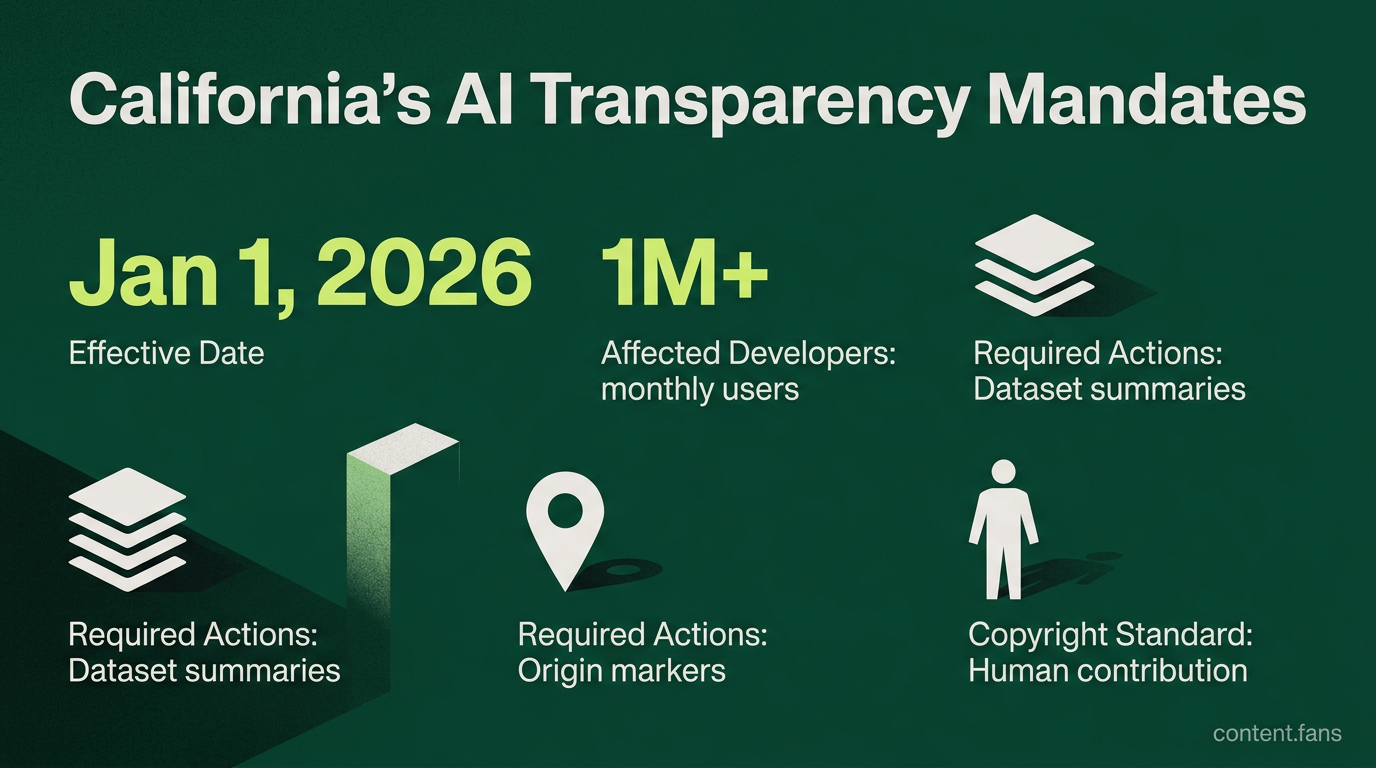
Concerns over AI-driven content reuse are moving from theory to policy, with California's new AI law set to take effect on January 1, 2026. The statute requires developers with over one million monthly users to disclose training dataset summaries and embed origin markers in AI-generated work (Gouchev Law), addressing industry-wide worries about database repurposing and content reuse by large language models.
While AI agents create value by reshaping existing material, this convenience introduces significant challenges related to unclear authorship and potential data leakage. Generative models can repurpose legacy text for new audiences by reassembling it, a process that can "bring dead content back to life" (Story Needle). As a result, content curators risk seeing their work recirculated without its original context or branding.
The Intellectual Property and Copyright Landscape
This new regulatory landscape operates against an important IP backdrop: U.S. copyright protection still hinges on meaningful human contribution. Legal analysis confirms that purely machine-generated output typically fails copyright tests, and the rise of autonomous AI agents complicates ownership disputes. This increases attribution risks, as AI-assisted content can circulate anonymously, potentially weakening the negotiating power of creators and small studios.
Governance Guardrails for Proprietary Datasets
California's AI law requires large developers to publish summaries of their training datasets and embed clear origin markers in AI-generated content. These measures aim to increase transparency, allowing creators and the public to identify machine-made work and understand the data used to train the underlying models.
Promethium's 2026 playbook recommends treating every agent as a separate principal with unique credentials and explicit permissions. Common enterprise safeguards include:
- An agent registry that records owner, purpose, and data scope
- Least-privilege access tied to user entitlements
- Runtime logging of prompts, retrievals, and outputs
- Human review for high-risk publishing actions
- Rapid revocation procedures when misuse surfaces
Mayer Brown adds that tiered oversight should escalate when agents access confidential or trade-secret material, indicating a growing alignment between security and editorial teams.
Actionable Steps for Content Creators
- Document human edits, prompts, and version history to evidence authorship.
- Label AI involvement clearly, using visible or hidden metadata as the California rules envision.
- Track reference assets in prompts so any unlicensed inclusion can be flagged.
- Review vendor terms for indemnity and dataset transparency before granting database access.
- Separate AI-assisted from AI-autonomous work in contracts to reflect different IP outcomes.
Emerging AI Product Patterns and Market Impact
New products are already demonstrating large-scale editorializing through summarization. Dow Jones's "Smart Summaries" allow users to query a licensed archive of nearly 3 billion articles, and AskNews processes half a million stories daily to extract insights. Such features compress vast archives into derivative answers that can compete with the source articles for user attention.
Across these deployments, dataset disclosure and lineage tagging are the first line of defense. However, experts believe policy will lag behind creative remixing. For now, content curators should assume every surfaced snippet may propagate in unexpected channels and build governance that travels with the data at every step.
What is California's new AI law requiring by January 1, 2026?
California's AI Transparency Act (AB 2013) is now in effect. It mandates that AI companies serving more than 1 million monthly users must:
- Publish a plain-language summary of each model's training datasets, including whether data were purchased, licensed, or contain copyrighted material.
- Provide free, public detection tools so anyone can check if text, images, audio, or code was AI-generated.
- Embed visible or invisible markers (metadata, watermarks, or cryptographic hashes) in any AI-created content distributed to the public.
Failure to comply can trigger fines of up to $100,000 per violation, assessed by the California Attorney General.
How will dataset disclosure help content creators protect their IP?
Creators now have a direct paper trail:
- The disclosure must list licensed vs. unlicensed copyrighted works, helping artists and publishers verify inclusion of their material and pursue licensing fees or takedowns.
- 2025 industry surveys show 47 % of content creators believe unauthorized use is "very likely" in generative models; public datasets give them concrete evidence for claims.
- Early 2026 negotiations already reference these disclosures, with 15 % higher licensing agreement values reported for creators who cite their inclusion in disclosed datasets.
What are the technical requirements for origin markers?
The law does not prescribe a single technology, but the California Civil Code Guidance (2026) lists three approved methods:
- C2PA provenance metadata (used by Adobe, Microsoft, and the BBC) embedded at file level.
- Invisible watermarking such as SynthID or Truepic, detectable via public APIs.
- Cryptographic hashes stored on an auditable ledger, tied to the original prompt or model run.
Developers must publish open-source detection scripts that work offline; as of March 2026, GitHub repositories for these tools have exceeded 12,000 cumulative stars and 2,000 pull requests.
Are there penalties for agents that editorialize or reuse curated content?
Yes, if the material is copyrighted and unlicensed. California's law is civil, not criminal, but it dovetails with federal copyright claims:
- If an AI agent "editorializes" curated news or data without disclosure and the underlying content is copyrighted, creators can file DMCA takedowns or state unfair-competition suits (Cal. Bus. & Prof. Code §17200).
- Courts in 2025 have already granted preliminary injunctions in three cases where AI-generated product reviews reused substantial passages from subscription databases without attribution.
What practical steps should small studios take before 2026?
- Audit existing AI tools against the million-user threshold; if any tool you integrate crosses the limit, demand compliance certificates from vendors.
- Register key works with the U.S. Copyright Office; 2026 caselaw shows registration within three months of first publication entitles creators to statutory damages up to $150,000.
- Embed your own C2PA metadata on images and text before publishing to strengthen provenance claims.
- Add visible disclaimers on AI-assisted content; a January 2026 study found pages with clear "AI-assisted" labels saw 18 % lower bounce rates and higher trust signals from search engines.
Staying proactive now aligns your production pipeline with both the letter and spirit of California's 2026 rules and protects your IP when agentic systems inevitably scale.