
California Updates Social Media Rules for Minors, Bans Addictive Feeds
Serge Bulaev
California has passed a law, SB 976, that may require social media platforms to get parental consent and verify the age of users under 18 before letting them use certain features called "addictive feeds." These features include endless scrolling, autoplay videos, and push notifications during nighttime or school hours, which might be linked to higher risks of depression and anxiety in teens. The law does not ban minors from social media but could limit their access unless parents opt in. The rules are set to be finalized by 2027, and there may still be changes after public comments. Some experts suggest that these changes might help lower mental health risks, but the industry could challenge the new rules in court.

California's new social media rules for minors are set to become some of the nation's toughest, with SB 976 targeting "addictive feeds" to address rising concerns over teen mental health. The law, signed in 2024, focuses on specific platform design features rather than outright bans, requiring companies to obtain parental consent before offering algorithmically driven content to users under 18.
What Does California's SB 976 Actually Prohibit?
The law prohibits social media companies from offering "addictive feeds" - like infinite scroll and autoplay videos - to users under 18 without first obtaining verifiable parental consent. It also restricts platforms from sending notifications to minors during overnight hours and school time, with rules taking full effect in 2027.
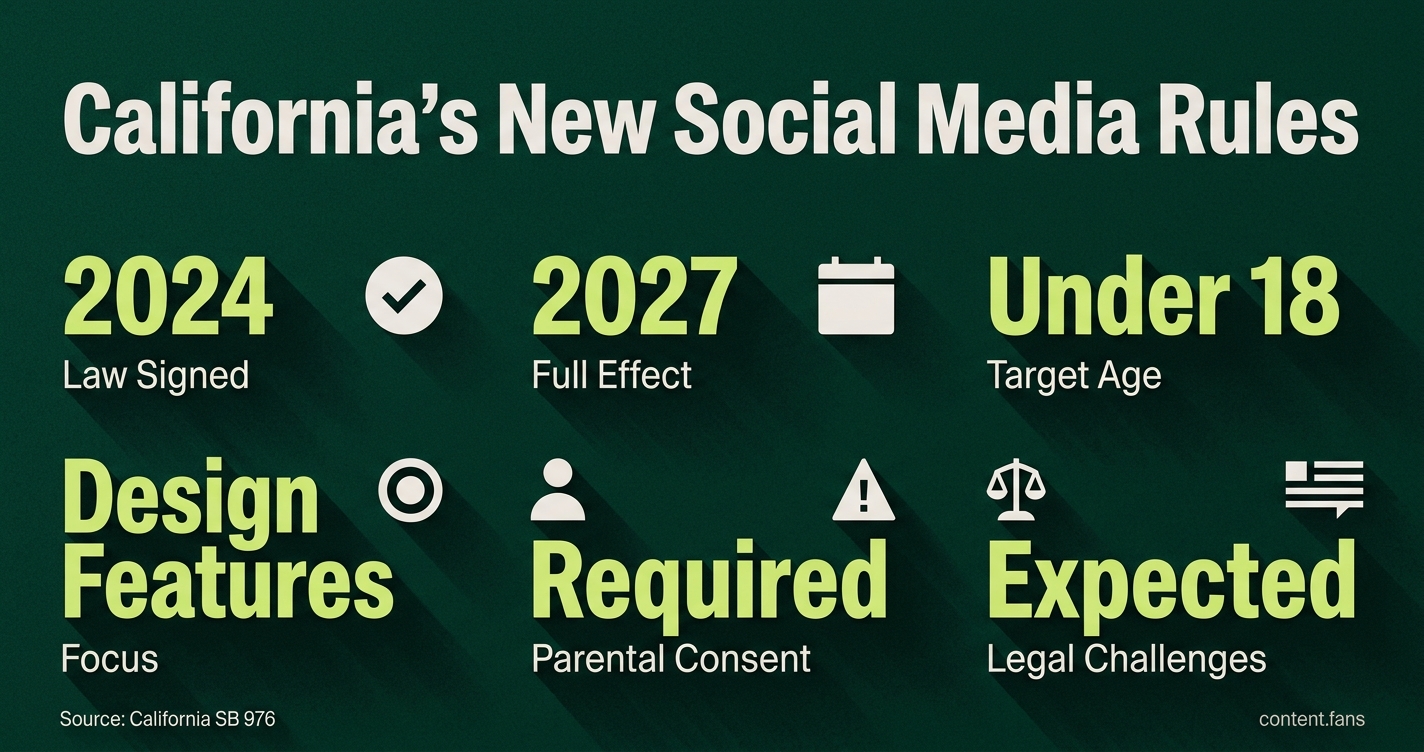
The centerpiece is the "Protecting Our Kids from Social Media Addiction Act" (SB 976). This law defines an addictive feed as a design that uses algorithms for endless scrolling or to push high-engagement content. The U.S. Surgeon General has linked such designs to higher risks of depression and anxiety in teens (PDF). The California Department of Justice is finalizing the rules, which will require platforms to implement age verification and parental consent systems by January 1, 2027.
What Social Media Features Are Considered "Addictive"?
Under SB 976, platforms must disable several features for minors by default unless a parent opts in. These engagement tools, which researchers cite for fostering compulsive use, include:
- Infinite or algorithmic feeds that never end.
- Autoplay video that starts without user choice.
- Push notifications sent during overnight or school hours.
- Reward systems that encourage rapid, repeated interactions.
The draft rule also establishes requirements for platforms to verify user ages and obtain appropriate consent.
How Does California's Law Differ from Other States?
While other states have attempted to ban minors from social media, California's law focuses on restricting specific features. This design-centric approach may help it withstand legal challenges that have stalled similar laws elsewhere. For example, courts have blocked youth access laws in states like Mississippi and Texas on First Amendment grounds, often citing age verification as an unconstitutional burden on speech. Industry group NetChoice is expected to challenge California's rules, but the state's Department of Justice argues that focusing on design rather than content is a more defensible position (SB 976).
A more restrictive California bill, AB 1709, which would bar children under 16 from creating accounts, had already passed committee stages by spring/summer 2026 and was moving through the legislature.
What Evidence Supports These Regulations?
Regulators cite a growing body of evidence linking specific platform mechanics to negative health outcomes. Research studies have associated features like infinite scroll, autoplay, and constant notifications with sleep disturbance and higher depressive symptoms in adolescents. Reinforcing this, the Surgeon General has stated that teens using social media for over three hours a day face a doubled risk of poor mental health.
What Are the Next Steps for California's Rules?
The regulatory process is moving toward a January 1, 2027, deadline for full implementation. The California Department of Justice published proposed regulations in May 2026 and held a public comment period ending in late June 2026. After reviewing stakeholder feedback, the Attorney General's office will finalize the technical standards for age assurance and parental consent. Social media platforms operating in California will then need to build and deploy these systems to comply with the new restrictions.